




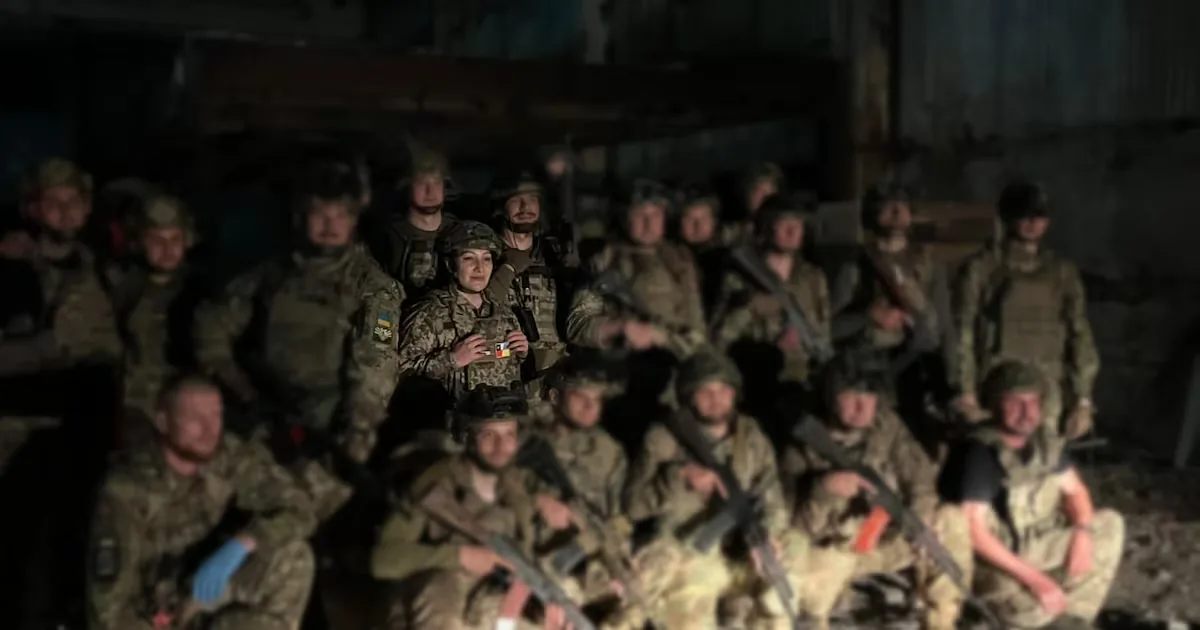
“Every day since I arrived in Ukraine, I’m afraid of dying,” says Camila Jofré, a 33-year-old Chilean woman, who is now in charge of a battalion’s infirmary in Ukraine. “I have three children and a husband waiting for me in Chile, and I’m here until August, so we’re praying that nothing happens to me during this time and I can return safely,” she says in a phone conversation with La Tercera.
Read more Delcy Rodríguez announces a “master plan” for the “integral” reconstruction of Venezuela
Jofré began her career in the Chilean Army, where she remained until December 2025 as a combat nurse, and after being discharged, she decided to look for work, so going to Ukraine seemed like a good opportunity. “My husband, who is also a soldier, told me: ‘Go, I support you, it will help you do what you know how to do.’ Here I have put into practice what I trained for these 15 years and, in addition, it has allowed me to have an economic income similar to what I had in Chile,” she explains.
That’s how she started looking for a way to get to Ukraine and finally, in January of this year, she arrived in the city of Ternopil, located in the west of the country. “I reported to the recruitment center and there they automatically welcomed me very well, with open arms, they thanked me for coming to defend their country and provided me with accommodation, food, health, all for free. I mean, I hadn’t even signed a contract yet and I already had accommodation, food, and everything. It took me four days to do my paperwork, sign the contract, and I went to the unit I chose, which was the drone unit,” she details.
The young woman, who belongs to Unit 425 Skelya, explains that although she doesn’t speak English, she communicates using her phone thanks to the good connectivity in the country. “As the days go by, you learn many words. In the nursing area, so to speak, it has been a bit easier for me because medications have similar names. For example, amoxicillin in Ukrainian is called amoksytsylin. So obviously, in those things, it has been a bit easier for me.”
“Here, the truth is I’m doing something that in Chile they would never allow me to do. I’m in charge of the infirmary of an entire drone battalion and I do everything, that is, suturing, anesthesia, diagnosis, treatment, everything. Basically, it’s like a surgical doctor. But I’m just a nurse. In Chile, for example, combat nurses are trained for that. At the School of Non-Commissioned Officers, I was trained to suture, trained to do CPR, to administer intravenous medications. What happens is that by health law, our homologation is as a technical nurse, and we cannot administer intravenous medications, we cannot suture, but military nurses are in a kind of intermediate degree. Because in combat, in the field, there is no doctor,” she says.
Jofré recounts that each day is different and that the people she attends to have different needs. For example, she might treat someone with bronchitis, and the next patient is a person without a hand.
“One is clear that anything can happen here, and one has to act to take pre-hospital health measures, for an emergency. If you, who know a little more than the soldier next to you, don’t do it, no one else will. Here I see everything from amputations, shrapnel wounds, which cause the most damage. That’s when a drone arrives, a grenade falls, an explosive falls. It doesn’t just emit, so to speak, fire, but it disintegrates, and each piece of metal is shot out in all directions. So each piece of shrapnel causes a lot of damage. And here we have everything, some days are calmer, others are chaotic. There are days when I attend to 15 people a day, and other days when I attend to 50, it’s very varied,” she adds.
Since the beginning of Russia’s war in Ukraine, women soldiers have played a crucial role in defending their country. More than 70,000 women serve in the Ukrainian Army, representing approximately 7% of the country’s Armed Forces. It is estimated that 10,000 of them operate on the front lines as medics, snipers, tank drivers, and increasingly, drone operators.
Read more Trump asserts freedom of speech at Correspondents’ Dinner postponed after shootings
Ukraine amended the law in 2018 to grant women equal rights in the Armed Forces and allow them to serve in all combat roles. Conscription does not apply to women. All women in the Ukrainian Army are volunteers. In the years since the full-scale Russian invasion in February 2022, women soldiers have reached the highest ranks of the Ukrainian Army.
Jofré, along with another young Colombian woman who is a drone instructor, are the only two women in their unit. “Ukrainian culture is very respectful. It’s like old-fashioned. For example, when we are in a group of men, they shake hands, and for women, it’s just a ‘hello’ from a distance. There’s no kiss on the cheek, no hug, no handshake. When there’s a bit more trust among acquaintances, women are greeted with a handshake. I have felt super respected, and I have also made myself respected. We have latrines here, and they made a bathroom just for the two of us and for the two Ukrainian girls, who are civilians, who run the business, the little kiosk there. And regarding combat, the Colombian girl has gone on missions, but drone operators don’t go to trenches or assaults. They are about one or two kilometers from the front, which is where she has had to work, and in my case, my job is just to enter and exit. So, the risk is great, because entering and exiting a position is the riskiest part, as that’s where drone attacks occur. But I don’t stay in that danger for long,” she recounts.
The young woman points out that the war in Ukraine is different from what one might imagine. For example, there isn’t an established regiment whose location everyone knows. “Here, the military tries to be as inconspicuous as possible because there’s a lot of intelligence. So here, units have many dependencies in many places, in cities, forests, fields, everywhere. I’ve been in several places. Currently, for example, I’m in a place with a tent and a kind of camp. But a couple of weeks ago, I was in a building with a private room and my own bathroom. It varies a lot.”
Jofré also refers to the risks of her job. “Threats arrive. In fact, we came here because the previous locality was completely bombed and no longer exists. Thank God we managed to leave before the bombing started, and that’s why we came here. Now wounded people arrive, but there’s also training in this place,” she explains.
“I’ve had to run, because drones fly over us, and they are not FPV drones, but Shaheds, which are more dangerous. Here in Ukraine, you download an application that warns you when an attack is coming. Although the guards also warn us, and if we are sleeping, they knock on the door, and we have to leave. But I have the sound of the engine recorded in my head; it’s like a lawnmower. I wake up earlier, and I’m already putting on my boots when they’re knocking, telling me we have to leave,” she says.
The technical nurse says that many foreigners who go to Ukraine arrive with expectations that do not match reality. “Everything arrives here, and generally, these are people who always wanted to be military or uniformed and couldn’t due to life circumstances. They come here with an idea of an American movie war and that they will be in a bivouac camp, and it’s not like that,” she explains.
“After they receive training, it’s their turn to go on a mission, and they get scared and don’t want to go. The issue is that the Army has already invested in them, already given them complete gear, already given them accommodation and food for two months, for at least two months. And besides, they are paying them a salary. So, how can you not go? Here, the Ukrainians are demanding and force you, and that’s where they complain and make videos asking for help. There are many civilians who idealize war, they come with other expectations, and many arrive here demanding things. And here we are the foreigners, we are the immigrants, we cannot arrive demanding things. They are very grateful to Latinos. We, for example, have the possibility of having our phones, something that the Ukrainians themselves don’t have; they are only given them two hours a day to communicate with their family. They don’t take anything from us; we all have our passports,” she concludes.