




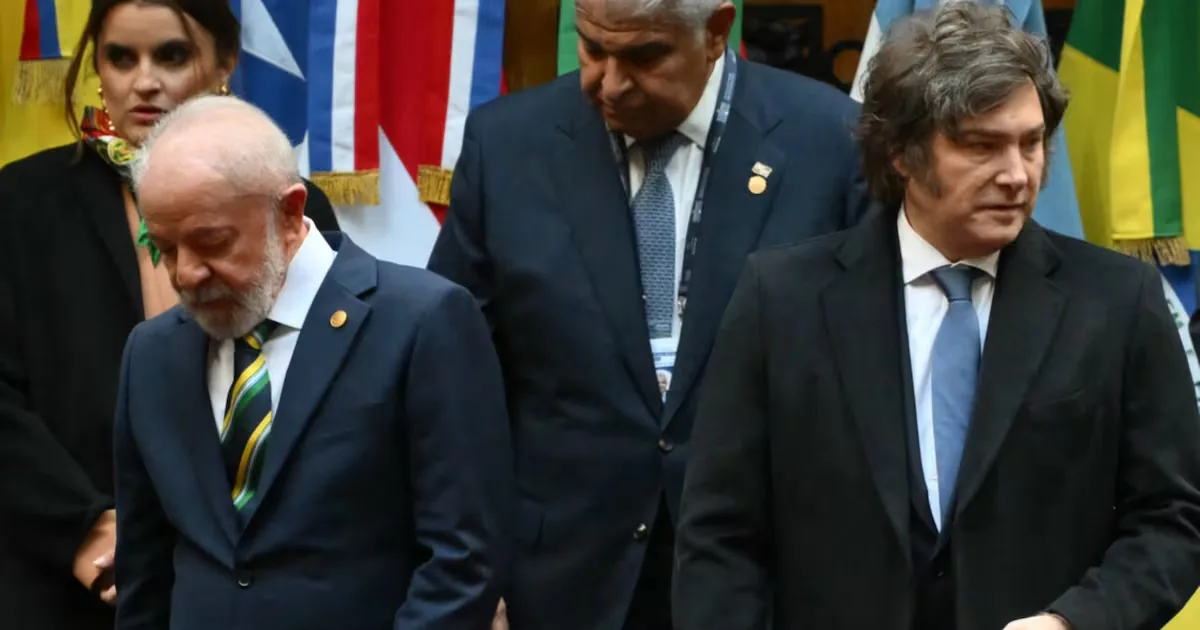
“It is no small thing to call the president of a friendly and neighboring country, who is also our main trading partner: 31.195 billion dollars exchanged in 2025, a 13-year record, attest to that, a ‘thief,’ ‘prisoner,’ and ‘trash.’ Two immediate questions arise. Was it necessary? For what?”.
Read more USA: More than a dozen wildfires in the state of Washington force mass evacuations
The question is posed by the editor of the Argentine newspaper Clarín, Pablo Vaca, following the diplomatic impasse caused by the Argentine president, Javier Milei, after the harsh statements he made against his Brazilian counterpart, Luiz Inácio Lula da Silva, and other authorities of the country during a political event held on July 25 in Sao Paulo, where the presidential candidacy of Flávio Bolsonaro, son of former president Jair Bolsonaro, was formalized.
During his speech, Milei launched harsh criticisms against Lula, whom he called a “prisoner,” and questioned the Brazilian government, which he described as made up of “socialist thieves.” He also expressed his support for Flávio Bolsonaro as the candidate capable of “stopping Lula” in the October elections.
The Argentine president also questioned the minister of the Supreme Federal Court (STF) Alexandre de Moraes, after stating that the magistrate had denied him a request to visit Jair Bolsonaro, who is serving a sentence of 27 years and three months in prison for attempted coup d’état, trying to forcibly repeal Brazil’s democratic order, attacking state institutions, and causing damage to public property protected during the assault by his followers on government buildings on January 8, 2023.
Milei’s insults received a swift response: the Brazilian Ministry of Foreign Affairs summoned the Argentine ambassador in Brazil, Daniel Raimondi, and the Brazilian ambassador in Buenos Aires, Julio Bitelli, to provide explanations. “In diplomatic terms, the initiative shows deep discontent between the two countries,” commented the newspaper Folha de Sao Paulo in its editorial, where it described the Argentine president’s performance as a “comic opera.”
For Merval Pereira, columnist for the newspaper O Globo, “Inviting Milei was a big mistake by Flávio Bolsonaro.” “The language and behavior of Argentine president Javier Milei during his visit to Brazil were totally inappropriate. He is a person who does not know the limits of the presidency,” he noted in an opinion article. “It was not the right ‘timing’ for a popular electoral campaign. Milei’s attitude was that of a populist leader, but he does not represent an admired and respected presidency in Brazil. There is no political connection between Brazil and Argentina; on the contrary, there is competition, and I don’t know if that benefits Flávio,” he insisted.
From Argentina, meanwhile, the influential columnist of the newspaper La Nación, Joaquín Morales Solá, referred to Milei as “a president with the method of public shaming.” “Never before had a president treated Lula or a supreme judge of a foreign country the way Milei did without them having done or said anything to him. But, is it an overacted strategy by Milei following a suggestion from Trump or does it somehow respond to Milei’s need to return to the fury that made him president in 2023?” Morales Solá wondered.
He added: “The lack of respect for the presidential office of another president undermines the moral authority of a head of state to demand respect for his own office. In summary, what Milei provoked with Brazil has a gravity never seen before.”
Seeking explanations for Milei’s attitude, Morales Solá quoted a comment from a high-ranking Argentine government official, who said that the “uproar” of the Casa Rosada tenant during his “furious” weekend in Brazil “was an overacting by the Argentine president following a suggestion from Donald Trump to help the Bolsonaro family in the neighboring country and harm the current Brazilian president Lula da Silva. Lula will seek re-election against Flávio Bolsonaro on October 4.”
“This Bolsonaro is the son of the former president of that country, Jair Bolsonaro, sentenced by the Supreme Court of Justice to 27 years in prison for leading a criminal organization that attempted a coup d’état in 2023 to prevent Lula from assuming the presidency. But no government official says they know if Trump asked Milei for so much or if he decided on his own to go further than any other Argentine president had gone in their international controversies,” he wrote.
“For Milei and especially for Trump, the idea of hindering a new term of Lula in Brazil is crucial,” analyst Eduardo van der Kooy said in Clarín, speaking of a “dirty, complex task” carried out by the libertarian leader “to curry favor a little more” with the White House tenant.
Lula responded to Milei days after the Argentine insulted him in his own country and in the middle of the electoral campaign. “You saw the clowning that the president of Argentina did here. I said nothing because my relationship is that of a head of state. I will not engage in a word exchange with ‘that thing.’” “I like the Argentine people,” clarified the leader of the leftist Workers’ Party (PT) and added: “I learned very early that I am neither better nor worse than anyone. I want to be on equal terms. And as long as I am president and alive, no one from outside will interfere in Brazilian elections.”
Brazil’s foreign minister, Mauro Vieira, met in Brasilia with the ambassador in Argentina, Julio Bitelli, who was called for consultations. Regarding the possible return of the diplomat, Itamaraty assured the newspaper Página/12 that “the matter will remain under review.” In that line, they added that “it depends on completing various formal procedures,” but also “on how the situation evolves.”
“There is no precedent of a foreign president who, on national territory, has accumulated aggressions and offenses against the head of state, democratic institutions, including the judiciary, and the Brazilian people. It is especially regrettable that this infamous episode involves the president of a country with which Brazil has maintained 203 years of friendship and cooperation and which has, in Brazil, its main trading partner,” the Brazilian government stated.
According to the newspaper El País, the insults of Argentine president Javier Milei to his Brazilian counterpart Luiz Inácio Lula da Silva “opened the biggest diplomatic crisis in recent times between the two countries, a new stumble that has been a constant in recent years.” “However, despite the poor or nonexistent personal relationship between the two, the main economies of South America have learned to live with those differences. There is no harmony in the palaces, but the wheel keeps turning,” the newspaper states.
The differences, at ideological and economic levels, are everywhere, and they are most felt in Mercosur, the media points out. The two countries are the pillars of the group and each looks in a different direction: for Lula, it must be strengthened because it is the only way for South America to have a voice in the world. For Milei, it is a heavy burden that prevents free negotiation. Even so, and although those differences have slowed the group down, they have not prevented the signing of the free trade agreement with the European Union, a milestone after two decades of negotiations.
Trade exchange also does not seem to have suffered: last year bilateral trade reached 31.2 billion dollars, the highest value in 13 years. Brazil is the main destination of Argentine exports, and Argentina buys a good part of Brazil’s industrial products. Last year, Brazilian exports to the neighboring country grew by more than 30%, mainly thanks to the automotive industry. “Divorce here is unthinkable: a car manufactured in the outskirts of Sao Paulo can have an engine from Córdoba. The interdependence is total,” El País illustrates.
Rafael Duarte Villa, analyst at the University of Sao Paulo, believes the diplomatic impasse “may affect political relations more immediately than trade relations.” “If trade relations were politicized, that is, if Brazilian political sectors were willing to be sensitive to Milei’s offenses against Lula, then certainly Argentina would have much to lose because its industry and trade depend heavily on Brazil,” the expert explained to La Tercera.
“But that will not happen because economic actors in those circumstances tend to isolate political crises and follow their own market logic. So, trade relations will not be greatly affected and will continue normally, despite their dissonance in political relations,” he predicts.
But Argentine political scientist Julio Burdman acknowledges that diplomatic impasses are not limited to the current administrations in Argentina and Brazil. “There has been a disconnect for a while, not only in this period but also in the previous one, when Jair Bolsonaro was in charge and in our case we had Alberto Fernández. There is a disconnect between what happens at the highest level, let’s say, of the leaders and what happens at the lower level of how politics works afterward. At the highest level, all these sparks and rhetorical clashes occur—as a consequence of the way communication happens nowadays, of the great trends toward polarization—but at the lower level, things continue to function because, I repeat, we have already had two periods of this kind of problems, but nothing is cut off, everything continues the same. Trade continues, all ties remain good,” he told La Tercera.
Nevertheless, Duarte Villa believes that on this occasion Milei, with his attacks on Lula, “gains points in relation to the Trump administration, especially in less pragmatic and more ideological sectors, such as the State Department, currently headed by Marcos Rubio.” “That is, he does a dirty political job as a way not only to consolidate an Argentine-American alliance but also to try to reap victories that can show the United States that he is doing a service. And, of course, with that Argentina can consolidate some degree of influence with the State Department or also obtain potential advantages in the future, such as credits, markets. Politically, for Milei, despite his apparent irrationality, that is his move,” he concludes.