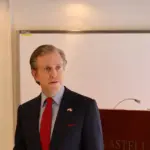



Pedro Cateriano is a renowned Peruvian lawyer and politician. He was prime minister during Ollanta Humala’s government and also served as Minister of Defense during the same administration. On July 15, 2020, during the Covid-19 pandemic in Peru, he was sworn in for the second time as President of the Council of Ministers in Martín Vizcarra’s government.
He has written four books, the latest being Vargas Llosa: His other great passion, released in 2025, where he presents a political biography dedicated to the Nobel Prize in Literature winner.
The lawyer spoke with La Tercera about the situation in Peru. He will visit Santiago to participate on September 9 in the talk “Freedom of Expression and Cancel Culture” organized by the Institute for a Free Society and Faro UDD.
What are the main challenges facing President Keiko Fujimori?
The main challenge she faces is to govern democratically. That is, respecting the constitutional order. The situation, from an economic point of view, is favorable; her election has been well received by both foreign and national business sectors, and that is important and reflected, for example, in monetary stability. The dollar has not skyrocketed; on the contrary, the exchange rate has decreased, expectations are positive, and there are great possibilities.
Peru, in the last 10 years, due to political anarchy, has not been able to carry out mining, oil, and gas projects. So, that is another major challenge: unlocking all these immense possibilities for economic development. If there is something to nuance, it is that the left has had great success in Peru blocking mining projects. However, it has been deaf, blind, and mute to the unstoppable advance of illegal mining, which I believe is one of the major problems associated with crime in the country.
In the foreign arena, many possibilities also open up to continue with economic integration mechanisms and free trade. I believe there is now a golden opportunity for the member countries of the Pacific Alliance to relaunch this important economic integration mechanism and finally achieve positive development, and I think the task is not only for governments but also for entrepreneurs, academia, and universities.
How do you evaluate the bilateral relationship with Chile?
I see the bilateral relationship between Peru and Chile as very positive. There are also possibilities for greater rapprochement. For example, the Tacna-Arica railway connection could be expanded via concession or through a mechanism in which the governments engage in dialogue. We also have possibilities for electrical interconnection. On the other hand, ensuring political stability to continue Chilean investment in Peru is important. It should not be forgotten that Chilean investment has participated in Peru’s economic development processes. And that is positive. And if it happens within the context of the Pacific Alliance, even better.
How do you evaluate the role of the Peruvian opposition so far, and what prospects do you see in this regard?
I do not like to speculate in politics. The government took office on July 28, and the left-wing opposition has already announced that it plans to question three ministers. So, I believe one of the major problems Peru has suffered in recent years has been political anarchy. This very high turnover of ministers, changes, falls, resignations of ministers has undoubtedly affected the country’s public management. So, if we continue with this escalation of falls, questioning, and censures of ministers, in that respect, the opposition could put the president in a complicated situation.
Now, there are some cases, for example, where some cabinet members engage in matters that need clarification. For example, the Minister of Education has traveled three times abroad with a former Fujimorist parliamentarian and attended to award her a medal at her swearing-in ceremony and has also appointed her to a board of the institution that manages teachers’ pension funds. Naturally, this not only causes a scandal in Peru but in any country. I believe responsibility must also be demanded from those who assume functions, especially when, shamefully, in the past some ministers have fallen for committing such acts.
How do you evaluate the return to bicameralism in the Peruvian Congress?
I am in favor of bicameralism. The Congress with a single chamber, an experience that occurred after Alberto Fujimori’s April 5, 1992 coup, has been truly disastrous. Although there is debate because the Senate’s configuration reflects the election results, in which Keiko narrowly won, and it also implies efforts for democratic dialogue, debate, and exchange of ideas. It will not be an easy task. The second chamber will at least prevent laws from being approved without greater debate, without participation from the media, academia in general, as has been happening in the country.
Regarding freedom of expression, are there independent institutions in Peru to resolve conflicts related to this right?
In Peru, freedom of information, opinion, press, and expression is guaranteed. We have had very dark periods, for example, during Juan Velasco Alvarado’s dictatorship (1968-1975), when the media were subjected for the seven years he ruled and the following five years when the dictator who succeeded him, Francisco Morales Bermúdez, also kept them under political control.
Later, much later, when Fernando Belaúnde Terry returned, his first act was to restore the media to their legitimate owners. Alan García, with all his flaws and his disastrous government, respected freedom of expression, press, opinion, and information.
But it must also be said clearly: Alberto Fujimori, during his dictatorship, did not need to seize the media as Velasco did; instead, through his advisor, he bribed them. He did not buy them. These are historical facts that must not be repeated. And I believe this is another major challenge for the current government: to show respect for freedoms of expression, information, opinion, and press.
How do you evaluate the quality of public debate in Peru? Has it been affected by polarization?
We are seeing polarization in solid democracies like those in Europe. Polarization does not allow a civilized exchange of ideas. We are now in what Vargas Llosa called the “civilization of the spectacle.” Attack, insult, and scandal are unfortunately prevailing. And in recent years, this has also grown due to social networks, which allow freedom of information. But they are also weapons that have contributed to polarization, and in Peru, this has been dramatically reflected in the very tight electoral results we have had from Pedro Pablo Kuczynski to Keiko Fujimori.