






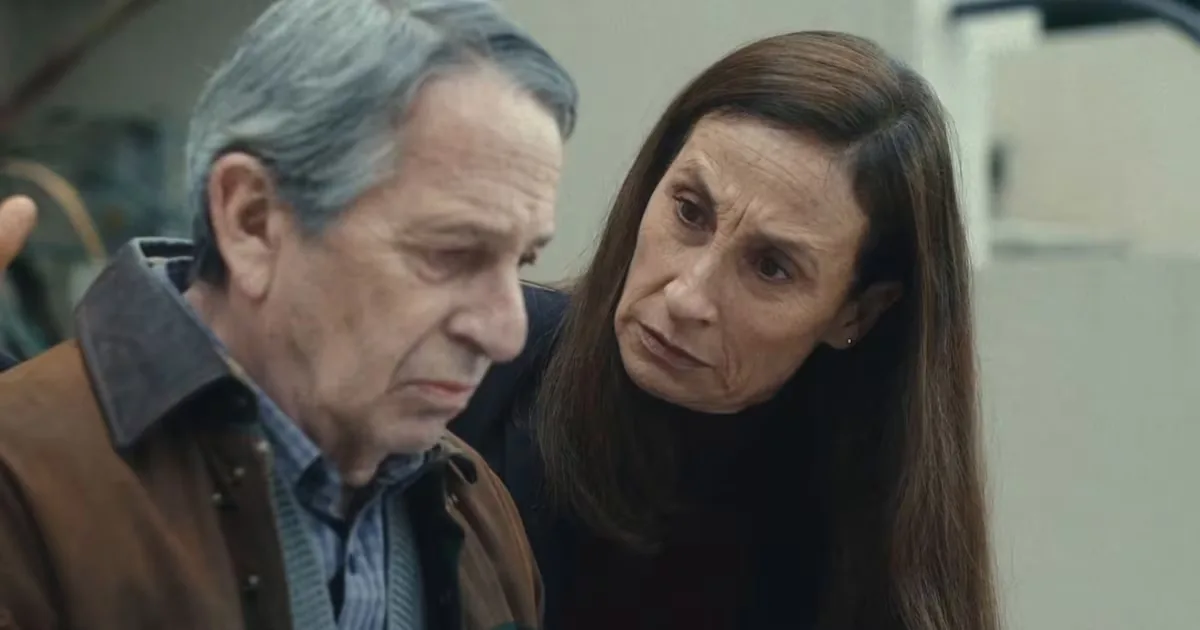
Before starting to give clues about its central mystery, the series Catedralesprofiles the confrontation between two antagonistic figures: Lía (Ignacia Baeza), the daughter who had to distance herself from her family to try to process the pain, and Carmen (Amparo Noguera), the daughter who has deepened her religiosity and who flatly refuses to reopen the wounds of the past.
Three decades after the unsolved murder of Ana (Octavia Bernasconi), the younger sister of both, the two women reunite and sparks immediately fly. In that reunion, triggered by the illness of the patriarch, Adolfo (Alfredo Castro), the strong opposition between the sisters is exposed and intensifies as new background information about Ana’s murder emerges.
“Carmen undoubtedly transforms her faith into an authority,” says Noguera, the actress responsible for portraying Carmen in her adulthood.
“Faith catches my attention. It’s not that I have it, but it catches my attention. It seems to me a quite enviable spiritual state in many cases, but in other cases like this one, when it becomes a dangerous fanaticism (…) It loses all spirituality and turns into a very dangerous space of power,” she explains to Culto about the Prime Video production based on the eponymous novel by Argentine Claudia Piñeiro, which released its six episodes this Wednesday, September 16.
In the past, in 1986, Carmen (Paula Luchsinger) is the daughter of the Sardá family who adheres to the norm. Part of the church choir, she falls in love with Julián (Giordano Rossi), even though he is an altar boy. In the present, in 2018, she is married to him (now played by Marcelo Alonso) and seems to have inherited the position once held by her late mother, Dolores (Paulina García), that of matriarch who unites the family based on the guidelines of religion.
“I think Carmen in both eras is a religious fanatic; she structures her life around this religion, believes she is doing the right thing and that she is right versus others. I think that fanaticism, whether ideological or religious, is very dangerous. It is very dangerous because it prevents you from seeing the other. In the narrative of us versus them there is no empathy, no dialogue,” Luchsinger states.
One of the sources of tension between the sisters is Mateo (Clemente Rodríguez), the son of Carmen and Julián. Very close to his grandfather, he begins to share different moments with Lía and gets involved in the investigation to clarify the case that fractured the Sardá family.
“Mateo is a character who indeed feels a lot, but since he is immersed in this very rigid world, logically those emotions appear repressed,” Rodríguez analyzes. From his perspective, the relationship he has cultivated with his grandfather is “an escape door from this somewhat claustrophobic family.”
The actor identifies similarities between his role and the aunt he never met, Ana. “He has a lot of energy and strength because of his age and youth, but he is also at a crossroads of knowing where that energy is going. And in that sense, without knowing it, he is in the present being very similar to Ana. That is not so explicit, but Ana is shaking up her faith, and Mateo is trying to do the same. He tries to assert himself from the other characters, who are his grandfather and his aunt Lía, to be able to have his own opinion about life and things.”
While Clemente Rodríguez worked around the tension that dominates his character, Paula Luchsinger focused on containment. “She is a very passionate character – driven by her love for God and her love for her family – but she is very contained, she is in control of the situation all the time. That was very interesting to me and an acting space that at first was a bit uncomfortable, but later was very rewarding.”
For Amparo Noguera, “all the characters in this series are very emotional, they are very human. Beyond whether one finds them right or not, one can get to know them, one can understand the mindset of the characters seen in this series. That seems difficult to achieve and attractive to me. In this case, I think it was achieved.”
“Beyond the work of art, cinematography, directing actors, and script based on a very good material, which is Claudia Piñeiro’s novel, I think that really humanizing the characters is important in a series. By humanizing them I don’t mean turning them into good people, but that as a viewer one is able to know that character and be able to talk about them, know who they are,” reflects the same actress.
The cast prefers to leave ambiguous whether, faced with the dramatic events unfolding in the present and that could shed new light on Ana’s death, Carmen will maintain or loosen her firm convictions.
“It’s complicated – Noguera maintains –. There is also the possibility, in life and fiction, that there are characters who do not change.”
Read more Datos Paula: the route of vegan fondas for this 18th