






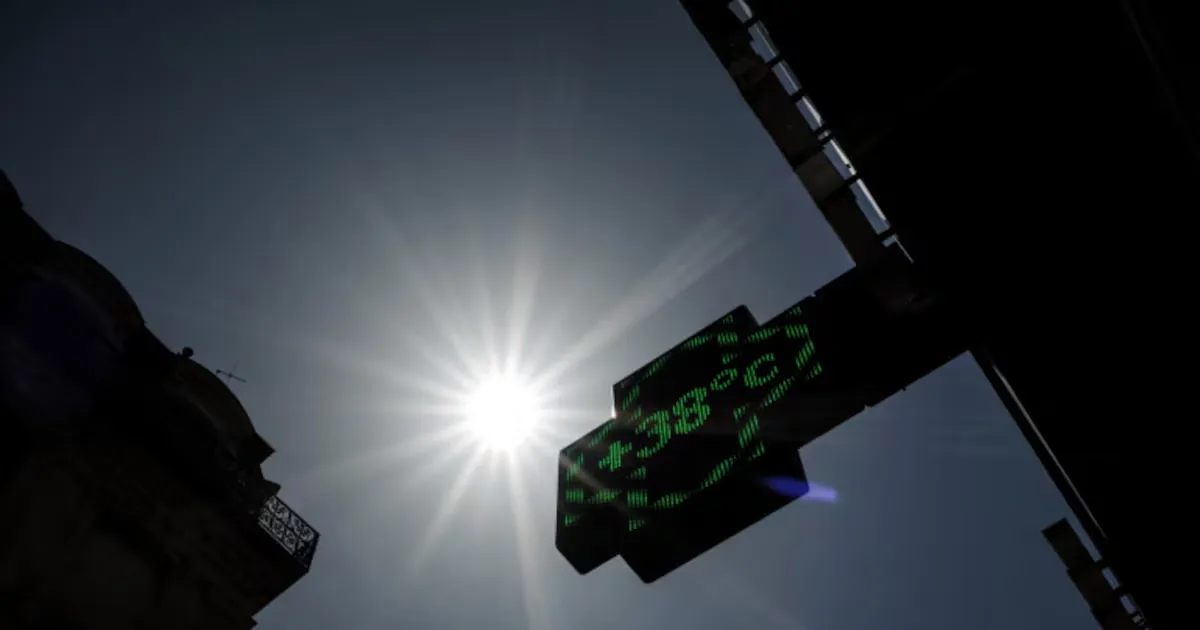
As phenomena that go hand in hand, the rise in temperature in France has simultaneously fostered drought in the rivers, which see their flows reduced to points that cause emergencies in various departments. Right now, the European country is experiencing its third heat wave of the year, after record temperatures in June caused more than 2,000 additional deaths across the country.
Sixteen of the 96 departments in the country were under an orange alert for heat wave last Monday, with maximum temperatures expected to reach 40 degrees Celsius in some areas of the southwest. The drought is worsening, and the vast majority of departments are subject to some type of alert in this regard. Water reserves have also been pushed to the limit, diminished by the combination of heat and scarce rainfall.
Prolonged heat waves in France are having devastating repercussions for the country’s rivers. 16% of French watercourses had dried up last June, compared to 6% recorded in June 2025. And the measures asked of the French to save water, amid all this, are seen as insufficient.
According to Météo-France, by the end of June soils were approaching their most extreme dryness levels ever recorded in the regions of Alsace, Aquitaine, Auvergne, Limousin, and Midi-Pyrénées. Dry vegetation is already serving as fuel for forest fires; 10,000 people have been forced to evacuate in southwestern France, where a fire fueled by strong winds has burned 4,600 hectares.
Drought alerts in France are based on a progressive scale: starting from monitoring and rising to alert, reinforced alert, and crisis. The highest level practically prohibits any non-essential use of water. Restrictions are established municipality by municipality, so neighboring localities within the same department may be subject to different rules.
According to the government platform VigiEau, as of July 1, 84 of the 96 departments of continental France had at least one municipality subject to some type of restriction on tap water supply. If water restrictions for agricultural use are included, the number of affected departments rises to 92 out of 96.
As of July 1, nearly a dozen departments had at least one municipality at the maximum “crisis” level regarding tap water, which entails restrictions on watering plants, washing vehicles, and filling private pools.
The situation outrages the French, who claim it is not their personal use that consumes the most water. Citizens have turned to social media to express their discontent with the situation, and many criticize the impact of data centers, which consume enormous amounts of water: “put a stop to those insatiable data centers before asking us to limit ourselves when watering the garden, flowers, etc.,” comments Galinette Cendrée in a Facebook post by the weather service La Chaîne Météo.
Others point to corn crops that require a lot of irrigation and leaking infrastructure as factors contributing to the imminent crisis.
“In the end, it will be the average citizen who has to stop watering their two geraniums, while the underground water distribution network, dating from the 1960s, loses water everywhere… Farmers will continue to have exceptions to pump or irrigate, even if they have crops unsuitable for the climate. It’s a bad joke,” points out Fred Lordhebus, a Facebook user, under a post about water restrictions from Météo Basse-Normandie.
Another person urges compliance with the restrictions and notes: “It’s about time users stopped watering flowers and lawns. It’s just a ‘drop of water,’ but if we all did it, the savings would be considerable.”
France’s water crisis is not an isolated fact: the country’s renewable water resources have steadily decreased, recording a 14% drop between the periods 1990-2001 and 2002-2018.
This phenomenon is driven by drier and warmer winters, with earlier snowmelt, and by greater evaporation due to increasing summer heat. Added to this is the high demand for water for agriculture, domestic consumption, and the cooling needs of French nuclear power plants.
During the June heat wave, nuclear reactors located on the Seine and Rhône rivers were forced to stop their activity due to the rise in water temperature.
And this Sunday, France’s main energy provider reported that three nuclear reactors were temporarily shut down and another eight are operating at reduced power due to the heat wave affecting the country.
“Due to weather conditions and to comply with regulations on cooling water discharges, and thus protect the environment,” reactors at the Golfech, Bugey, and Chooz plants, located respectively on the banks of the Garonne, Rhône, and Meuse rivers, were stopped, the energy group EDF told AFP.
The measure responds to an environmental protection requirement aimed at avoiding excessive discharge of hot water into rivers whose temperature is already rising due to the heat wave.