








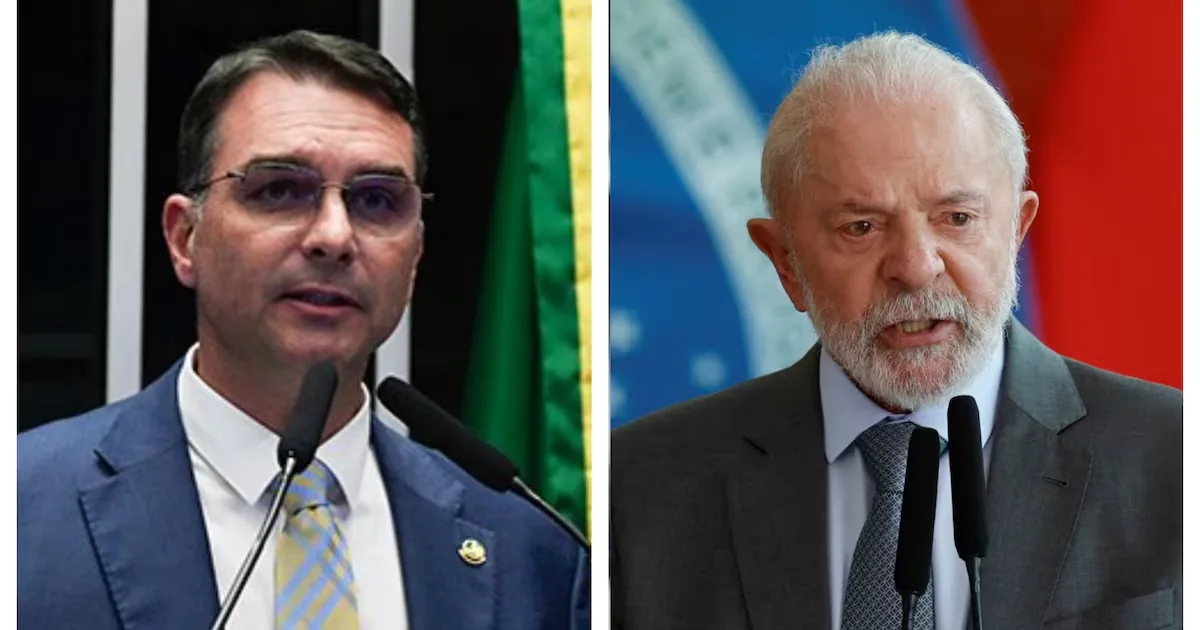
Polls are beginning to give Luiz António Lula da Silva some relief. Three months before the presidential elections in Brazil, the leftist leader reaches his best approval rating since 2024 and, ahead of the October elections, leads all runoff scenarios and increases his lead over Flávio Bolsonaro to eight percentage points.
This is shown by a Genial/Quaest poll published this Wednesday indicating that Lula’s government has the approval of 48% of Brazilians, compared to 47% who disapprove of the current administration. This is the first time since December 2024 that the approval rating is numerically higher. In comparison, in July last year, disapproval stood at 53%, a figure that dropped to 48% in the previous poll published last month, highlights the newspaper O Globo.
In April, the difference between disapproval and approval ratings was nine points. In May, it decreased to three, and in June it was only one point, a figure that remained the same in July, adds the media outlet G1.
The improvement in Lula’s government’s approval rating is a key indicator to understand the current state of the presidential race, says Felipe Nunes, director of Quaest. “What we are showing is that government approval has been improving consecutively since April,” he says.
“And this improvement is based on three factors: the ‘Desenrola 2.0’ program (for debt renegotiation) is reducing Brazilians’ debt, the debate about ending the 6×1 work schedule creates the expectation that people will be able to work less and have a better quality of life, and the income tax exemption is finally starting to reach important sectors of society,” he comments.
Regarding the “Desenrola” program, Quaest indicates that 66% of respondents know the debt renegotiation program (compared to 57% in May, when the initiative was launched). Additionally, 55% consider it a good government idea, and 35% state that their income has increased significantly since the program’s launch. In June, this figure was 30%.
“In other words, Brazilians recognize the importance of renegotiating their debts,” says Nunes.
According to Quaest data, 31% say they have no debts. In May, this figure was 27%. On the other hand, two months ago, 28% declared having many debts, a figure that has dropped to 21%.
The program is aimed at those earning up to five minimum monthly wages, that is, 8,105 reais (about 1,595 dollars), and allows them to renegotiate debts incurred until January 31, 2026, with a delay of between 90 days and two years, including credit cards, overdrafts, and personal loans.
Regarding the end of the 6×1 work schedule, a proposal supported by the government and approved in the Chamber of Deputies in May, 69% are in favor and 50% expect to work less with the reduction of the workday. Even among right-wing voters and Bolsonaro supporters, more than 40% responded that they expect to work fewer hours.
“What is the big secret to ending the 6×1 work schedule? We found a positive expectation about the idea of working less; that is, the government is managing to create that expectation, and this obviously helps the government improve,” says the director of Quaest.
The proposal, which has not yet been approved by the Senate, modifies the Constitution and reduces the weekly workday from 44 to 40 hours, without salary cuts, and foresees a gradual implementation within a maximum period of 14 months after its entry into force.
As for the income tax exemption, which benefits those earning up to 5,000 reais (about 985 dollars), it came into effect at the beginning of the year, and since then the percentage of people who say they have noticed a difference in their income has increased.
For 24%, incomes increased significantly. This figure was 15% in February and 17% in April. In February, 50% said they had not noticed any difference. This percentage dropped to 39%.
Read more Family scones
According to the Planalto Palace, approximately 15 million Brazilians will stop paying income tax with the new law, points out G1.
The good news for Lula regarding the improvement in approval of his government is also reflected in the presidential race. The Quaest poll shows the leader eight points ahead of Senator Flávio Bolsonaro in a simulation of a second round of the presidential elections. Lula has 45% of the voting intention compared to 37% for Flávio.
In June, Lula obtained 44%, compared to 38% for Flávio Bolsonaro. In May, the president got 42% and the senator 41%. These figures indicated a technical tie. In April, Flávio numerically surpassed Lula, with 42% against the president’s 40%. In March, both obtained 41%.
“In a possible runoff scenario, Lula’s lead over Flávio would be 8 percentage points, after having fluctuated positively by 2 points during the last month,” says Felipe Nunes, director of Quaest.
The poll presents four scenarios for the runoff. In all of them, the president would be reelected. The smallest difference is against Flávio Bolsonaro. The largest advantage is against Renan Santos, with 12 percentage points.
Nunes points out that there is a “weakness” in Flávio Bolsonaro’s campaign. This weakness in Flávio’s campaign can be justified by several factors. The most significant was the conflict with Michelle Bolsonaro, which only half of Brazilians were aware of. The videos released seem to have caused some damage among Flávio’s potential base, as 35% of the right and 20% of Bolsonaro supporters believe Michelle was right to publish the video,” he said.
Regarding this, the Quaest survey shows that Flávio’s disapproval rating rose to 57%, one point more since June, while that of his main rival in October, Lula, has fallen three points in the same period (from 53% to 50%). The difference between the two is now seven percentage points: in April, the president was the most disapproved (55%), followed by the senator (52%).
Likewise, the poll reveals that Flávio Bolsonaro has lost support among voters who identify as right-wing but are not Bolsonaro supporters. The director of Quaest explains that this support was at 45% in December, in the first-round scenario, when the senator announced his candidacy with the backing of his father, former president Jair Bolsonaro.
In May, it reached a maximum of 74%, and since then, the trend has been downward. Currently, 54% of right-wing voters who are not Bolsonaro supporters say they will vote for the senator.
However, among Bolsonaro supporters, there is stability. Flávio’s voting intention has remained above 90% since February.
According to O Globo, Flávio’s unpopularity has been increasing since his link with banker Daniel Vorcaro to finance the film “Dark Horse,” about his father, Jair Bolsonaro, was revealed. And it has fluctuated upward after the publication of videos of his stepmother, Michelle Bolsonaro, in which she accuses her stepson of mistreating her and disrespecting her political opinions, as well as his trip to the United States.
The senator, the newspaper points out, apologized to his stepmother and reaffirmed his stance in favor of women and religion to mitigate the repercussions in those electoral sectors, where Michelle is one of the most influential figures in the country. This month, he also spoke out in Washington against tariffs on Brazilian products and defended the instant payment system Pix, in an attempt to mitigate the negative impact on his campaign derived from Bolsonaro’s actions in favor of foreign sanctions against alleged violations of allies’ rights.
Despite these adverse events, Felipe Nunes emphasizes: “Even with this wear and tear (caused by the fight between Flávio and Michelle Bolsonaro), no other name seems more competitive than Flávio against Lula.”
Read more United States blocks passage of two merchant ships in Hormuz after reestablishing naval blockade