






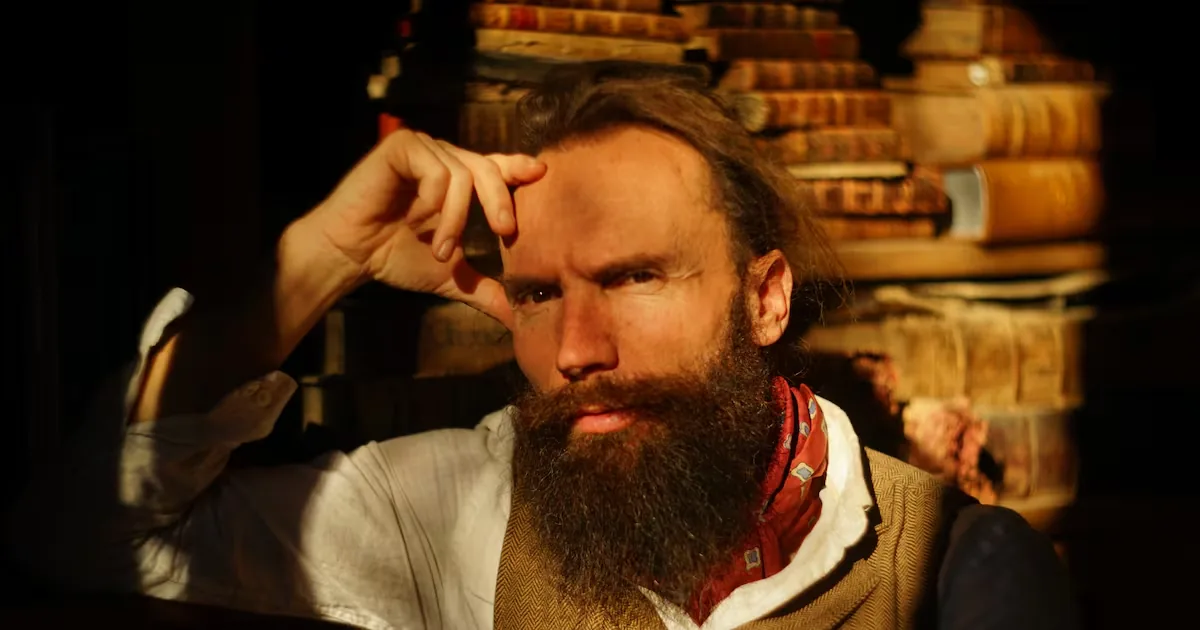
Prominent French archaeologist and paleontologist, Ludovic Slimak began his professional journey in a cave in southern France 36 years ago, studying the footprints of the Neanderthals, about whom he is one of the world’s leading experts. The Neanderthals are the human species closest to Homo sapiens and, once they became extinct (about 40,000 years ago), we became the only human species on the planet.
Slimak has led a total of 54 archaeological expeditions across three continents, 20 of which took place in Turkey, Ethiopia, Djibouti, Russia, and the Mediterranean region of France. He is the author of more than 230 scientific studies focused both on the organization and history of Neanderthal societies, as well as on the structure of the first Homo sapiens populations in the European continent.
His research, according to experts, has profoundly redefined our understanding of the perceived relationships between these two branches of humanity—Neanderthals and sapiens—reconfiguring the cultural and historical framework of the last Neanderthal societies. Based on his research, Slimak also attempts to shed light on the current human condition, which he discusses in this interview.
“I speak from my experience, 36 years during which I have immersed myself in the organization of humanity that was not us: in their daily life, their crafts, their knowledge, their territories. Then, I worked on contact, I worked on extinction, on the collapse of populations. When we talk about Neanderthals, it is an excuse to talk about ourselves,” he says via Zoom from his office in France, between Toulouse and the Pyrenees.
In his recent book, The Last Neanderthal, he asserts that they did not become extinct due to exogenous factors, or only because of them, but because of the superior efficiency of the sapiens.
Let’s start with the extinction of the Neanderthals. You say it was a suicide. Why?
The global view of the extinction of the Neanderthals, and of human extinctions in general, has been based on a catastrophic perspective. We need to find a cause. Just as we look for an asteroid to explain the extinction of the dinosaurs, now we need one to explain that of the Neanderthals. And this Neanderthal asteroid could be climate change, volcanic eruptions, or stellar radiation. In all the main hypotheses proposed, it seems we have sought the same dinosaur story to explain it. Except human populations do not work that way. The extinction of the dinosaurs was not the extinction of a single population; it was a global extinction event that affected all living beings on Earth. Therefore, in this case, we have to imagine a catastrophic event that affects one population and no other on Earth. And when we examine human societies, whether Neanderthals or all other human forms that became extinct at that time, we face the fact that there was no extinction of all humanity, since Homo sapiens still exists. And we see very clearly how human society collapses work.
How do human societies collapse?
Collapse can indeed occur through the encounter of two populations. For example, when Europeans arrived in America, very marked, intense, and terrible demographic collapses occurred.
But, indeed, one could say: “Look, European settlers arrived in America and were carriers of germs, for example.” But if we analyze it deeply, if the populations of America, the indigenous peoples, or all populations that have been in contact with Europeans have been decimated, it was not because of germs. The crux of the matter is what happens in the minds of populations that come into contact with other populations… They will be destabilized in their traditional activities, their structures, and their values. Their social relationship with their neighbors, whether friends or enemies, will change completely.
Is it because of conflict with others?
At the moment of contact, it is not about conflict, nor about being stronger because of weapons, but about children seeing themselves as strong, handsome, and better than their neighbors. That is inherent to all human beings, that is how things are. And this relationship is very important in generational transmission; children need to feel proud of their parents’ value system. And when children see that there are other populations that do not share the same values, that do not tell the same stories, that do not have the same gods, the same legends, the same customs, but that are objectively much more effective, the whole system… all the stories we told ourselves, all those value structures, lose all meaning for the children. It is a collapse of value systems that are no longer transmitted between elders, between parents and grandparents, and children, because children no longer believe in them.
Read more “Harmful to health”: wildfires in Canada endanger the World Cup final between Argentina and Spain
Is that what happened to the Neanderthal when they encountered the Homo sapiens?
That is what I propose, that specific interpretation, which is a true reading, not only philosophical but also of cultural anthropology. What happens when two populations meet? Well, the great common point between the Horn of Africa, the Aboriginal Australians, and the peoples of America is that a collapse of value systems occurs. And why would it be replaced? By alcohol, tobacco, drugs, and even, in the case of the Aboriginals, a kind of addiction to coffee and tea (…). I worked in Djibouti, for example, in the Horn of Africa. The terrifying thing is that in the capital of Djibouti, people lie on the sidewalks, waiting every morning for trucks carrying what is called CAT, a drug. In fact, people no longer want to live. So they spend the day, take CAT in the morning, and sleep on the sidewalks. Most of the population is in a state of unconscious collective suicide. People no longer want to live.
And why?
These are people who come—not from the city of Djibouti, but from nomadic populations living around, in the Horn of Africa—and whose value system has completely collapsed. They think: “I’m going to the city, I’m going to Djibouti, I’m going to find the good life, the easy life.” Then they think: “Let’s go to Yemen.” And then they go to Europe. And each time, they say: “We’re going to find the good life.” And each time I try to explain to them: “But you’re only making things worse. If you go to Yemen, you will be slaves.” These are traditional populations living a nomadic lifestyle. And suddenly, they arrive in the city, and the only thing waiting for them there is not the good life, but drugs and collapse. There is nothing to be done. No one is waiting for them. When two extremely different populations meet, and when one is not superior but more effective, more efficient than the other, it induces a collapse of the opposing society.
It is an internal risk…
The risk is internal. Exactly. The risk of perceived obsolescence. It is not that we are obsolete because we are always exactly the same, but that we no longer believe in ourselves and, therefore, have a feeling of obsolescence. And this feeling of obsolescence is what would be extremely dangerous if we came into contact with an intelligence external to us. And that is what is extremely dangerous today in the development of artificial intelligences, which are becoming increasingly effective, increasingly efficient, and where the problem is our children.
What children see about human capabilities versus artificial intelligence capabilities.
Exactly. They will think: “Why should I learn geography? Why should I learn history? I will never know it as well as what artificial intelligence tells me.” And there lies the collapse of their ability to imagine that one day they will be a good drawer, poet, writer, bricklayer, or whatever they want. Right now we are facing this. We are at a crucial moment, an encounter with another intelligence. The terrible thing is that we are at a turning point, meeting an intelligence external to ourselves, one we created but that is not our own intelligence, and that is becoming autonomous, capable of self-improvement without human intervention. The fundamental problem for young people is the collapse of their value system, as I said. The collapse of their mythology, in which they believe that they, the Homo sapiens, are the best in the world in terms of intelligence. And from the moment we lose that belief, we place ourselves, I think, in the same position as the Neanderthals 40,000 years ago. The sapiens did not have to be malicious to the Neanderthals. It is simply the confrontation in which the younger generations no longer want to participate or believe.
And now I understand why you said you went from exploring caves to trying to understand who we are, and that what happened with the Neanderthals can help us better understand the present. How to convince young people to believe in a better future amid climate crisis, geopolitical tensions, and so much polarization?
Yes, what you ask me is very difficult because, in reality, the terrible thing is that we cannot pass that discourse on to the new generations. As you just described (the world) it is very true, very accurate, but at the same time that is not the message we should convey to children. We are very aware that when you have children you assume an immense, titanic responsibility. And the question is not only in what world we leave them, but what words we give them to talk about our world. And I think we must pay a lot of attention to that, since collapses actually occur because of the despair of children. Therefore, we must be very attentive and remind them of the basic reality.
Which one?
That they are in an extremely beautiful world, a kind of small oasis in a vast void millions of light-years away. And this oasis, today, in its current state, is still incredibly beautiful. Its diversity and beauty are absolutely stunning. The second point is that the message we must give them is not: “Well, now that you are here, you are in serious trouble.” No, it is not that. We must offer them a different perspective, one in which we tell them that every generation has faced this. And the generation of our parents or grandparents certainly found itself in a much more complicated and difficult geopolitical situation. Until 1990, we were in the Cold War, with a divided world and nuclear superpowers ready to annihilate the planet. If you take a step back, one generation, we fall into 1939-45; if we go back another generation, we fall into 1914-1918. So the important thing for the younger generation is to understand that the current situation is not exceptional. Life consists of managing disasters; we all try to improvise and manage, but that also means they still have some control over things. If the Soviet empire could collapse without total nuclear conflict, if it could end peacefully, if we could get out of Nazism without the whole old world being dominated by the Nazis, well, we have come out of all that… And today, the world we live in has all its flaws, but also all these magnificent things. And most importantly, which I develop in the book, is that we must not let the young generation feel that the future is written, because if not, nothing can be done. No, no, no: the world belongs to them.
Read more Review of the HUAWEI Watch Kids X1: a watch for children (designed for parental control)