






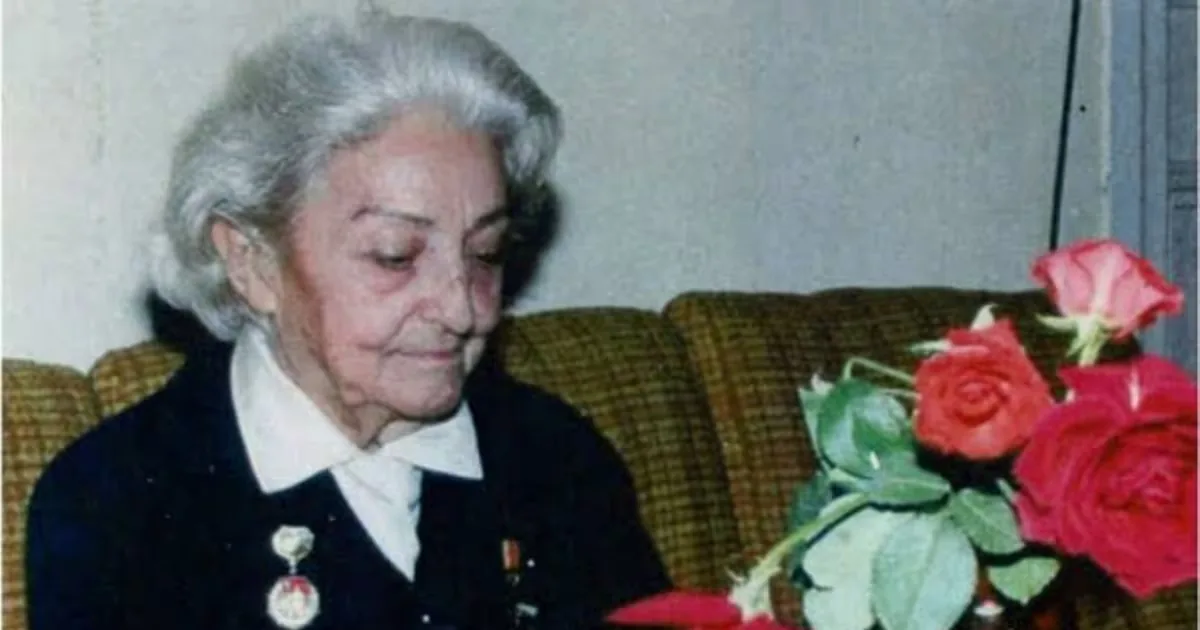
Patria was the code name given to her by the KGB (State Security Committee), although the Spanish África de las Heras was known as Ivonne in Ukraine, María Luisa de las Heras in Uruguay, and María de la Sierra in Mexico. Recruited by the Soviet secret services in 1937, she became an elite international agent.
However, for the writer Laura Ramos, María Luisa was simply the woman who took care of and gave cakes to her and her brother, as well as to other children, while their parents held gatherings in their homes in the 1960s. Years later, in 2019, her brother Víctor Ramos told her that the lady, also known as the seamstress, was a spy for one of the most famous intelligence services in the world.
“Every weekend, (my parents and their friends) would gather at someone’s house and have dinner, and after dinner they would stay chatting in the living room, and María Luisa always said that she was not interested in politics. And we are talking about the 1960s, and, moreover, they were almost all communists related to the Communist Party. (She) always said she adored children and liked being with children. Then she would go to the bedrooms where we were and tell us stories,” Laura Ramos recounts to La Tercera.
“Now I also think about it and say: how clever, because it was a way to make herself necessary, because this was a group of young adults. They would have been in their thirties and she was a woman who would have been in her 60s, because she was born in 1909. And besides, she presented herself as a haute couture seamstress, which could not interest this group of intellectuals, friend, seamstress, and much older. However, she made the connection through the family’s kidney, which were the children,” explains the author of the book My KGB Nanny (Lumen).
When Ramos learned that María Luisa had been a Soviet agent, she traveled to the woman’s birthplace in Ceuta and then went to Cambridge to see the archives of the former agent Pavel Sudoplatov, where she found out about a series of homicides, sabotage, kidnappings, and also spoke of a Spanish woman described as “our best agent.”
“There I discovered that while she was in Montevideo, those years when she took care of us, she had traveled permanently to the Soviet Union. When she told friends she was going to Europe to travel, to vacation in Europe, she was actually going to the Soviet Union, where she was received as a war heroine. In the end, she received the title of colonel; in fact, she had parachuted over Nazi troops. That is, she arrived in a huge nation where she was a heroine and then returned to her humble job as a seamstress,” Ramos says.
The writer points out that while María Luisa lived in Montevideo she did not spy on them, but her mission was to wait for the Soviet agents that Stalin sent to spy on the atomic bomb in the United States. She received them and gave them false documents so they could be in the United States. “She traveled the paths of the interior of Uruguay to look for graves of dead children whose ages, if they had lived, matched those of the Soviet agents. Then she requested birth certificates and with these certificates made new documents with very sophisticated mechanisms,” she recounts.
One of the episodes that most shocked the Argentine writer was learning that De las Heras had drawn the plans of Frida Kahlo’s house for the assassination of León Trotsky in 1940, because her parents were admirers of the Bolshevik leader, who had arrived in Mexico exiled in 1937.
In her book, Ramos states that María Luisa would even have been in the car waiting for Ramón Mercader, Trotsky’s assassin, outside the Mexican painter’s house, which was where the Soviet lived.
“What shocked me the most exactly was that, because for us, who were six or seven years old, she was a character as if she were family, she was like a heroic character who had fled from a villain who was Stalin. My dad told us stories about how Stalin had managed to kill him and we were moved. That is, we are very emotionally involved with all the exile and assassination of Trotsky in Mexico. When I found out that the lady who took care of us had participated in the assassination of our hero, it was a terrible pain and I did not want to write this biography because I did not sympathize with her. Until I started reading and understood a little, I realized that she did not have a personal grudge against Trotsky, there was no emotion in that,” she concludes.
Read more “Harmful to health”: wildfires in Canada endanger the World Cup final between Argentina and Spain