


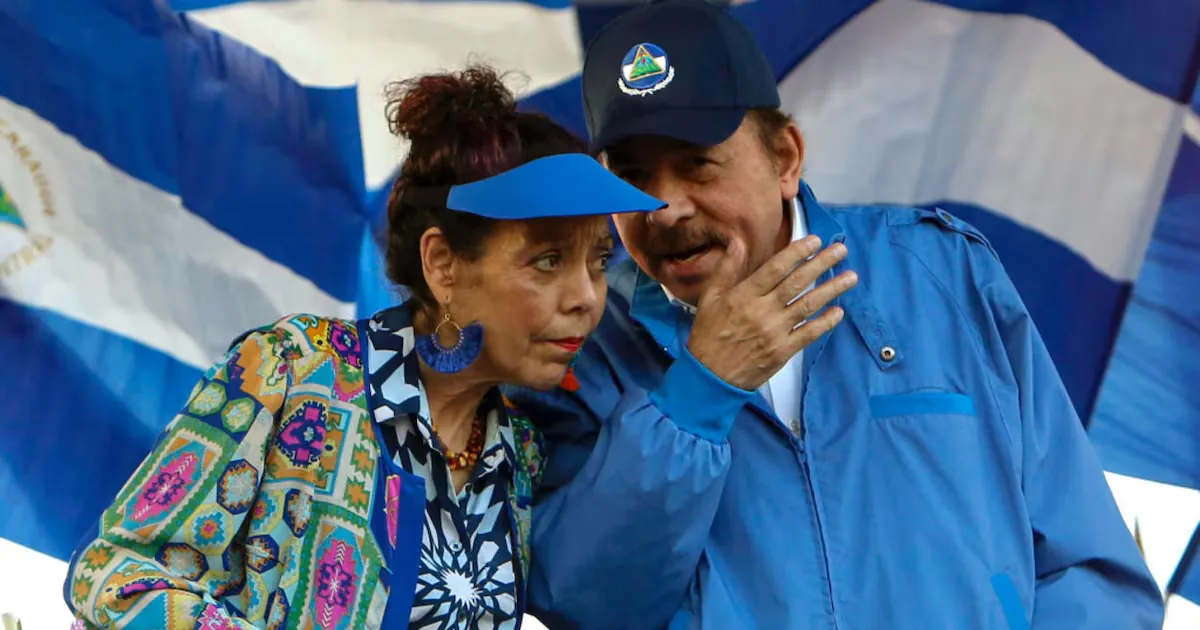
“Forget it, there will be no more elections here,” announced Nicaraguan President Daniel Ortega during a commemorative event for the 47th anniversary of the Sandinista Revolution, held on Sunday in Managua, the capital of the Central American country.
“There will be no more elections for them (the opposition) to try to seize the government, seize power,” added the 80-year-old president, who also announced that the National Assembly, controlled by the ruling party, will approve laws to “put a wall, a block to the coup plotters, to the traitors.”
“No matter how much money the Yankees (United States) give them, they will not be able to,” he asserted in a speech that was televised nationwide.
Nicaragua was supposed to hold presidential elections at the end of 2026, but last year the ruling party approved a questioned constitutional reform that postponed the elections until 2027. However, Ortega’s statements now suggest that even that electoral event might not take place.
For the Spanish newspaper El País, although in practice the announcement does not modify a reality known by Nicaraguans – local and national elections have been marked by successive frauds since 2008, according to international electoral observation organizations – it does represent a discursive and political leap. The 2021 presidential elections were already the best example of a system without competition: Ortega and his wife, co-president Rosario Murillo, imprisoned all opposition pre-candidates with real possibilities of disputing power through the ballot box and claimed 75.92% of the votes.
In the same vein, The New York Times stated that the pronouncement marked an “explicit end” to any pretense that Nicaragua was still a democracy.
Nicaragua was expected to hold presidential elections in 2027, a year later than promised after the National Assembly, which is controlled by Ortega and Murillo, extended the co-presidents’ term, but that is now in doubt.
“Ortega buried Nicaraguan democracy a long time ago,” said Félix Maradiaga, a former 2021 presidential candidate who was arrested by the Ortega-Murillo government, expelled from the race, and then exiled to the United States in 2023. “This is simply an expression that unequivocally demonstrates how the mask he wanted to present of a certain legality has fallen off,” he told the Times.
“It is evident that Ortega and Murillo fear the idea that the slightest political opening could create the conditions for dissent to manifest and threaten their control of power,” said Tiziano Breda, senior analyst for Latin America at ACLED, an independent conflict monitor. “Instead of staging a rigged election, they have chosen to eliminate electoral competition altogether,” the expert added.
The Secretary General of the Organization of American States (OAS), Albert Ramdin, considered that, based on Ortega’s statements, “the Nicaraguan regime has now made explicit what its actions have been demonstrating for a long time: it has abandoned democracy, even the appearance of it.” Such a stance “constitutes the definitive denial of the sovereign right of the people to elect their government,” Ramdin added on X.
Washington also criticized Ortega’s statements. “Daniel Ortega’s declaration that under his family dictatorship Nicaragua will not hold elections again shows his true authoritarian nature,” Secretary of State Marco Rubio declared in a statement in which he called on the international community to “join forces” to show the “dictatorship that it cannot continue acting as if nothing is happening.”
Rubio pointed out that “the Nicaraguan people have the right to elect their own leaders through democratic elections.” “The United States calls on the international community to unite to show the Murillo-Ortega dictatorship that it cannot pretend to do business as usual with other nations when it is frustrating the basic principles of our democratic hemisphere,” he stated.
Ortega’s speech on Sunday was also an unusual public appearance for the leader, The New York Times noted. He has largely disappeared in recent years, sometimes going months without showing himself.
His wife has become the face of the government after Nicaragua’s National Assembly amended the Constitution last year, making her co-president and consolidating her power over the nation’s institutions, including the Army and the courts.
Murillo received the official title of co-president in February 2025, and the two analysts consulted by CNN agreed that Ortega’s transition to his wife is already in effect. This also appears to be the State Department’s stance, which began naming Murillo before Ortega in communiqués, a possible recognition of her growing political weight.
“Historically, there has been a feeling that a transition to Rosario will cause fractures within the Sandinista Front. It is still possible, but today’s Front is very different from that of a decade ago: not only is it a personalist party, it is also so for Rosario, who worked to ensure that people in positions of power are loyal to her, and not just to Daniel,” said Professor Kai Thaler, from the Department of Global Studies at the University of Santa Barbara (California), who has conducted research on the Central American country, stating that the presidential couple maintains a strong control over security forces and citizen control apparatuses.
Without adversaries or the possibility of organizing opposition marches, part of the opposition places some hope in an internal break within the core. Although in recent months there have been purges and accusations against officials close to the presidential couple, analysts agree that there are no ruptures in sight.
“It does not seem that there are alternatives within the regime or great possibilities of any fracture. There is a possibility of another family succession by one of the children, like Laureano, but there are no generals, vice presidents” who could emerge as a possibility, Thaler said.
“The most plausible scenario is the continuity of the regime with Rosario Murillo in a stronger position than anything else. Daniel (80 years old) is less and less present in public life. Rosario (74 years old) is much more active in governing day-to-day. There is a greater role in politics for Laureano, for the children, but to date there are no indications of any possibility of transition,” he reaffirmed.
However, Nicaraguan political scientist Manuel Orozco, director of the Migration, Remittances and Development Program at the Inter-American Dialogue organization, qualified that the co-president “does not have a popular base” and continues to rely on Ortega’s image. “Her political capital with the Army is quite functional, transactional in nature. They are allowed to manage resources, but if pressure arises, if the cost-benefit changes, support will decrease. There is a balance of power in her favor internally, but it is not solid enough to guarantee that she will reach 2027,” he told CNN.
Orozco maintained that the United States “has been developing a series of pressures” with which it imposes sanctions and Nicaragua usually does not respond, in an almost stable dynamic. “A mistaken reading gives the impression that Nicaragua comes after (Venezuela and Cuba), that the only US policy is direct intervention. There is no calculation of what that means, no one thinks what it would mean for the US to remove these people from power when there is no opposition, the citizenry does not know who the exiled leaders are, and there is economic stability. It is speculating about something that is not certain,” he asserted.
With that caution, he said that, in his opinion, the United States would be thinking more long-term, with the horizon of the general elections theoretically scheduled for November 2027, if Ortega’s warning is not fulfilled. “They calculate to synchronize pressure to introduce some kind of reform,” he stated.