




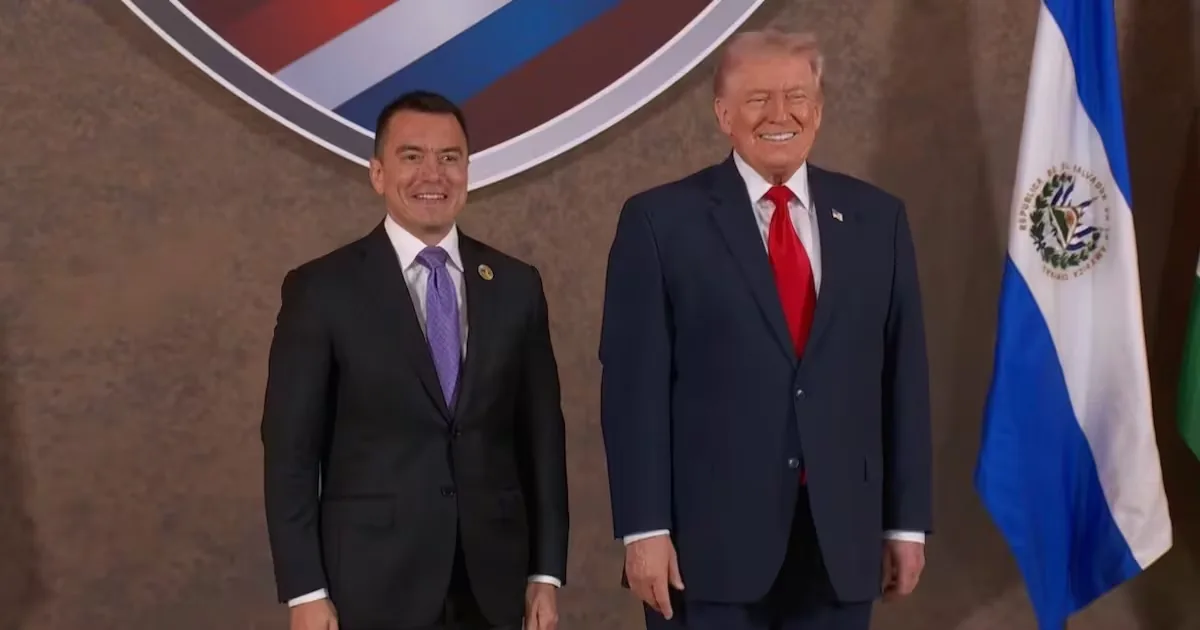
The Donald Trump administration has deepened its security cooperation with Ecuador in an effort to respond to the growing violence in the country and the organized crime groups operating throughout the region. But this collaboration would be taking place in a context marked by “serious violations” of human rights committed by Ecuadorian forces, drone attacks against fishing vessels whose origin remains unclear, and the disappearance of several fishermen, Human Rights Watch (HRW) denounced in a report published this Tuesday. The US Congress should urgently examine these incidents and the security cooperation relationship between both countries, advised the NGO that investigates and denounces human rights abuses in more than 90 countries.
The 80-page report, titled “A Dangerous Alliance: Abuses, Unanswered Questions, and US-Ecuador Security Cooperation,” documents three incidents in which several people were subjected to abuses, including drone attacks, torture, and arbitrary detention. In a fourth case, a fishing vessel and most of its crew disappeared under circumstances pointing to a possible attack. “Each of these incidents is somehow related to the US-Ecuador security alliance or raises questions about its responsibility that neither government has adequately answered,” the NGO denounces.
In an operation that the United States described as “joint,” Ecuadorian soldiers tortured and arbitrarily detained four agricultural workers and subsequently burned and bombed a dairy farm. In other incidents, drones of unknown origin attacked two fishing vessels, injuring several crew members. A third vessel remains missing, the report states.
Between March and June 2026, Human Rights Watch investigators interviewed 62 people, including victims of abuses, as well as lawyers, witnesses, and members of affected communities. Investigators reviewed and analyzed more than 100 photographs and videos provided by lawyers and interviewed individuals or published on social media, as well as satellite imagery, vessel monitoring data, fire detection data, and medical and judicial documents.
The first incident refers to a military operation in San Martín, on the border with Colombia, between March 1 and 6, 2026, which US officials have described as “joint.” While neither the United States nor Ecuador has revealed the specific role of each country’s forces in the operation, Human Rights Watch concluded that Ecuadorian forces arbitrarily detained and tortured four Colombian nationals working on a farm, set fire to three properties that apparently had no connection to organized crime groups, and subsequently attacked two of those properties with air-launched munitions.
When Ecuadorian soldiers arrived at a farm in San Martín, the workers had no reason to suspect what was about to happen. What followed were beatings, electric shocks, and mock executions. Their testimonies, along with those of other community members, reveal acts of torture and indiscriminate destruction carried out by Ecuadorian forces operating in conjunction with the United States, HRW notes.
“They would throw water on me and then shock me,” said one worker, referring to electric shocks. “I fainted at least twice,” he added. He and another victim described how Ecuadorian soldiers threatened to cut off their fingers or pull out their nails with pliers to force them to confess where the caches and weapons were. “They pointed the gun at me. They racked it and hammered it, but there were no shots,” one of them said.
Hours later, the men were released near a hospital, without authorities having filed charges against them.
The other three incidents refer to the disappearance, in January, of the fishing vessel Fiorella and most of its crew, as well as armed drone attacks against the fishing vessels La Negra Francisca Duarte II and Don Maca in March, all off the coast of the Galapagos Islands.
Between January and March 2026, three Ecuadorian fishing vessels—Fiorella, La Negra Francisca Duarte II, and Don Maca—disappeared or were attacked while operating in the Pacific. On January 20, Fiorella disappeared along with most of its crew. On March 17 and 26, crew members of La Negra Francisca Duarte II and Don Maca, respectively, reported being attacked by armed drones.
Survivors from La Negra Francisca Duarte II and Don Maca stated that, after the attacks, they boarded a nearby blue and white vessel, where armed US nationals dressed in military-style uniforms with US flag insignia detained them and handed them over to the Salvadoran Coast Guard.
Read more The UN accuses Israel of «intensifying» its attacks against Gaza: «No place is safe»
“I was in the hold, icing fish, when I felt the first explosion,” recalled a crew member of Don Maca, a boat fishing off the coast of Ecuador. He and other crew members described how drones attacked their fishing vessel in late March 2026, leaving many injured.
They said a US-flagged ship approached them. Once aboard, men they described as armed US personnel handcuffed them, hooded them, and pushed them onto the ship’s deck, where some were ordered to sit and others to kneel. The personnel asked for their names and detained them for approximately eight hours on a hot metal deck. Some said they heard or saw the personnel destroy their vessel and accompanying support boats. The personnel handed them over to the Salvadoran Coast Guard, who took them to El Salvador. They were allowed to return to Ecuador 10 days later, in early April.
Meanwhile, eight crew members of another fishing vessel, Fiorella, have been missing since January 20 along with their vessel. Two crew members who were fishing away from the vessel when it disappeared said they lost contact with Fiorella’s captain around noon and later saw what appeared to be a plume of smoke in the distance. Hours later, they returned to the vessel’s last known location but found no trace of Fiorella or its crew.
The US Department of Defense and Coast Guard have denied any involvement in these incidents, and Ecuadorian authorities have not even confirmed that they occurred. Thirteen survivors interviewed by Human Rights Watch said that, after the attacks, they were detained aboard a ship by individuals they identified as US nationals who were armed and wearing military-style uniforms.
“Security cooperation between the United States and Ecuador has been too opaque and dangerous for Ecuadorians,” said Juanita Goebertus, Americas director at Human Rights Watch. “The US Congress must demand clear answers and effective safeguards before more harm is caused,” she stated.
The NGO’s report notes that the US government and President Daniel Noboa’s administration in Ecuador must take immediate steps to clarify their role in the incidents described in this report, as well as essential details about the nature of the alliance, the role of US forces, and what safeguards have been incorporated into their joint operations to ensure human rights.
Noboa’s administration must also reconsider its determination regarding the existence of an “armed conflict” in the country and focus its efforts on strengthening the judicial system’s capabilities to combat organized crime, HRW adds.
It also requests that the US Congress demand that the Trump administration provide clear answers to the numerous questions surrounding its security cooperation with Ecuador. It should also examine whether such cooperation has adequate safeguards, given the “growing number” of human rights violations by President Noboa’s administration, it emphasizes.
“They have to clarify this case, so that this does not happen again,” said a member of the San Martín community, where the ground bombings occurred. “Or who knows who might be next.”
“Joint operations against organized crime must not become an excuse for committing abuses,” Goebertus noted.
Read more Iran’s Revolutionary Guard claims a new attack against United States facilities in Jordan