




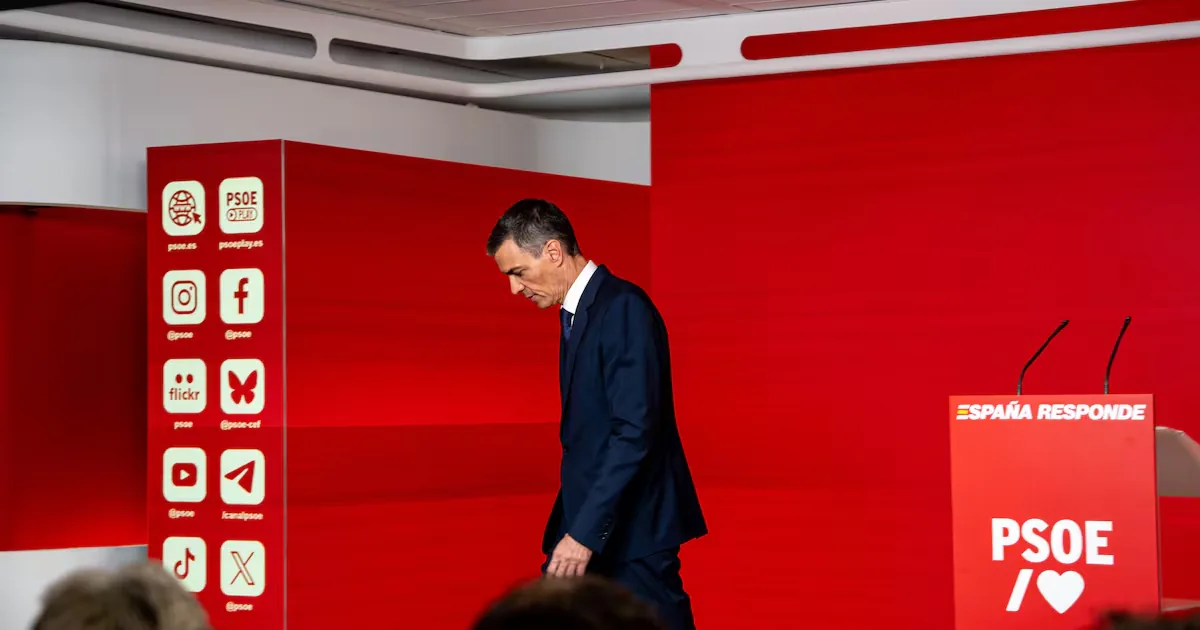
He was not a current ruler, but amid so many controversies, the Spanish Socialist Workers’ Party (PSOE) did not need another one from its figures. Former Prime Minister José Luis Rodríguez Zapatero (2004-2011) was charged this week in a case of alleged influence peddling linking him to a Venezuelan airline and dozens of companies, adding fuel to the whirlwind hitting Pedro Sánchez’s administration, with one year left in the legislature, facing calls for early elections due to this scandal and others affecting the ruling party and figures close to the socialist leader.
Read more Government projects behind the favorites for the elections in Colombia
In an interview with La Tercera, Spanish journalist and former director of the newspaper El País, Antonio Caño, discusses in detail the latest days of current events at La Moncloa and the outlook for Sánchez’s government.
First of all, what is the situation with the Zapatero case? What happened, what occurred with this alleged influence peddling?
Well, it is complicated in a few words. The case is still in an investigation phase. What there is are indications that Zapatero used his closeness and personal friendship with the prime minister and the government itself to obtain financing: a bailout for a Venezuelan airline called Plus Ultra, which actually did not meet the conditions to receive that bailout.
It was 54 million euros obtained, according to the indications of the investigation, thanks to the influence Zapatero had over the government, and his commitments with the Spanish government and, in turn, with the Venezuelan government. And from that case, the justice system is trying to prove a very close and long-standing link of Zapatero with the Venezuelan government, for which he acted as a kind of intermediary in various matters, in oil sales, in contact with the Chinese government. In short, the case file has more than 800 pages, so it is difficult to summarize.
It is very complex, a complex case, but ultimately it implies that Zapatero, if the accusations are proven, acted corruptly, received money from the Venezuelan government in exchange for favors over several years, and probably, or perhaps also, as an intermediary for Chinese state companies to establish themselves in Spain.
Did these situations under investigation occur before, after, or during Zapatero’s government?
All these activities are subsequent, years after Zapatero left office. Zapatero left the government. All these cases are from the last 10 years, but they do not affect Zapatero’s government, but Sánchez’s government. Here the conclusion being investigated is contact between Zapatero and Pedro Sánchez’s government.
How long has this been under investigation? When did the controversy explode and how did the government react?
The investigation is long, but it has been kept secret because the investigation involved the Swiss Prosecutor’s Office, the French Prosecutor’s Office, the Spanish Anti-Corruption Prosecutor’s Office, and also some information provided by the U.S. justice system. And all this has been investigated for more than a year. But it was a secret case, its existence was not known.
And this was made public last Monday, when the judge decided to summon Zapatero as an investigated person, as charged in this case.
How have the PSOE and the government in general reacted? What has Pedro Sánchez or his circle said about these revelations?
The government so far has said they believe in Zapatero’s innocence. Some members of the Socialist government have accused the judges of this being a persecution, a political witch hunt against the government. And Sánchez himself has limited himself to saying he believes in Zapatero’s innocence.
Nevertheless, even though he is being investigated as charged, he has not yet been convicted of anything.
He is now in the investigation phase. Zapatero will testify before the judge on June 17 and 18. There the judge will have to decide whether to order provisional detention of Zapatero, which cannot be ruled out. There is a good probability that this will happen: that on that day the judge orders provisional detention.
But the trial will still take time because it is very complex, very long. Many people and entities are involved, so there is still a trial and a final sentence to come.
As a result of this case, certain groups are already requesting early elections. How realistic could that be?
There is a real political storm in Spain, of enormous magnitude, because it adds to the case of a former minister being investigated for alleged corruption surrounding Pedro Sánchez and the government. This very week, Pedro Sánchez’s brother had to appear for corruption. In the coming days, the opening of trial for Pedro Sánchez’s wife will be announced.
The two main secretaries of the Socialist Party are one in prison and the other awaiting to enter prison. That is, there are multiple corruption cases surrounding the government and the PSOE. And this Zapatero case has come to fill a glass that was already full.
Therefore, of course, the calls for early elections are many. The last to call for early elections was Felipe González, but also the president of Castilla-La Mancha, Emiliano García-Page, one of the most notable socialists, called for early elections. In short, there is a massive request for the calling of early elections, but for now the current government does not seem willing to listen to those requests.
Why has Pedro Sánchez explicitly refused to do so?
He refuses to call elections because he knows he will lose them with absolute certainty. He already lost the last ones, he lost those in 2023, but there, with an agreement with the Catalan separatists—the Amnesty Law for leader Carles Puigdemont, outside Spain—he still managed to form a government, which is in minority. But at this moment, he would lose them with absolute certainty and the chances of forming a government would be practically nil.
How have the opposition parties, both the PP and Vox, responded? Have they responded separately or attacked Pedro Sánchez in this case as a bloc?
No, no, they have attacked separately. Vox wants the Popular Party to present a motion of no confidence, which means replacing the government through a vote in Parliament. But the PP does not want to do that for now and, for the moment, limits itself to calling for elections.
What about Sumar, Podemos, and the various parties to the left of PSOE with this case?
They were already in a disastrous situation. All parties to the left of PSOE are practically disappeared. They have had very poor electoral results.
Polls give Sumar and Podemos minimal representation in the next Parliament, very scarce. All of them were big supporters of Zapatero, and Zapatero was somehow the person who brought PSOE and Podemos together. He was the mediator between Pedro Sánchez and Pablo Iglesias.
So it is a very strong blow, certainly for PSOE, of course, first for PSOE, but it is also a very hard blow for that left, because that left, let’s say the far left, had always celebrated Zapatero and had Zapatero as a figure of enormous relevance, a true reference, not only political but also ethical, moral. From that point of view, Zapatero being involved in this matter is devastating, of course, for the entire left.
Personally, what do you think will happen in the short term? What can be expected?
Today itself (Wednesday), as we speak, the police have entered the headquarters of the Socialist Party requesting documents about illegal party financing, which is another corruption case that was not known until now. In short, we see daily corruption cases, the situation is really heading towards a true debacle and is politically unsustainable, unsustainable. The government does not have a majority in Parliament, budgets have not been approved throughout the legislature.
With half of what is happening, any government would have already called early elections. But Sánchez resists; he resists, among other things, because he fears that he himself may have been implicated in judicial situations, his family is, and probably his calculation is that he can manage all that better from the presidency than if he leaves power.
So, I do not know very well, it is impossible to anticipate what may happen, I can only say that the deterioration is enormous, that right now it is inconceivable to think that the government will be able to resist, but there are no legal mechanisms to remove the government other than what I have mentioned, and therefore, there is nothing left but to wait for Pedro Sánchez to decide to call elections or those corresponding by their legal term, but that will be in the summer of 2027.
It is impossible to think it can resist, but as I say, there are no legal mechanisms to remove it, so he has to decide it himself, so there is nothing that can be done.