







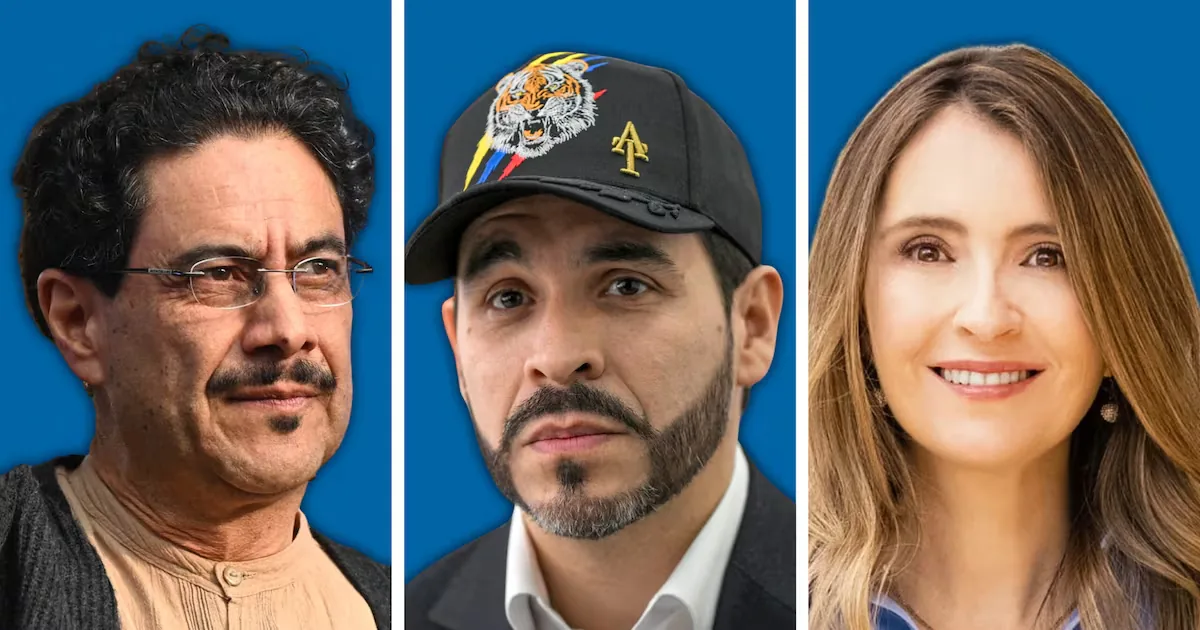
This Sunday, May 31, the first round of the presidential election process in Colombia will be held. There are 11 candidates for the Casa de Nariño. But the contest has been narrowed down to three main contenders: Iván Cepeda, Abelardo de la Espriella, and Paloma Valencia.
According to polls, the official candidate, the leftist Cepeda, leads the voting intention with an average of 38% support. Meanwhile, De la Espriella, a far-right outsider, approaches second place with around 28%. Then comes the senator representing the traditional right, Paloma Valencia, with 18%.
Thus, none would reach the required 50% to win in the first round, and therefore, they are aiming for the runoff scheduled for June 21.
Iván Cepeda Castro, from the official party Historic Pact and political protégé of President Gustavo Petro, entered politics motivated by a problem already classic in the South American country: violence. Son of union leader Manuel Cepeda Vargas, assassinated by paramilitaries in 1994, he built his career as a human rights defender before reaching the Senate.
“His profile is that of an ideologue more than an administrator: he speaks in historical terms, mobilizes collective causes, and builds his political identity from memory and ‘pending justice’,” detailed Simón Doncel, a political scientist consulted by France 24. “The question surrounding his candidacy is not whether he convinces his base, he already has that, but whether he is capable of speaking to a Colombia that still distrusts,” he continued.
The countryside, rural land concentration, and agrarian reform are the main axes of his campaign. Regarding this, Doncel said: “He talks about delivered hectares, peasantry, rural development, food production, and territorial inequality. Cepeda frames the election as a historical dispute between two models: landowning elites versus popular sectors.”
“In that context, agrarian reform appears as a symbol of the pending change in Colombia,” explained the political scientist. This last point is not minor: Colombia is the country with the highest concentration of land ownership in the entire region, according to a 2016 study by the organization Oxfam.
But the favorability Cepeda enjoys is a phenomenon rarely seen in recent Colombian politics.
“It’s almost a well-executed magic trick,” said political scientist Juan Fernando Giraldo to the French media. “Petro has managed to translate his popularity into voting intention for his candidate. I can’t think of recent local examples: not even former president (Álvaro) Uribe, with 80% approval in 2008, achieved this feat for his candidate,” he pointed out.
Abelardo de la Espriella is a lawyer of controversial cases—among them, the defense of Álex Saab, the alleged frontman of Nicolás Maduro—and a businessman who turned his surname into a brand and a candidate who today presents himself as a defender of the homeland, order, and authority.
For years he built a reputation from television cameras and social networks. Over time, that media and judicial exposure—France 24 noted—ended up shaping a public figure that mixes spectacle, patriotic discourse, and permanent political confrontation.
In this contest, his government program “Patria Milagro” is summarized in 13 proposals based on order, punishment, and market. “His discourse needs visible antagonists: ‘the regime,’ ‘the usual ones,’ ‘the caste,’ to build his ‘outsider’ identity and appeal to those he calls ‘the never’: those who have never lived off the State,” Doncel noted.
“Abelardo de la Espriella has a very particular leadership. His campaign persona takes regional references: half Bukele, half Milei,” explained Eugénie Richard, professor of political marketing and strategic communication at the Universidad Externado de Colombia. “Physically he has taken care of his appearance to resemble Bukele, also in the security discourse. And half Milei, because he has those ultraliberal aspirations of cutting the State; he calls himself ‘The Tiger,’ clearly alluding to Milei’s lion,” the academic comments.
His campaign abounds with biblical references, nationalism, and a disruptive digital aesthetic, featuring many videos generated with artificial intelligence, just like Donald Trump.
Beyond Colombian borders, De la Espriella’s emergence is another case of the regional rise of hypermediatic far-right leaderships, personalist and built from permanent confrontation, experts agree.
Paloma Valencia is heir to a family lineage linked to politics and academia. Granddaughter of former president Guillermo León Valencia on her paternal side and of the founder of Universidad de los Andes on her maternal side, she studied at the same institution—considered one of the best in Colombia—and built an image of a disciplined, prepared, and doctrinal politician.
Unlike her contenders, Valencia focuses her criticisms on Petro’s government: insecurity, health, economy, and institutional crisis. “She does not present herself as an anti-system figure, but as someone capable of correcting the State’s course,” Doncel stated.
The government program of the Uribista, “Colombia Más Grande,” revolves around a central idea: regaining state control. Her proposals combine toughening security policy, strengthening the public force, defending the free market, emphasizing the health crisis, and institutional wear.
Thus, her campaign reworked a known formula of the traditional Colombian right: capitalizing on fear of insecurity and uncertainty into promises of political authority. And, even, the Centro Democrático candidate proposed appointing former president Álvaro Uribe as Minister of Defense, resuming his security model, an option she ultimately discarded.
But in contrast to De la Espriella’s discourse, Valencia’s electoral bet points toward moderation, according to Giraldo’s analysis for France 24. That moderation, understood as a strategy to capture center votes, was reflected in the choice of her running mate, vice-presidential candidate Juan Daniel Oviedo, an openly homosexual economist who talks about diversity, inequality, and new forms of political representation.