




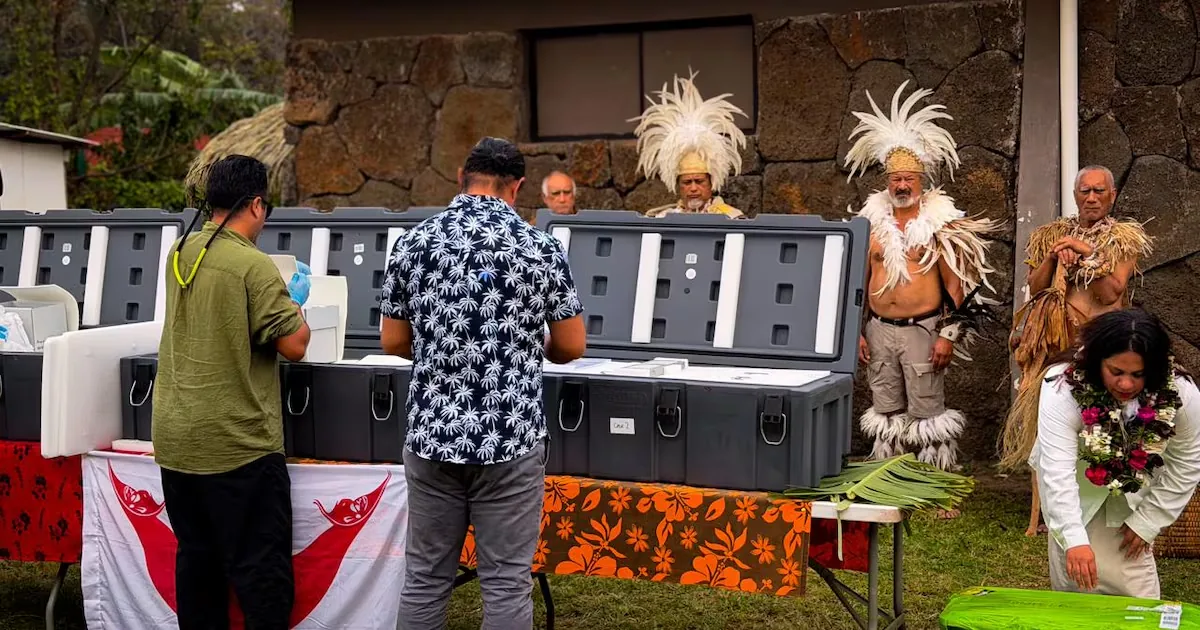
News for the historical heritage of Rapa Nui. In a ceremony at Arturo Merino Benítez International Airport, national authorities, representatives of Rapa Nui, and delegations from Australia welcomed the delegation in Chilean territory responsible for the transfer of 18 pieces of ancestral Rapa Nui remains (Ivi Tupuna), returned by the Australian Museum, who then continued their journey to Rapa Nui, according to a statement from the Ministry of Cultures.
Read more Columpios al Suelo releases «Starry Night» their new single
The event was led by the Undersecretary of Cultural Heritage, Emilio De la Cerda, representatives of the Council of Elders Te Mau Hatu o Rapa Nui, the Easter Island Development Commission (CODEIPA), the Australian Embassy in Chile, and representatives of the Australian Museum.
The bioanthropological remains correspond to 17 skulls and a sample of human hair, which had been kept at the Australian Museum since the late 19th century and whose restitution was made possible thanks to the Museum’s restitution initiative, the joint work developed between the Rapa Nui community and this Australian entity, and the subsequent coordination for the transfer with Chilean State institutions.
After the ceremony, the Ivi Tupuna were boarded on a flight to Rapa Nui, where they were received by the community in a traditional ceremony.
“We experienced a moment of deep emotion and justice for the Rapa Nui people. The return of our Ivi Tupuna allows our ancestors to return to the place they have always belonged to, strengthening our memory, our spirituality, and the bond with our future generations. We thank the commitment of the Australian Museum and all the institutions that made this restitution process possible, which represents a new step in the repair of a history marked by dispossession,” said Carlos Edmuns Paoa, president of the Rapa Nui Council of Elders, according to the text.
The Undersecretary of Cultural Heritage, Emilio De la Cerda, highlighted in the same statement that “restitution processes are only possible thanks to a collective effort. Behind every return are communities, institutions, technical teams, and authorities who, from different areas, contribute to building the necessary trust to do justice with the heritage of the peoples. These processes reflect a profound change in the way we understand heritage, based on respect, collaboration, and recognition of the rights of indigenous peoples.”
“It has been an honor for our Embassy to collaborate, together with the Chilean government, with the Rapa Nui community and the Australian Museum to facilitate the return home of valuable ancestral remains. After a long journey of 143 years, the island’s ancestors return to the place they should never have left. Australia recognizes that each community of origin is the legitimate custodian of its own cultural heritage, and we are happy to contribute to this historic repatriation,” said Andrew Martin, Australian Ambassador to Chile, in the text.
Melissa Malu, Head of Collections and Pacific and World Cultures Engagement at the Australian Museum, stated: “We are honored to accompany the return of the Ivi Tupuna to Rapa Nui. As a museum, we recognize the deep significance of this restitution, reiterate our apologies for the past, and hope that this act strengthens a relationship based on respect, collaboration, and trust with the Rapa Nui community.”
The restitution is part of efforts led by the Rapa Nui community to recover ancestral remains that were taken from the island during the 19th and 20th centuries and that today remain in collections of various museums and institutions around the world.
“This process, led by the Australian Museum, was coordinated by CODEIPA and supported by the Ministry of Cultures, Arts and Heritage, the National Cultural Heritage Service, the National Customs Service, the General Directorate of Civil Aeronautics, and specialized companies responsible for international transport in Australia and Chile,” the statement emphasizes.
The Ivi Tupuna were received in Rapa Nui on Friday, July 17, where the protocols defined by the Rapa Nui community for their safeguarding at the P. Sebastián Englert Anthropological Museum (Rapa Nui Museum) and subsequent treatment according to their traditions and community decisions will continue.