








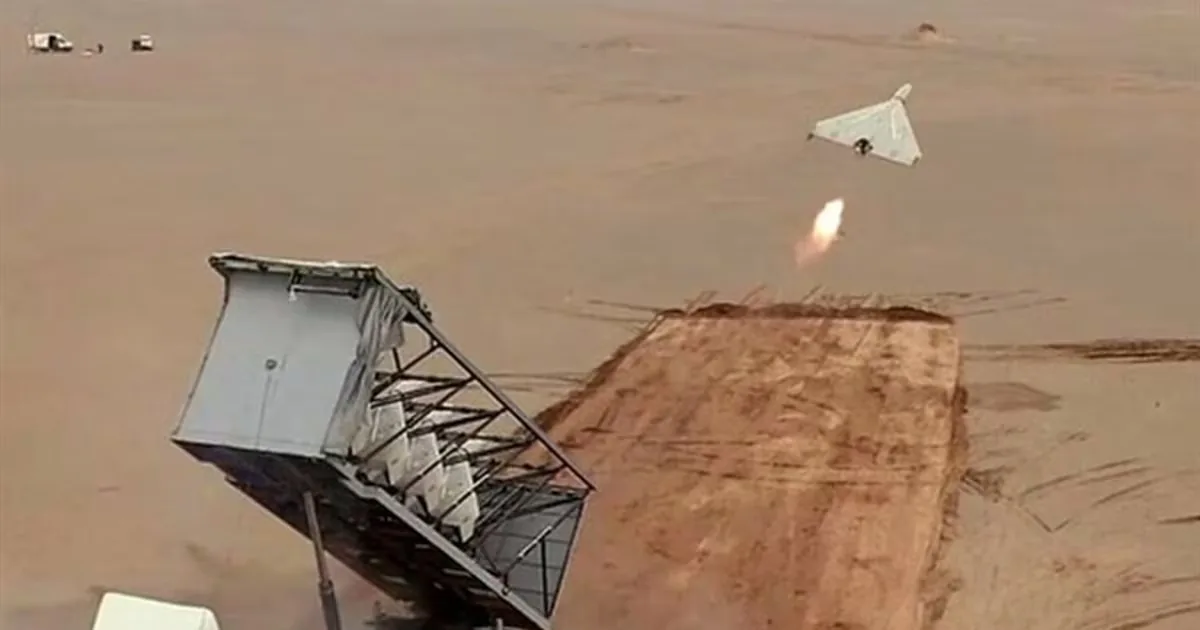
Autonomous weapons that appeared in science fiction movies are now a reality and are being used in Russia’s war in Ukraine. The most concrete example occurred last July 6 in an attack by Kremlin forces against the city of Zaporizhzhia, in southeastern Ukraine, which left three people dead.
Read more China and the new milestone in the race for AI dominance
The attack, revealed by The New York Times, was carried out by a drone guided by an experimental artificial intelligence system and not by a human pilot. “This poses a risk to the entire world,” Colonel Serhiy Minaiev, commander of Zaporizhzhia’s air defenses, told the newspaper. “In a few years, we will live in a ‘Terminator’ movie. This is no joke. Machines are making decisions to attack,” he added.
The development of this technology has raised questions about the humanitarian and ethical dimension. In this regard, the head of the United Nations and the director of the Red Cross warned this week that autonomous weapons capable of killing people without human intervention could soon be used in conflicts and called for urgent negotiations to restrict their use.
“We are dangerously close to crossing a moral red line: the autonomous attack of machines against human beings,” declared UN Secretary-General António Guterres in a joint statement with the president of the International Committee of the Red Cross, Mirjana Spoljaric.
“Negotiations must begin now to urgently adopt a legally binding instrument regulating autonomous weapon systems with clear prohibitions and restrictions,” they stated.
Next week, states will meet in Geneva to discuss possible new rules amid growing concern about the role of semi-autonomous weapons assisted by artificial intelligence that have been used in conflicts in Ukraine, Sudan, Gaza, Iran, and the Persian Gulf.
The rapid advancement of artificial intelligence (AI) has revolutionized military technology, fostering the development of Lethal Autonomous Weapon Systems (LAWS), or “killer robots,” as they are also known. These are a special class of weapon systems that use sets of sensors and computer algorithms to independently identify a target and employ an integrated weapon system to attack and destroy it without manual human control.
Although these systems are not yet in a widespread development phase, they are believed to enable military operations in environments with degraded or denied communications, where traditional systems might not be able to operate.
This integration of AI into military systems not only enhances the effectiveness of combat operations but also transforms the OODA military strategy (Observe, Orient, Decide, and Act), where it can be used in all military decision-making processes, including intelligence, surveillance, and reconnaissance (ISR).
This implies a shift from traditional computer support (such as ballistic calculations) to AI involvement and autonomous decision-making and operation in all phases of military action, noted South Korean expert Euysun Hwang in an essay published by Stanford University.
<p“Very soon, autonomous systems will stop operating individually; over time, they will form units the size of platoons or even battalions that will share information and coordinate without human intervention. And whoever waits for human approval before acting will lose,” wrote former CIA chief David Petraeus and Ukrainian expert Isaac Flanagan in an article for Foreign Affairs magazine.
In this context, major technological powers such as the United States, China, and Russia have already accelerated the development of military AI technologies in preparation for future warfare and have incorporated them into their defense strategies. For example, in 2018, the United States published the Department of Defense AI Strategy, which highlighted the role of artificial intelligence in the military field. Similarly, China and Russia have declared the adoption of AI technologies in all sectors of defense and national security.
One place where it has been tested is Ukraine, which has had to use them for its survival. The think tank Center for Strategic and International Studies (CSIS) noted in a report last June that a typical Ukrainian or Russian attack mission requires one pilot per drone in the set, an operator who monitors sensors and electronic warfare transmissions, an engineer who prepares the payload, and a commander who gives the attack order: between three and six people for a single first-person view drone that hits a target. Software is the only solution.
Ukraine has around 400 types of drones and uses hundreds of thousands each month. Without a common layer to integrate them, the system would be unmanageable. That layer is the Ukrainian battlefield management software known as Delta.
Even Russian military theorists have repeatedly recognized the advantages of this software, specifically pointing to Delta as a clear Ukrainian advantage. Moscow has urgently begun developing its own equivalent in a system called Svod, along with the Glaz/Groza complex, for civilian use, which is now integrated into Russian drone units.
There are two aspects worth highlighting in how both sides reached this situation. CSIS indicated that both systems were built from the ground up, based on the needs of ground units rather than a hierarchical command and control vision. Both systems first integrated modern sensors and platforms, and only later began to use legacy systems.
In 80% of attack missions, the software that coordinates unmanned systems and integrates everything is not a support capability but the combat system itself. Whoever has the best integration wins more engagements, and faster, the think tank stated.
“Ukraine and Russia have already demonstrated that the way forward is software designed for the unmanned future, not adapted from the manned past. The United States has the talent, industry, and capital needed to develop that layer on a large scale. What it has lacked is the structure of effort: a clear decision to bet on autonomy as the future of war, a single institution with the mandate to tactically orchestrate the operation within less than a decade, and a definition of a lethal autonomous weapon system that encompasses the software where the decision to attack is made, rather than just the ammunition that executes it,” it added.
In this regard, there are questions about whether the United States is prepared for these challenges. “The United States still has the most powerful Army in the world, but it is not yet prepared for a new war era defined by these realities. It needs to produce more drones and low-cost interceptors and better adapt to the demands of competition in artificial intelligence. Just as the Army cannot accumulate air power without building aircraft nor dominate the seas without ships, it cannot win in the AI era without leveraging data, acquiring computing capacity, and learning to better use AI models. To maintain the advantage on the battlefield, the U.S. Army must find a way to efficiently assimilate these new technologies,” wrote Paul Scharre, executive vice president of the Center for a New American Security, in Foreign Affairs magazine.
“This will require overcoming cultural and bureaucratic barriers within the Armed Forces, forging closer relationships with the private sector, and finding new ways to assess military power. But if the U.S. Army does not adapt in this way, it will find itself increasingly matched on the battlefield. After decades of dominance ensured by its technological advantage, the United States will be weakened by having dangerously let its leadership slip away,” he concluded.