







Christopher Nolan dreamed for 20 years of the image of the Trojan Horse entering Sparta and of Agamemnon’s men sneaking out at night to attack the city from its heart. He imagined it during the time he was briefly involved as director of Troy (2004), but it is not until this 2026 that this image finally materializes on the big screen. And what a way.
Read more Bayeux Tapestry at the British Museum: the historic “movie-like” transfer of the European jewel
In one of the most ambitious projects of his successful career, the filmmaker adapts the Odyssey, perhaps the most epic tale of universal literature. Flanked by his usual group of collaborators, the creator of Memento (2000) and Oppenheimer (2023) interprets Homer’s story in his own language, that is, through temporal plays, a monumental scale, omnipresent original music, and a top-tier cast.
At Culto we were already able to see The Odyssey and here –note, with some spoilers– we break down the main keys of the film that premieres this Thursday the 16th in Chilean cinemas.
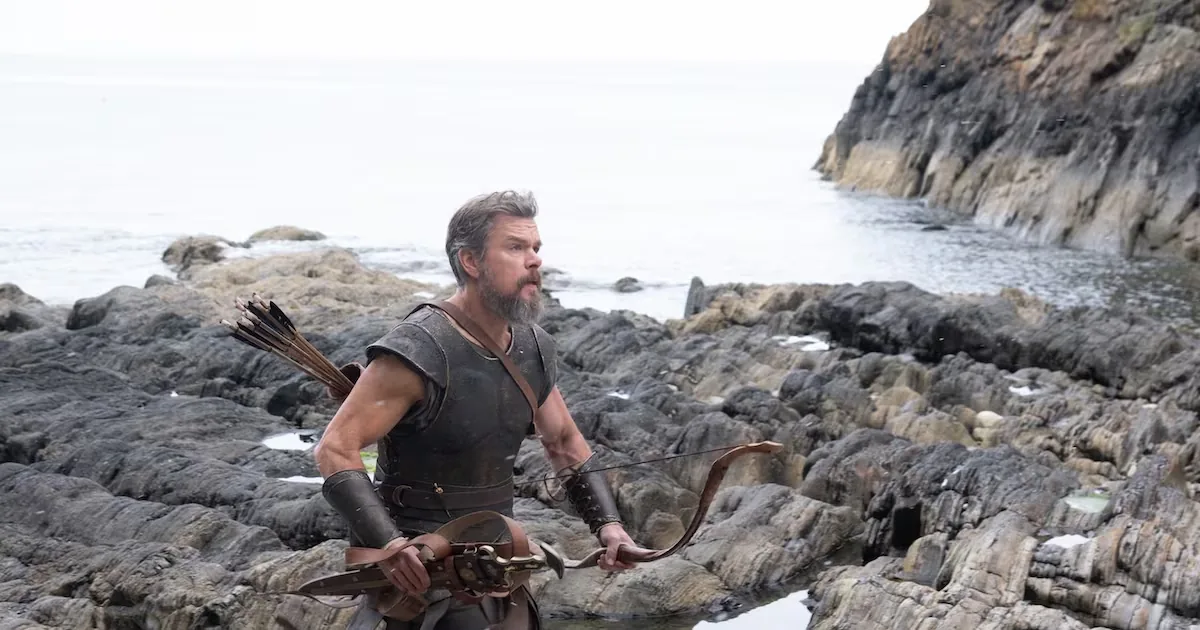
The bulk of the film is narrated from Odysseus’ (Matt Damon) confinement on the island of Calypso (Charlize Theron), eight years after the end of the war and almost 20 since he left his land. As he tries to remember his past –and suffers because of it–, the film presents the harsh experiences he went through with his men while battling to return home. In that raw narrative, parallels with other protagonists of the director’s cinema are inevitable, tortured men who desperately struggle to find answers.
With cunning, the director gives a more secondary place to everything that happens in Ithaca. Penelope’s (Anne Hathaway) suitors accumulate and wait for the queen to finally choose one of them to remarry. Desperate for a solution, Telemachus (Tom Holland), who was a baby when his father left for war, goes to meet Menelaus (Jon Bernthal).
With permission from heavyweights like James Cameron, Steven Spielberg, and Ridley Scott, there is no other man in Hollywood with the craft and poise when it comes to mounting great blockbusters of this caliber. Every aspect of The Odyssey seems designed to make the cinema hall rumble and weave an unforgettable experience (it is the first fiction feature filmed with Imax cameras).
Perhaps the most striking thing is the care he puts into the most intimate moments and the way he develops his interpretation of Homer’s classic, in full dialogue with the anti-war stance of Oppenheimer (2023). He seems to have perfected his formula of spectacle and introspection.
One of the big questions of the film was how the director of Interstellar (2014) would represent the more fantastical elements of the story. The answer that The Odyssey gives is that practically all those ingredients are there, from the cyclops to the sorceress Circe (Samantha Morton) and the Laestrygonians (cannibal giants).
Perhaps the greatest freedom is taken regarding the gods. While their influence on the misfortunes of Odysseus and his men is undeniable –their actions unleash their wrath–, Nolan opts for a more “earthly” approach, avoiding explicitly showing Olympus or the deities (except for Zendaya’s Athena).
The filmmaker has joked about the idea that other stars like Leonardo DiCaprio, Christian Bale, and Tom Hardy declined to bring Odysseus to life in his adaptation. Jokes aside, the actor holds up as the main axis of an epic-tinged story. That is, as a warrior in battle, as a leader of a group of soldiers, and particularly as a man drowned in the actions of a past he does not want (or cannot) remember.
Damon has stated that this seems to be the last Hollywood film of its kind. If so (although Nolan disagrees), he is the luckiest actor in the world.
Anne Hathaway takes advantage of every second she has on screen. She moves between Penelope’s vulnerability and ferocity, stealing every scene she has with her male co-stars. While Robert Pattinson has fun as the queen’s main suitor, Samantha Morton makes the segment dedicated to Circe unforgettable.
Although other actors have had more presence during the promotion of the feature film, there are a couple who occupy a more prominent space than one might have imagined. On one hand, John Leguizamo, who plays Eumaeus, a faithful servant to Penelope and old friend of Odysseus. On the other, Himesh Patel, responsible for portraying Eurylocus, one of the shipmates and second in command. Although he does not have as many minutes on screen as them, Elliot Page’s role holds great symbolism in the ambitious fabric proposed by Nolan.
The Independent hailed the feature as the best work of Christopher Nolan’s career. “His version of The Odyssey, one of the oldest stories preserved, is unusually intimate. What he extracts from this 3,000-year-old epic condenses his most recognizable obsessions –often, men’s desires to control time and fate– into the purest feeling of hope against despair (…) It is, moreover, Nolan’s best work to date. It deserves to be the film that defines him,” it opined.
The Wrap agreed with that assessment, stating that “it is not an epic action movie about swords and sandals, but a melancholic horror story of a magnitude never before seen in Hollywood. Oppenheimer may be the film that defines Nolan, but The Odyssey is his masterpiece.”
“What begins as a quest to reclaim Ithaca from the ashes gradually transforms into a journey to recognize why the world burns: not because men defy the gods, but because they betray each other,” IndieWire said, calling it “a raw, rich, and breathtakingly thunderous adaptation.”
For its part, The New Yorker magazine missed a greater presence of the gods. “The story remains an exciting adventure full of passion, terror, tenderness, and wonder, but lacks the particular emotion involved in reading Homer,” it noted, stating that “probably viewers who have not read Homer are more likely to enjoy The Odyssey.”
That said, it acknowledged: “The actor whose performance is most closely tied to Nolan’s conception of the character is Matt Damon (…) It is a role that demands a performance that is both muscular and eloquent, powerful and volatile, but Damon follows Nolan’s premise by making Odysseus appear impassive and overwhelmed.”
Read more Why the movie Behemoth! is the biggest challenge of Pedro Pascal’s career