





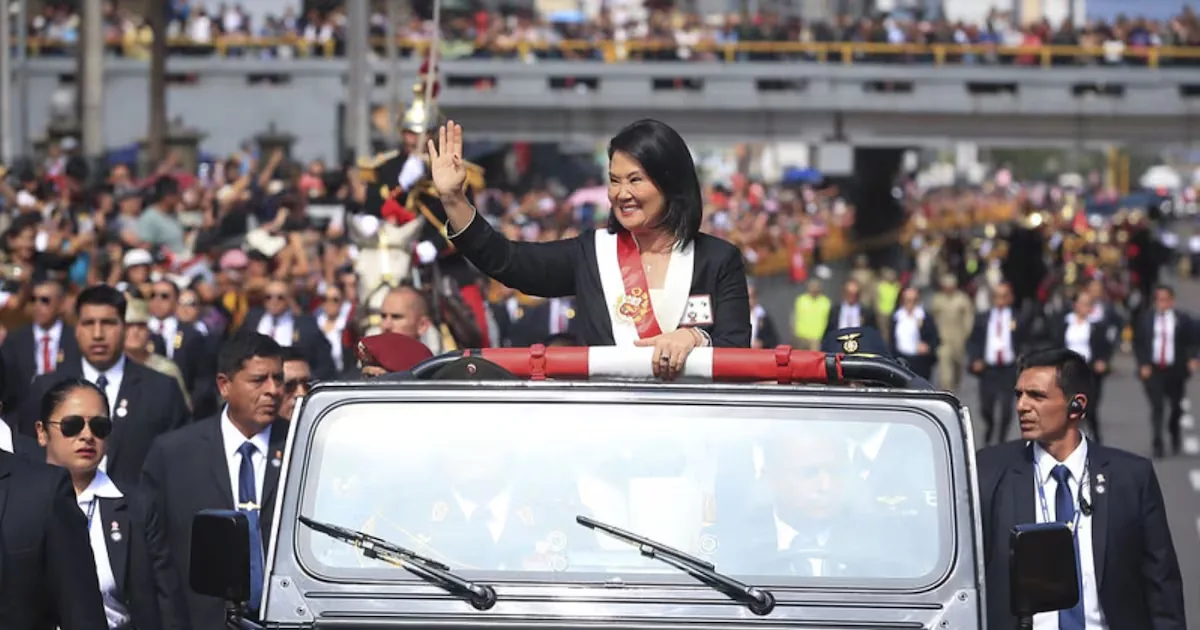
After trying several times, Keiko Fujimori achieves her goal and becomes the new president of Peru. Her oath as president is much more than that. It also implies the return of Fujimorism to power.
Read more While France burns from wildfires, Le Pen’s party sees an opportunity to gain political advantage
The period of Alberto Fujimori at the helm of the country’s destiny divides the Andean nation and his legacy is marked by the conviction he received as responsible for human rights violations.
Keiko Fujimori’s narrow victory in the second round over candidate Roberto Sánchez and her recent inauguration bring with it a series of questions about the breaks and continuities with her father’s legacy.
The first concepts and initial expressions of the president serve as a basis for analyzing the perspective of the new stage of Fujimorism in power.
During her first speech as head of state, she announced a 15% increase in the minimum wage and a one-time compensatory bonus to encourage micro and small businesses to formalize employees with this compensation.
At the same time, she said she would double the pension program for elderly people with fewer resources and promised to halve child poverty. She also released “extraordinary resources” to face the arrival of the El Niño phenomenon and its torrential rains and floods for Peru and Ecuador.
In an interview with France 24 in Spanish, political scientist Gonzalo Banda Lazarte considers that these measures are framed within a tradition of the new president’s political space. “In general, Fujimorism has always been a populism that despised traditional politics. A political pragmatism that delivered campaign promises.”
Banda Lazarte considers that much of the conceptual development contained in the inauguration speech is based on promises of public spending that he qualifies as “messages to her political client.”
For her part, Kathy Zegarra, analyst and member of the Network of Political Scientists of Peru, agrees with this view but observes a more institutionalized profile of Keiko compared to her father. According to the political scientist, the former president “created a new political party for each election,” while his daughter builds a solid and disciplined party structure that responds to her and gives her the possibility of having a firmer governance base than her predecessors.
She argues that Fujimorism is a bet on maintaining the existing political and economic “establishment” and that, in any case, “it is a doubling down of the machinery that has dominated traditional politics in Peru in recent years to better guard its turf, to better secure the economic and political boundaries that protect it.”
Regarding her speech, she describes it as “very unambitious” and “without a deep political idea.” Furthermore, she concludes that “it has not had a refounding character.” She bases this on the president’s journey to reach this position: “One would think that a politician who has lost so many second rounds and struggled so much to come to power would have a somewhat more ideological, much more inspiring speech that tried to paint the image of a country she wants to leave behind, and instead, the speech was quite brief, neatly done, and very simple. It ended in 45 or 50 minutes, depending on how you read it, 14 pages.”
The new president of Peru, Keiko Fujimori, announced that the Armed Forces will “temporarily” take over security operations and internal order control in areas of the country declared in a state of emergency to face organized crime and delinquency.
“During states of emergency, the Armed Forces will temporarily assume leadership of security operations and internal order control, in close coordination with the National Police,” she said during her first message to Congress. She then added that the military must work with the National Police “until security is fully restored” in the country.
Read more Cristina Fernández denounces her case before the UN Human Rights Committee
Banda Lazarte considers this a way to respond to her campaign promise to end organized crime through a “hard hand.”
Zegarra recalls that these statements come when Congress approved a package of legislative reforms that protect the Police and military forces against the use of violence when repressing or conducting operations. This implies the creation of an exclusive jurisdiction for the personnel, who will be judged by military or police courts, instead of civilian ones, as before.
Both agree that the idea of initially restoring order against delinquency is an impossible promise to fulfill.
“It is not just a matter of you taking charge of the Executive, decreeing states of emergency, sending the military forces to fight, and that will solve it. In fact, many presidents have already done this in Peru; it is a well-worn thing. I think there is not much novelty in that sense. The only novelty might be that, perhaps, the operations will be much more violent,” warns the political scientist.
For Zegarra, Fujimori has an opportunity to further reduce an anti-Fujimorism that is a very strong political current in the country but has shown a decline in recent elections. The brake on Keiko in several consecutive elections was not enough to prevent her victory in the last second round. Now, it is essential to observe her moves toward the sectors that reject her.
Banda Lazarte points to the idea of “national reconciliation” and that “there is only one Peru,” outlined by Fujimori, but considers it contradictory because “if your government is going to be a government of reconciliation, it implies acceptance that it is a divided country.”
The focus is on the policy that will be given to the sectors that protested against the government of the also conservative Dina Boluarte: “I think if there is something to reconcile in Peru, it is the politics that sometimes happens in Lima with the politics that has happened in the regions where there were protests in 2022 and 2023. There has been no announcement about that,” highlights the political scientist.
The political scientists consulted by France 24 in Spanish highlight the significance of the return of Fujimorism to power for the victims of human rights violations during Alberto Fujimori’s regime. “I am afraid that there will be an attempt to rewrite history,” says Zegarra.
Banda Lazarte considers that Keiko tries to show that “she has already turned the page.” The analyses agree that if at some point there was certain revisionism on the part of the current president, that no longer exists. The specialist recalls that attacks against the memory commission are even observed and reads that attitude as an attempt to re-signify the actions of Alberto Fujimori and the Armed Forces during their years of government.
“It seems to me that it is a reconstruction of historical memory. The victims of Fujimorism will surely be forgotten, and it is very painful,” he highlights.
The expert concludes with a reflection on the moment of the presidential inauguration: “When you see her walking through the center of the hemicycle without yet having the presidential sash and at one point you start thinking: ‘Hey, she is going to be president.’ It is something surreal because it is a scene that chills your skin a bit. And when she puts on the presidential sash, it is a very traumatic moment for many Peruvians, but I can’t imagine for the victims of the dictatorship. It must have been very difficult to discern.”