
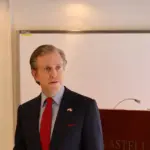




If there is a restless name in the world of Chilean books, it is Galo Ghigliotto (49). From Valdivia, he is a writer who has ventured into poetry and narrative, but he is also a translator (he translated into Spanish The Other Daughter, by Annie Ernaux published by Los Libros de la Mujer Rota); an editor in charge of two independent publishing houses, the historic Cuneta and the new Puya Editora; and as if that were not enough, he is one of the founders of Furia del Libro, the event that has been running for 17 years, which with two editions per year has become an important hub for the Chilean book world.
Read more Macron announces shipment of new interceptor missiles to Ukraine after Russian offensive
But let’s take it step by step. What concerns us is the new book that Galo Ghigliotto has just published, precisely with Puya Editora. As an author, Ghigliotto is a recognized name in national letters: he obtained the Literary Creation Grant from the National Book and Reading Council (2011), won the Municipal Gabriela Mistral Literary Games Award 2016 for Killing the Mandinga, won the MOL Award (Best Literary Work), from the Ministry of Cultures in the category “Published Novel” for his acclaimed The Museum of the Mist (2020). Today, he returns with a volume of stories that has the poetic and suggestive title His Corpse Advances Toward the Sea.
These are stories that cover themes such as love and death, with a well-refined pen, a solid structure, and touches of humor. “These stories come from very diverse sources and are part of a body of stories that I have been assembling for a long time – he tells Culto -. I think the oldest included in this selection is from 2009 or 2010. Since then I have always been writing stories and, for years, I gathered them into two different projects, The New Mythology and The Sinister, but I never decided to publish either. When I finally thought it might be time to publish one, I asked my colleague Katherine Hoch, an editor, to read both projects and tell me which she found more interesting. Her answer was that, actually, there was a better book if we made a selection that mixed stories from both. That’s how His Corpse Advances Toward the Sea was born.”
Death is an idea that surrounds several of the stories. Why does it appear so much?
Because death is in everything. If there is an experience that every living being inevitably has to go through, it is death. In that sense, it is as absolute as life itself. I don’t necessarily feel that I made a conscious decision to write stories about death. It just seems difficult to write about the human experience without death appearing in some way.
What interests you about the idea that the dead “keep advancing”?
Perhaps I am interested in recognizing that the dead never really finish leaving. They remain as long as someone remembers them. The only way for them to disappear completely would be if those who remember them also died and were forgotten, but even then someone can remember these last ones and, with them, indirectly, something of those who were before. There is a kind of chain of memory and forgetting that continues moving through time. That’s why I like the idea that the dead keep advancing. Ultimately, for me, true death, definitive death, is nothing other than oblivion.
There are quite dark situations in the stories, but also humor. Is it natural for you to mix both?
Yes, it feels very natural to me. The mockery that humor allows helps me point out the absurd and, in a way, illuminate the darkness with a mocking light. That light allows what was hidden to suddenly be seen as it is and often we discover that, besides being terrible, it can be miserable or pathetic. I don’t think of humor as a way to take gravity away from things. Sometimes the opposite happens: humor allows looking at something terrible from an angle where its absurdity becomes even more evident.
What place does black humor occupy in your writing?
It occupies an important place. It was already present in Every Now and Then the End of the World, from 2013; also in Killing the Mandinga, from 2016, and especially in The Museum of the Mist, from 2019. In His Corpse Advances Toward the Sea it appears again. Although I wouldn’t say black humor necessarily has a predominant place in what I write, I do believe that, over time, it has become a recognizable characteristic of my writing, especially as a tool that allows me to approach uncomfortable, violent, or painful experiences without treating them exclusively from solemnity.
Love also appears a lot, although often in a quite complicated way. What interests you about love as a literary theme?
I think love is a concept that today is especially questioned. We have inherited a very strong notion of romantic love: the idea of soulmates, predestination, even spirits destined to meet again and again. These are fictions and, like all fictions, they can serve very different functions. They can be an ornament that two people build together, a shared fiction that helps them stay together and give meaning to a relationship. But they can also function unilaterally, as camouflage for seduction or even for persuasion and manipulation. That’s why I think there is still a lot to say about love. And I don’t mean only erotic love. There is brotherly love, love for children, for friends, and also love for oneself. Loving involves responsibility. Self-love, for example, should translate into self-respect, and that self-respect will inevitably change the way one relates to others. Also, the loving experience often leads us to other experiences that end up completely changing our life, our place in the world, and therefore also our effect on the world. In fact, I think love should be a subject of study in schools and universities. We are taught many things, but very little about how to establish bonds, what responsibilities loving someone implies, how to distinguish love from possession or dependence, how to respect the other and how to respect oneself. If it is an experience that so decisively crosses our lives, it is strange that we are practically not taught to think about it.
You have published stories but also novels and poetry. What differences do you see between writing one or the other?
There are several differences and some are less obvious than they seem. Time, for example, does not seem to me an essential difference. One might think that writing a poem necessarily takes less time than writing a novel, but that is not so. Joaquín Giannuzzi kept correcting his poems even after they were published. There are testimonies that, already older, before a reading he still made corrections to the texts he was about to read. The stories in His Corpse Advances Toward the Sea were also written over many years and, for that reason, had many readings and many subsequent revisions. That later work, that “eye for detail,” as Mario Bellatin calls it, is also part of writing. If I had to establish a difference thinking only about that first moment, the impulse that gives rise to the text, I would explain it with an image. Writing poetry is like taking a brief dip in a stream. Writing a novel can be like trying to swim from the beach to a nearby island. And writing a story I see more like walking across the rocks to get from one beach to another.
How do you see storybooks in Chilean literature? What attracts you to the format?
I think Chilean short stories are tremendously heterogeneous. I think, for example, of Mauricio Wacquez’s stories, which seem to me like jewelry work; of José Miguel Varas, with some extraordinarily powerful stories; of Francisco Coloane and that Chilote coldness that is even in his way of observing. And from there one can make a huge leap to Alejandra Costamagna, whose stories can have tremendous hilarity and precision. That same heterogeneity makes me think that, if we can talk about a Chilean narrative tradition, perhaps it has been more novelistic than short story-based. I don’t see so clearly a current or a flow that drags and organizes the production of stories. I see rather very different authors doing very different things. Among the more recent authors I think, for example, of Malu Furche or Juana Inés Casas. And what attracts me to the format? Above all, the multiplicity. A good book of stories allows radically changing voice, tone, procedure, or world. That freedom interests me a lot.
Read more Judge overturns immigrant visa ban imposed by Trump administration on 75 countries
You are also an editor, how do your two professions dialogue — or clash — when you work on your own book?
Recently, thinking precisely about this, I came to the idea that before being a writer or editor one is a reader. And that reader then splits. On one side is the creative reader: the one who while reading feels the impulse to get up and write something that the reading just provoked. On the other is the picky reader, the one who while reading wants to change a word, move something, correct a phrase, intervene. I think the editor is born from that picky reader. Editing my own texts is especially difficult because there comes a point when I stop seeing what is there. The reading becomes blind. Maybe, if I were alone on an island and had no alternative, I could do it, but I much prefer that there is another person reading and that we can establish a dialogue. When I work on my own book I feel those two readers appear again: the creative and the picky. They argue among themselves and try to reach some agreement, but by then both are at the service of a third reader, who is the one who will finally receive the book. It’s almost like holding a book that one is about to return to a library so someone else can read it.
Has being an editor changed your way of writing?
Yes, definitely. But perhaps not so much because of the exercise of editing others as because of the huge amount of manuscripts one ends up reading. Something curious happens. Many writers who are starting — and it happened to me a long time ago — worry a lot about protecting a manuscript before showing it because they fear someone might steal an idea or a story. That caution is not unnecessary, of course, but it strikes me that often it appears before another that seems fundamental to me: making sure that what one is going to show has a quality consistent with the ambitions one has for that book. As an editor you read many manuscripts with problems and end up recognizing defects, clichés, or mechanisms that don’t work. And all that inevitably gets incorporated into your own writing by antagonism: you start to keep very present what you don’t want to do. That’s why I think, curiously, the books that most help develop one’s own taste are often the books we don’t like, even those we consider bad — with all the subjectivity that word contains. Those books draw very precisely the limits of the territory one does not want to enter. Then come the books we do like and, in some way, fill the space that rejection had delimited.
You are behind two publishers, Cuneta and now Puya Editora. How has the experience of having an independent publisher been?
I can answer you the same as I told students who enrolled in the USACH Editing Diploma for years: it’s not what it seems.
What do you like and dislike about the editing profession?
What I like most is the possibility of communicating and sharing with authors I admire. I have been lucky to publish, in different editorial projects, writers whose work interests me a lot and to be able to talk with them about their methods, preferences, readings, the decisions they make when they write. That is extraordinarily enriching. Sometimes I find myself recounting fragments of conversations I had with some writer as if they were things I had read somewhere, because they ended up being incorporated into my own way of thinking about literature. What I like least is not exactly about editing, but about what happens afterward. One can put a lot of work and passion into a book and, once it is published, throw it into a kind of abyss. Many times we don’t know what happened to it, if it was read, if it produced something, if someone on the other side even received it. That absence of correlation between the work invested and the reception can be quite frustrating.
You are also one of the founders of Furia del Libro, which today has not only the summer edition, but also the winter one and Furia Ilustrada. How have you seen Furia’s growth?
I have seen it as quite an organic growth. I think of Furia as a kind of expansive hall: as more publishers arrive, the space expands to contain them. The advantage we have had is that the structure has been elastic enough to grow and, at the same time, solid enough not to fall apart with that growth. I think that explains much of what has happened and it is also precisely what must be cared for.
Do you notice a greater interest from readers in independent publishers that has allowed Furia’s growth?
Yes, but I also think that interest has been built. Independent publishers have learned to communicate better and to reach their audiences more actively. Today a book competes for a limited amount of attention and leisure time. It is not enough to publish and wait for the reader to find the book: that encounter must be built. I think many independent publishers have understood this better and better and Furia has also contributed to that process. Also, Furia has been expanding its audience to reach people who don’t even necessarily know what differentiates an independent publisher from another kind of publisher. That seems to me a good sign: it means the space stopped speaking only inwardly.
What has been the most complex thing about Furia in these years?
Keeping its founder sufficiently enthusiastic so he doesn’t throw in the towel. I say it half jokingly, but only half. Probably one of the most exhausting things has been learning to live with criticism. And I’m not talking about criticisms that point to concrete problems or propose improvements; those are necessary and have often helped us. I’m talking about another kind of criticism, minority but very noisy, that seems to seek more the affirmation of moral superiority over the other than the concrete transformation of something. I think sometimes there is a certain lack of sense of reality there. Making culture in Chile is difficult. Making projects related to books is even more so. There are economic, institutional, and material restrictions, teams to support, and an enormous amount of work that remains invisible. That’s why I find it hard to understand certain demands formulated from a kind of abstract purity, as if organizing a cultural project consisted only of having the right positions and not in making it exist materially.
How so?
Recently, following a discussion, someone suggested that Furia should no longer be called independent. And that made me a very concrete question: if an independent publisher claims that a space that exclusively brings together independent publishers no longer deserves to be called independent, what exactly is it proposing? That it stops being a space for independents? When one tries to take certain discourses to their practical consequences, sometimes one discovers that there was not really a proposal behind, but rather the projection of one’s own frustration. Those discussions wear you out because they make a lot of noise, even if they represent very few people. And maybe that is one of the hardest lessons of these years: to distinguish between criticism that forces you to think and criticism that simply forces you to waste energy.
How do you see the Chilean book world currently?
Very lively, very rich, and above all, very alive. The criticisms I mentioned earlier are a minority. What I mostly see is people making books, starting publishers, writing, translating, designing, illustrating, and creating new spaces. I also think there is a growing understanding that an editorial project can have a cultural vocation and, at the same time, need a commercial dimension that allows sustaining it. That constant activity is precisely what keeps the Chilean book world alive.