








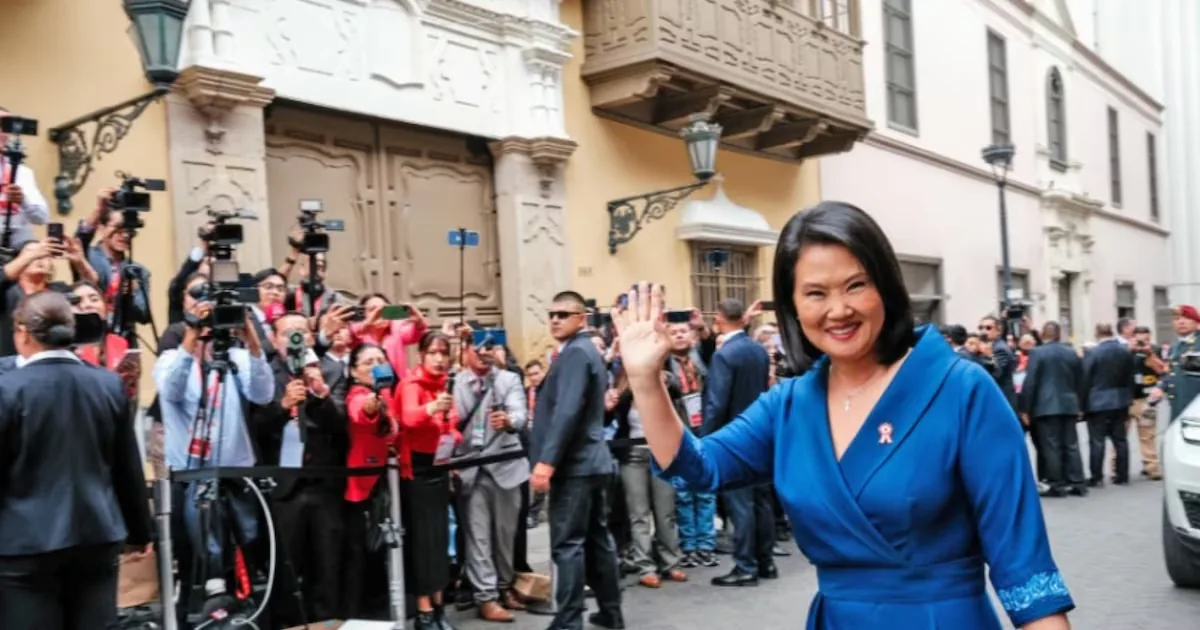
“I want to speak to those who did not vote for me. I promise that we will put the State at the service of the population to end the inequality and confrontation that suffocates us as a society,” promised Keiko Fujimori last July 15, just over a month after the presidential runoff where she finally defeated the leftist candidate Roberto Sánchez, after losing three elections in 2011, 2016, and 2021.
Thus, the daughter of former president Alberto Fujimori (1990-2000) – who passed away in 2024 and was imprisoned for 16 years for corruption and murder – returns more than a quarter of a century later to the presidential palace where she lived and was first lady after her parents’ divorce in 1994.
But Keiko Fujimori’s narrow victory in the runoff does not close the country’s political crisis; rather, it barely opens a new phase, marked by fragile legitimacy, persistent polarization, and an uncertain governance scenario, analysts highlight. The leader of Fuerza Popular assumes the presidency of Peru this Tuesday for the next five years with a tough mission: to bring stability to a country that has had eight presidents since 2016.
Due to the constitutional redesign that returns to a bicameral system after 34 years and the votes her party secured in Congress, Fujimori will not assume office under an immediate threat of vacancy, as happened with Pedro Pablo Kuczynski in 2016 and Pedro Castillo in 2021, which gives her at least some room to maneuver but maintains the challenges typical of a Latin American country for governance, CNN notes.
According to the Lima newspaper La República, the start of Keiko Fujimori’s government seems marked “between total control of power and the shadow of authoritarianism.” “She comes to power under a series of questions about respect for democratic institutions, the risk of hegemony from the new Senate, and the memory of the 1990s regime, fueled by her own statements during her campaign in which she said she sought to be president to ‘govern as her father did,’ as well as proposing Peru’s exit from the Pact of San José and the reinstatement of ‘judges without faces,’” the newspaper points out.
“Keiko Fujimori begins her regime denouncing that the last governments are handing over the country in a ‘catastrophic’ way and even states that the current outlook is ‘desolate’ and ‘very sad.’ However, specialists recall that Fujimorism, from Parliament, dedicated itself to shaping the country it now criticizes,” it adds.
One of Fujimori’s first challenges, a 51-year-old administrator, will be to ensure governance, as she does not have a majority in the Legislature. “The Congress of the Republic is the true center of power and has removed four heads of state in the last decade,” says Glaeldys González Calanche, analyst for the International Crisis Group for the southern Andes, cited by the Mexican newspaper Expansión.
Luis Benavente, Peruvian political analyst and executive director of Vox Populi Consultoría, explains this challenge to La Tercera. “I believe that in Congress she will find a very, very fierce opposition, quite tough. It is a Congress constituted with very strong ideological polarization. In senators it is 50%-50% and in deputies it is 55% left, 45% right. So, at this moment she has the presidency of the Senate in a controversial way due to a spoiled or null vote from an opposition senator. And she has the Chamber of Deputies, which is controlled by the left, in an adverse way. So, I think there are quite radical congresspeople who will be a very strong opposition. That is a challenge for Keiko.”
“I don’t think we will repeat the history of having four presidents per term instead of one. There are no votes for impeachment. There are no votes to change the Constitution, because two-thirds of the votes are needed in both chambers, in the Senate and in Congress,” said Alfredo Thorne, former Finance Minister of Peru, in an interview for the podcast Latin America in Focus.
However, González Calanche points out that although political instability is far from the levels recorded during the anti-government protests of 2022 and 2023, the causes of these remain present. “Despite the country’s steady economic growth, Peruvians have little confidence in their political leaders’ willingness to address marked social inequalities, corruption, and deficiencies in state institutions,” the analyst indicated.
Read more Let’s talk about love: I gave up for love (of myself)
Likewise, Benavente points to the division of the country that became evident after the elections. “I believe there is a very strong social, national challenge that I think should be a priority,” he says. “Of course, it is usual that after an electoral campaign there are wounds. But this time the situation has been extreme and extremely ideological, there have been no ideological nuances. So, the two most radical ideological sectors are the ones that faced off in the runoff. And half of Peru in votes actually represents another country, a kind of other country.”
The analyst illustrates the phenomenon: “Keiko’s victory occurs from Ica to Tumbes, that is the central and northern coast of the country where 60% of the population lives. And the victory of candidate Roberto Sánchez is in all the rest of Peru: the south, the entire highlands, and the jungle. And there are the poorest areas where there has been greater exclusion and where there is very strong resentment towards a system that has not worked due to corruption, due to centralism that was not defeated. So, I think one challenge for Keiko is to integrate the country, to make a policy of rapprochement to the regions, especially the poorest ones, to listen and make the model work in those areas. I think there is quite a big challenge there.”
As in other Latin American countries, the great concern of Peruvians is citizen security. Fujimori will have as one of her main challenges to resolve the worst insecurity crisis in decades, fueled by the spread of criminal gangs, local and foreign, that control contract killings and extortion. Homicides rose from 1,000 in 2018 to 2,600 in 2025 and extortion reports from 3,200 to 26,500, according to data from the Ministry of the Interior of Peru.
“Crime is advancing very strongly with extortion and contract killings, that fatal combination that even affects the human rights of people. Many people in Peru cannot exercise their right to free movement because the risk they face is simply very high. Or they cannot exercise their right to work because extortion targets small informal merchants who, if they don’t pay the quotas, can be shot or have their house set on fire. So, there is no exercise of the right to work,” Benavente explains to La Tercera.
“This is the crime situation that will require not only equipment, investment, technology work, but also modifying the constitutional legal framework to be able to act, because in Peru what happens is that a criminal commits a crime and a few hours later the prosecutor’s office orders their release due to legal rules that protect the criminal and not society,” the Peruvian analyst denounces.
Besides public security, Benavente also places the El Niño phenomenon as another of the “currently fundamental priorities.” “Already this July, which is usually one of the coldest months of winter, in Lima, for example, the temperature has reached up to 28 degrees and it is announced that from October to December would be the critical stage of the El Niño phenomenon,” he points out.
“The last devastating El Niño phenomenon was in 2017, which was really very strong, it seemed like a horror movie in the daily life of Peruvians throughout March of that year. No progress has been made in flood containment tasks, river cleaning. So the country remains very vulnerable and Keiko Fujimori has very little time to carry out those engineering tasks that demand more time, besides the extreme heat that obviously harms and can cause mortality,” he notes.
Regarding this, the RPP network points out that the El Niño phenomenon represents the “main economic challenge” for the incoming government of Keiko Fujimori. With a forecast of intensity comparable to the 1997 climate emergency, this event could generate losses of up to 16 billion soles (about 4.7 billion dollars) for the Peruvian economy, according to Credicorp Capital’s estimate.
This could reduce the Gross Domestic Product (GDP) of this year by up to one percentage point, mainly affecting fishing and agriculture, two key sectors for Peruvian employment and exports, explained to that media the economist from the Peruvian Institute of Economy (IPE), Diego Macera.