









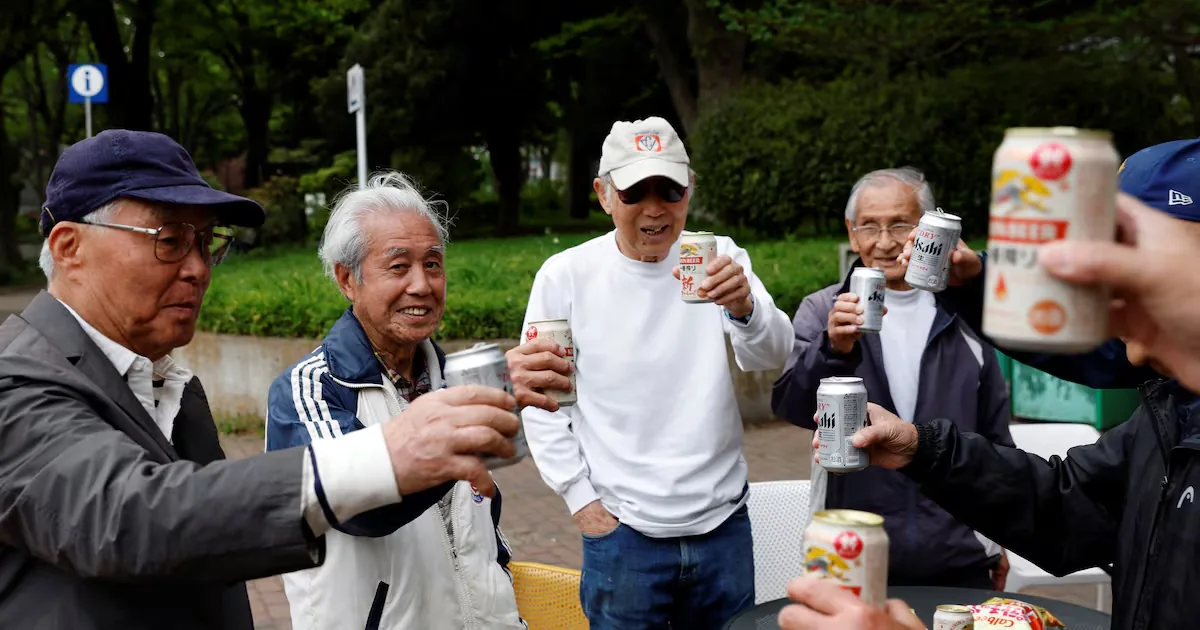
Japan has been experiencing a demographic decline for decades, but there is an age group that is gaining new members and has more members than ever before.
For the first time, the number of people aged 100 or older in Japan surpassed the 100,000 mark and reached a historic high for the 56th consecutive year, according to data released this Tuesday by the Japanese government ahead of the upcoming Respect for the Aged Day on Monday.
The Ministry of Health, Labour and Welfare of Japan reported that, as of September 1, the number of people aged 100 or older in the country increased by 7,914 compared to the previous year, reaching a total of 107,677.
Women accounted for about 88% of the total, with 94,298 people, while there were 13,379 male centenarians.
The oldest person in Japan is Fuyo Kishimoto, from the city of Kyoto, who turned 114 last December. She became the oldest person after the death in August of Shigeko Kagawa, a resident of Yamatokoriyama (Nara Prefecture). Kagawa was 115 years old.
The oldest man is Hikaru Kato, from the city of Kumamoto, who turned 112 in May.
By prefecture, Shimane recorded the highest proportion of centenarians – 186.65 per 100,000 inhabitants – and topped the list for the fourteenth consecutive year. Shimane was followed by Kochi, with 169.52, and Tottori, with 152.48 per 100,000 inhabitants.
On the other hand, Saitama had the lowest figure, with 51.27; followed by Aichi, with 57.79, and Osaka, with 60.06 per 100,000 inhabitants.
Health Minister Kenichiro Ueno expressed that he was “delighted that so many people lead long, healthy, and active lives,” pointing to advances in medicine and technology.
However, Kenichiro also warned about the challenge the country faces in maintaining a sustainable social security system.
The number of centenarians in Japan has steadily increased. In 1963, when the country enacted the Social Welfare Law for the Elderly, there were barely 153 centenarians nationwide. That number exceeded 1,000 in 1981, 10,000 in 1998, and 50,000 in 2012, detailed The Japan Times.
Japanese people are among the longest-lived in the world, with an average life expectancy of 81.35 years for men and 87.33 years for women, ranking seventh and first worldwide, respectively.
Experts attribute Japan’s high life expectancy to a relatively healthy diet, low obesity rates, universal healthcare coverage, and an active lifestyle. Although Japan is known for having grueling workdays in cities, some residents embrace the philosophy of “ikigai,” which encourages people to bring value and joy to life, CNN reports.
The cuisine of this island nation is mainly based on fish, vegetables, and rice, and contains less saturated fat than many Western diets, highlights the BBC.
Older people also walk, use public transportation, ride bicycles, and regularly do stretching exercises.
Read more Death toll rises to 16 in building collapse where dozens of displaced people lived in Gaza
Japan has been aging for years, and adult diaper sales have surpassed baby diaper sales for more than a decade.
Companies have also developed new products for the elderly population, such as a motorized exoskeleton to facilitate movement of various body parts and glasses that automatically adjust focus.
Although the exact reasons why women live longer are not known, specialists point to the low incidence of cardiovascular events before menopause and lower smoking rates among women as possible contributing factors.
Given the growing number of very elderly people, achieving healthier aging has become a national mission.
In 2019, the Japanese government set the goal of increasing healthy life expectancy by three years for both men and women by 2040, using 2016 levels as a reference, when it was 72.14 years for men and 74.79 for women.
For a population to replace itself, each woman needs to give birth to an average of 2.1 children. Last year, Japan’s total fertility rate fell to a historic low of 1.14.
The total population is estimated to decline to 87 million by 2070, representing a 30% decrease from its peak of 128 million recorded in 2008, according to data from the National Institute of Population and Social Security Research.
Currently, residents aged 65 or older make up about 30% of the population, and they are expected to represent nearly 40% by 2070.
Japanese authorities have described this trend as an “existential crisis,” and Prime Minister Sanae Takaichi has described the decline as a “silent emergency.”
In 2025, the total population of Japan decreased in all prefectures—except two—and the rate of this decline is accelerating.
The numerous government programs and subsidies aimed at encouraging young people to have more children do not seem to be increasing birth rates, the BBC indicates.
Experts point out that the causes are complex and range from declining marriage rates and increased female participation in the labor market to rising child-rearing costs.
Although immigration has increased in recent years, foreigners represent barely about 3% of the population, and opposition to accepting more people from outside has grown.
Read more Saudi Arabia accuses the Houthis of launching a drone towards Mecca