







It was one of the moments that raised doubts ahead of the 2026 World Cup final; the unprecedented halftime show featuring various stars. A moment that was held for the first time in a World Cup final, with the usual sense of spectacle seen in the U.S.
Read more Geoff Tate presents in Chile “Operation Mindcrime The Final Chapter”
Already at the opening ceremonies there was the presence of various figures and even before the final match, at the New York New Jersey Stadium, there were artists like Post Malone, Laura Pausini, Robbie Williams, among others. In other words, it was already sufficiently saturated.
Derived from the NFL, the halftime show – curated by Global Citizen – spared no expense. “The performances were quite episodic, to the point that they seemed to take place on different planes of existence,” commented The New York Times.
The opening was by Madonna, who performed a remixed version of Music, staged on a jeep driven by legends Ronaldo and Ronaldinho. Dancers, a DJ (Stuart Price, producer of Confessions on a Dance Floor and CONFESSIONS II) and lots of color. A segment that felt pre-recorded and then gave way to a field entrance. “It was extravagant, flashy, and deliberately over the top,” noted Billboard.
Next was conductor Gustavo Dudamel, leading musicians from the New York Philharmonic and the Simón Bolívar Symphony Orchestra of Venezuela. The group performed a vibrant and colorful version of Seven Nation Army by The White Stripes, a song that has been adapted by stadium crowds. And alongside them, Muppets puppets. In other words, the norm was to take the whole situation to the max.
Then came a moment eagerly awaited by their worldwide fanbase; BTS, the K-pop stars, performed their hit DYNAMITE. With their usual precision, they displayed a well-rehearsed choreography before an enthusiastic audience. “Their performance was dizzying, but nothing about it felt rushed,” detailed Billboard. A good warm-up for their anticipated – and still pending – next visit to the country.
From there, a segment that has sparked debate; after being introduced by actor Jason Sudeikis in his role as Ted Lasso, Justin Bieber entered alone with an acoustic guitar to sing Everything Hallelujah, a track from his album Swag II, in a minimal version that contrasted with the grandiosity of the show and slowed the pace a bit. “Viral hit after his Coachella performance or not, maybe it wasn’t the time for introspection,” detailed The Guardian.
A similar opinion about that segment was expressed by The New York Times. “It was a drop in energy in the frenetic pace of the show, no doubt, but also a welcome moment of solitude and stillness amid the chaos of the crowd.”
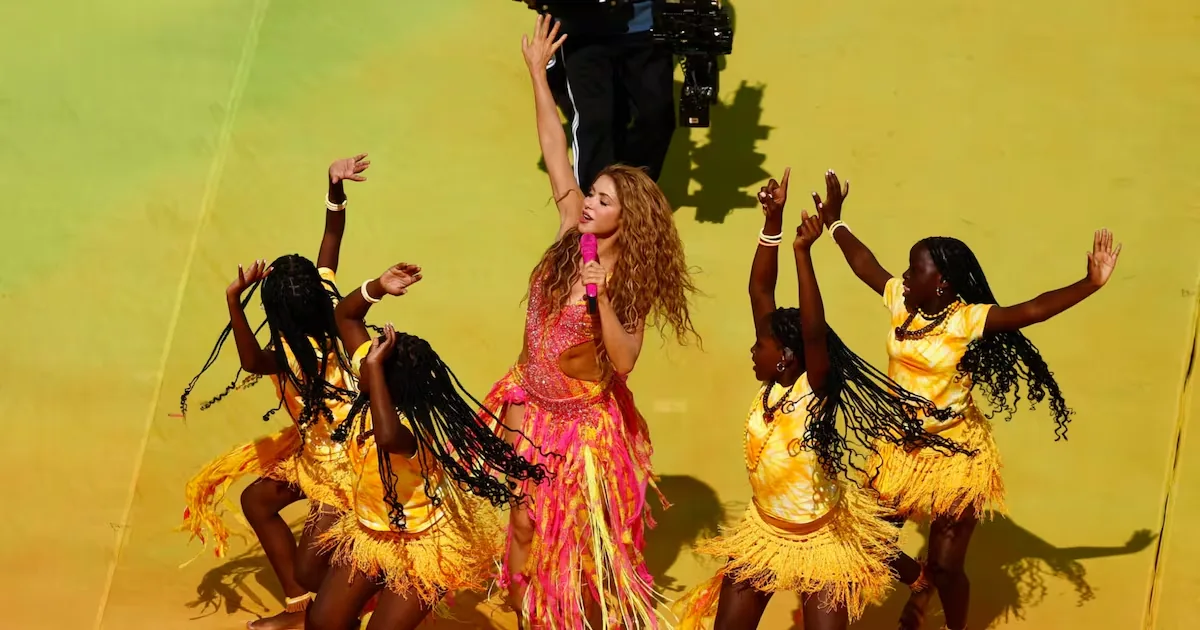
Then came the block that felt more traditional, Shakira – in her fourth World Cup – took the stage alongside Burna Boy to perform Dai Dai, the official World Cup song. Nothing that hadn’t been seen before, dancers, confetti, then moving to a more childlike and global closing with the PS22 chorus alongside Chris Martin and Coldplay, who went somewhat unnoticed. In total, 11 minutes of a presentation that felt dynamic.
Overall, the show achieved good resonance. According to data obtained by Culto, in Chile it reached an average online audience of 3,353,715 people following the CHV broadcast, a substantial figure. And although certain doubts floated regarding the relevance of the show, in general, the feeling prevailed that despite everything, it delivered.
On its side, detailed The Guardian. “While the halftime show was not impactful enough to convince viewers that it should be a regular feature at every World Cup final, it worked well enough to justify its existence, at least on this occasion.”
Meanwhile, the NYT praised the show and noted that it managed to overcome initial doubts. “In the end, the halftime show avoided disaster: the turf seemed to have been protected, the players survived their prolonged cooldowns, and none of the artists made a fool of themselves. But it was also so impeccably executed and so compact that the final impression was one of suffocation from overactivity.”
More critical was Time. “From an artistic perspective, however, the halftime show tried to cover so much that it ended up saying nothing. Compare it to Bad Bunny’s personal, culturally specific, politically resonant, and tremendously entertaining performance at the Super Bowl, and the first entertainment intermission of the FIFA World Cup final seems like an ad from some old edition of the compilation series That’s What Music Is! Which, of course, is to be expected from a production tasked with representing the entire world and not upsetting anyone.”
You can watch the halftime show here.