







The report “Breaks and Opportunities,” prepared by the ECLAC Commission on Geopolitics, Globalization, and Development for Latin America and the Caribbean, identifies eight breaks in the world order and gathers ten recommendations for the region’s international insertion.
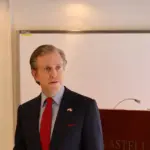
The document was presented this Tuesday in Santiago, and the research was chaired by the former president of Colombia from 2018 to 2022, Iván Duque, along with the former president of Chile, Michelle Bachelet. The recommendations in the document start from the following premise: the postwar order is transitioning from a rules-based system to one based on power relations and competition among powers. In this context, the study suggests that Latin America requires its own position in the face of this change.
The commission was convened by the ECLAC executive secretary, José Manuel Salazar-Xirinachs, and comprised thirteen people from different backgrounds and ideological inclinations.
The document resulting from the study analyzes the gaps in regional development, the strategic assets of Latin America and the Caribbean, and the region’s options in a scenario of disintegration of multilateral spaces. In an interview with La Tercera, Duque clarified that the report should not be understood as a finished work but defined it as a “roadmap for development for Latin America for the next 30 years.”
The report uses the word “breaks” instead of “trends” or “phenomena” to describe changes in the world order. Why that nuance? At what point in the commission’s work did you realize that it was no longer enough to talk about a gradual transition and that it was appropriate to speak of a break in the postwar order?
The term “break” shows that we are no longer facing a transition. We are facing a change that accelerated and was more abrupt than many could have predicted. The break and weakening of multilateralism are unquestionable. The break in consensus around the climate crisis is also undeniable. The weakening of democracy worldwide is noticeable.
Each of those eight breaks shows that changes occurred, that they happened faster, and that some are more abrupt. That is why this term is used. Moreover, these breaks mark a change in trend that is not temporary and could be structural.
This paves the way for the report to assess how Latin America should position itself in the face of these breaks, how it should consolidate its opportunities, and how it should assert its strengths.
The study identifies the phenomenon of democratic setbacks and political polarization in the region. How realistic is it to ask governments to build minimum consensus and sustain state policies beyond electoral cycles?
Latin America must improve governance to face its geopolitical challenges. That means strengthening institutions, as the report mentions. Without strong institutions, it is difficult to have structured geopolitical planning with the capacity to advance.
It is also essential to restore trust in institutions, even in the region’s most mature democracies. What we suggest to recover that trust, strengthen democracy, confront organized crime, and sustain long-term state policies requires minimum consensus. These consensuses operate within countries and also among countries.
Competitiveness is neither left nor right. The fight against organized crime is neither left nor right. Job creation is neither left nor right. Policies are needed that stimulate the private sector, integrate us into the global economy, and allow us to capture geopolitical opportunities without getting stuck in debates that leave us behind the rest of the world.
In the presentation of the study, you emphasized “active non-alignment” and the need to avoid rigid decisions tied to the will of superpowers…
The point is that there should be no rigid alignments. We have to look at our location and geopolitical opportunity from what benefits Latin America and what allows it to capitalize on its opportunities.
It is not about rigidly aligning under a situation of submission. With the United States, we share values and principles, as well as trade relations, investment, and technological, military, and security support. We share democracy, separation of powers, a constitution with clear guidelines, and the protection of freedoms. With China, we share trade.
Read more Carrot and cinnamon energy balls
With other countries, we share investment. With others, specific strategies work in energy or science and technology. The absence of rigid alignments responds to the flexibility we must have, without sacrificing the values and principles we uphold.
But the report recommends doing this in a context where, for example, we are experiencing the application of the Monroe Doctrine by the United States. How can this “non-alignment” be maintained in practice without provoking commercial or security reprisals from the U.S.?
Latin America cannot have as a geopolitical objective the application of any doctrine in any third country. The doctrine proposed by James Monroe was not interventionist. It stated that the United States would help protect the independence processes of the region’s countries against any foreign power that wanted to recolonize them.
Since then, we have seen doctrines in which Latin America and the United States integrated cooperatively. Free trade agreements, CAFTA and NAFTA initiatives, agreements with Chile, Colombia, and Peru, the Organization of American States, and the Inter-American Development Bank are mechanisms of a solid alliance with the United States.
What we seek with this report is that Latin America does not depend on the geopolitical doctrine of any other country. That it can interact, cooperate, and be an ally, with a clear position of its autonomy in the geopolitical sphere.
How can the report’s recommendations be applied in a context of regional disintegration and distancing from multilateral instances?
It is an important bet by ECLAC because it does not seek unanimity. Convening thirteen people with ideological, educational, and viewpoint differences and reaching a report with consensus elements is an example for countries themselves to implement many of the recommendations.
These recommendations are neither left nor right. They are practical elements for countries to improve their capacity to generate wealth, reduce social gaps, and combat enemies that threaten the stability of democracies, such as organized crime.
This ECLAC bet to build from difference facilitates conversation within countries to implement many of the recommendations.
The report treats organized crime not as an exclusive security issue but elevates it to a regional governance priority. As co-chair of the commission and based on your experience as president of Colombia, what specific mechanisms of comprehensive cooperation could work?
Greater collaboration and strengthening of intelligence are needed. Intra-regional mechanisms for asset forfeiture of criminal organizations must be activated. The offensive capacity of public forces among countries must be more uniform. Mechanisms to dismantle these structures must start from collaboration among the justice systems of different countries.
Latin America concentrates about 8% of the world’s population and 30% of homicides, with victims and perpetrators mainly between 18 and 25 years old. Security is a democratic value and a public good that is neither left nor right, and its safeguarding requires collaboration among all countries.
We want the region to stop being seen by transnational crime structures as a transit place, logistical point, or platform for illegal trade. Security, presented as one of the central elements of the region’s geopolitical conception, paves the way for detailed and results-based policies within countries.