






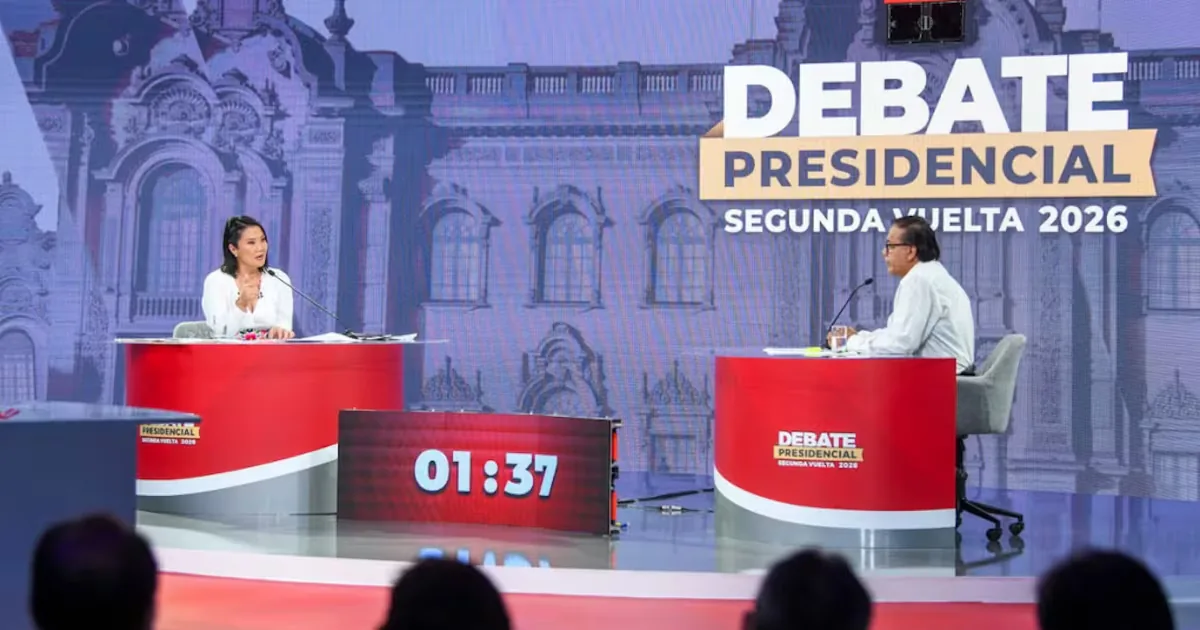
One week before the second round takes place in Peru, presidential candidates Keiko Fujimori and Roberto Sánchez faced off this Sunday night in a televised debate marked by topics such as the economy, employment, and poverty reduction.
Mutual accusations were the tone during the candidates’ face-to-face. For example, Sánchez confronted Fujimori by alluding to her family life. “I do know how to respect my mother,” said the leftist candidate.
“Mrs. Keiko says she knows it is an independent family that moves forward. I rather remind her that I do know what it means to move forward with your family, respecting my father, respecting my mother, respecting my wife, respecting my brother. We have moved forward like that. And that, do you know what it means? It is your spiritual value, even to want to transform a country,” Sánchez expressed, highlighting that he does respect his mother.
Fujimori responded by showing her indignation: “What a shame, how little of a man you are.” “When attacks of this nature come, I want to remind that my political life has been lived in adversity against the current, but here I am facing forward, standing tall and with my head held high. But when attacks like this come, I now allow myself to address Kyara and Kaori. Girls, you know and we know how the last days were when we accompanied your grandparents, my dad and my mom. Let’s not pay attention to these kinds of low attacks,” she added referring to her daughters.
The candidate from Juntos Por el Perú, in his first intervention, pointed out that there was a need to increase the amount of the minimum living wage. This amid an inflation scenario that directly affects the most vulnerable families in the country.
“The basic family basket, due to fuel prices and inflation, should today be at least 1,814 soles (US$ 533) to mitigate. What is the minimum living wage? 1,130 soles (US$ 332). That is why, in our government, we have decided to advance those 1,814 soles, starting with 1,500 soles (US$ 441),” he said.
He also said he would provide bonuses to promote the creation of businesses by micro-entrepreneurs and entrepreneurs. In this regard, he stated that developing employment also means “promoting businesses, the entrepreneur, the micro-entrepreneur.”
“That is why we will form a fund of 15,000 soles (US$ 4,413) million for truly accessible credit, cheap credit, with guarantees, but where we also provide technical assistance so they can diversify entrepreneurial businesses with technology and innovation,” he indicated.
“The relevant work here is the woman, because she is the one who leads and carries out a set of businesses in an exemplary way. Poverty is no longer only in rural areas, it has also moved to the city. Two million three hundred thousand middle-class Peruvians have now increased poverty to nine million Peruvians. There is hunger, there is malnutrition,” Sánchez emphasized.
The candidate from Juntos por el Perú said he would strengthen the National Program of Direct Support to the Poorest, which will also extend to cities. According to him, in the first year of his government, no less than one million families will be recognized with a pension to fight poverty.
Sánchez distanced himself from the communist label and even guaranteed that in a possible government Julio Velarde will remain in charge of the Central Reserve Bank of Peru.
“We have not expropriated anything from anyone. We do not want to take away your savings. That fear narrative that you (Keiko Fujimori) have raised is false. We are not communists, we believe in work, in the right to grow, to have wealth,” Sánchez said.
He added that, for that reason, he will guarantee the state policy that has existed since 1979: macroeconomic stability and autonomy of the Central Reserve Bank. “This means the permanence of Mr. Julio Velarde. We have had some minor disagreements, but state policies and institutions are respected,” he concluded.
For her part, the Fuerza Popular candidate, Keiko Fujimori, indicated that her government will boost the GDP growth rate, which is around 3%, and that they will leave it at 6% by the end of her term.
“Poverty is not reduced with speeches, it is reduced with employment. Peru already demonstrated this when there was stability and employment, millions of families were able to escape poverty. Today, we have to recover that path. What Congressman Sánchez proposes goes exactly in the opposite direction: banning agro-exports, stopping mining, limiting the entry of basic inputs. That does not create jobs, that destroys your job,” she said.
She said they would defend the autonomy and independence of the Central Reserve Bank of Peru, unlike “what Mr. Sánchez’s formula proposes.” She also announced that she would eliminate bureaucratic obstacles. “The state will stop persecuting and extorting. Sunat (National Superintendency of Customs and Tax Administration) and Sunafil (National Superintendency of Labor Inspection) will be reformed to promote job creation,” she said.
Like Sánchez, she also promised support for small and medium-sized enterprises and said she would reactivate PromPYME to support MYPES (micro and small enterprises) and entrepreneurs, with cheaper credit, more state purchases, more technical assistance, and training to export, mechanize, and digitize.
Finally, she said she would unblock large stalled projects, such as the Central Highway, Chinchero Airport, Poechos dams, lines 3, 4, 5, and 6 of the Lima Metro, the train from Lima to Ica, the train from Lima to Barranca, the South Andean Gas Pipeline, and the Majes Siguas II project, among others.
“We also know that today you suffer from fuel prices. For that, we will reactivate the stabilization fund guaranteeing a stable price,” she said.
The leader of Fuerza Popular assured that she will implement the “National Pacification Plan” and said they would expel irregular migrants who commit crimes in the country. “We will activate patrols in dangerous areas. We will form integrated task forces, by the police, the prosecutor’s office, the Armed Forces, and the population itself,” she added.
She said she would strengthen the intelligence system that defeated terrorism. “We will use it again to defeat crime,” Fujimori said. In this regard, she indicated that to have security “we must have a model police, well-equipped, transparent, and highly trained.”
At another point, she assured that the Armed Forces will take control of the country’s borders. “For example, now, on the border with Ecuador, there are only two patrols,” she said.
She also said that in her government “prisoners must work in prisons for their food and to repair society. They will build slabs, roads, and stairs.”
When asked about the high number of extortions in the country, Fujimori said that “unfortunately in our country we live in impunity. There are thousands of complaints that never become sentences. That is why we propose that the justice system use the flagrancy system to achieve quick and efficient convictions. We also plan to request powers so that in the first 100 days of government we can implement police stations, buy patrol cars, and we also have a great team.”
Sánchez, for his part, said that “it is important to make some reforms to the law so that the Armed Forces can exceptionally come to the aid, in support of the National Police, especially in territories that have been taken over by crime and extortion. They are no man’s lands. These are exceptional situations and we need firepower and presence in the fight against crime. But this is also aggravated because the prosecution of crime, of criminal organizations, has been weakened, and all that has been the result of the laws that Mrs. Keiko’s bench has directed. She has to tell the country that. That is complicating the frontal fight against insecurity. And that is her responsibility.”
The leftist candidate indicated that in a possible administration of his, he will “clean” the Police of some “bad elements.” He said he will create an Investigation Police.
“Crime has increased even more because a parliamentary force in Congress, to clean itself of its wrongdoing, has subverted the justice system, creating pro-crime laws and deepening the abandonment of the fight against crime, and that is called the ‘lady of chaos’,” he said.
“(…) The National Police must be cleaned of bad elements. Recover them. As well as create an Investigation Police in Peru to be effective. Increase their salary, pay their social debt,” he said.
On the other hand, in his presentation, Sánchez stated that there is a “political mafia” in Congress, alluding to the Fuerza Popular bench. “We have to talk about crime and corruption. There is a congressional political mafia. Political parties that have leaders with cocktail trials, with money laundering trials have decided to take over justice,” he said.
“I challenge Mrs. Fujimori if she is willing to repeal the pro-crime laws? What do you say to Peru? We also need, in the fight against corruption, for example, civil death for corrupt officials,” he added.
Fujimori, for her part, criticized Roberto Sánchez for his closeness to Antauro Humala and questioned his proposals to strengthen the Police. The candidate recalled Sánchez’s statements during the campaign and asked him to clarify if Humala would have any role in a possible government of his.
“How can you talk about strengthening the Police, Congressman Sánchez, if you have Antauro Humala, a police killer, among your ranks? On April 8, at the last rally of the first round, you said the following: ‘the fight against crime will be in the hands of compatriot Antauro Humala.’ Peruvians want to know, will Antauro Humala be by your side?” she asked.
The press highlighted that Sánchez avoided answering about his closeness to Humala and instead questioned Keiko Fujimori, accusing her of having politically protected President Dina Boluarte against investigations for the deaths recorded during the protests.
“Those who have to answer to justice for the more than 50 murders, Mrs. Keiko, whom you have shielded, who have not cared about the lives of more than 50 compatriots, with your partner Dina Boluarte, filing the investigation, mocking the people, is you. I reject violence wherever it comes from. In Juntos por el Perú, we bet on peace, on life. If someone has pending cases with justice, let them account for it. I defend life. I am a democratic man,” he replied.
Fujimori rejected Sánchez’s accusations and recalled that Dina Boluarte was part of Pedro Castillo’s government. She also said that Fuerza Popular pushed for early elections after the leftist former president’s attempted coup.