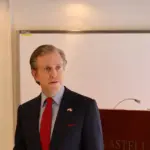

“Who is Ricardo Zúñiga, the man who helped negotiate the agreement between the White House and Cuba?”, titled The Washington Post on December 22, 2014. The then U.S. diplomat of Honduran origin was one of the main secret architects behind the Washington negotiations that achieved the release of contractor Alan Gross on the 17th of that month. This event marked the historic beginning of the restoration of diplomatic relations between the U.S. and Cuba under the government of Barack Obama.
Read more Russia’s hybrid war intensifies in Europe
As a career member of the U.S. Senior Foreign Service for 30 years, Zúñiga held multiple roles, including, from 2012 to 2015, senior advisor to President Obama for the Americas and senior director for Western Hemisphere Affairs at the National Security Council. Likewise, during the Joe Biden administration, he served as Principal Deputy Assistant Secretary of State for Western Hemisphere Affairs, as well as special envoy for the Northern Triangle.
Today, from the private sector, Zúñiga is a founding partner of Dinámica Américas, a consulting and strategic advisory firm founded in 2023 based in Washington, which helps companies and organizations navigate the political, geopolitical, and risk complexities in the Americas. Additionally, he is a senior advisor at the United States Institute of Peace, an independent federal agency founded in 1984 to prevent and resolve violent conflicts worldwide.
Precisely to analyze the complexities shaping the current scenario in Latin America, especially after the State Department last week published an unusual video where it firmly states that U.S. dominance in the Western Hemisphere “will never again be questioned,” Zúñiga spoke with La Tercera about Donald Trump’s foreign policy and the effects of the Republican president’s Monroe Doctrine in the region.
How is this aggressive reinterpretation of the historic Monroe Doctrine promoted in Trump’s second term understood?
I think it stems from a very different vision than all American governments after World War II. And it is a vision based on a conviction by Donald Trump that the best time for the U.S. was in the second half of the 19th century. As you have seen, they made a recent video where they praised the model, called it imperialist, of McKinley and Teddy Roosevelt, and use it as the model they prefer. And they mention many times in that video the word dominate, dominate the region, preserve the sovereignty of the United States and subjugate the sovereignty of other countries in the Americas.
That is a vision very much of his movement, MAGA, which is America First, but it is a vision not shared by the vast majority of U.S. international relations specialists. It is a vision of a modernized imperialism, but without complexes from their point of view. So, that is why the attention to Greenland, to the Panama Canal, is what I would call an analogous vision in a digital world.
But there is also a certain reality in terms of applying that approach, whether against organized crime, controlling migration, keeping other powers out, mainly China. There are pieces of that more orthodox policy of the last 60, 70 years in the U.S., but openly and proudly militarized, which clashes with many countries accustomed to a different way of operating by the U.S. Even the absence of strong support for democracy and the rule of law. The absence of that is also striking, both for people coming from that more traditional tradition in the U.S. and, of course, in the region. So, in my view, it is creating a negative reaction that will last long after this period.
With governments in the region clearly aligned with Washington, how do you see the dilemma between not losing U.S. favor and risking national sovereignty?
I would say there are different trends. There are trends ideologically aligned with President Trump, which is a right-wing populism, mostly in security matters. I think there is no doubt there; insecurity has created space for these new actors or a new form of old actors who are somewhat dressing in this security-focused vision and using Bukele and Trump as examples to follow. Milei fits there, in a way; Noboa in Ecuador; Bukele, of course; Abelardo de la Espriella in Colombia.
But also the vast majority of countries are simply trying to survive this moment and maintain at least a correct, if not positive, relationship with the U.S., because they see that having a negative relationship carries too high a risk. And I would say from Panama northward there is one relationship with the United States, and from Colombia southward there is another.
I give the example of President Noboa, who is very, very loyal, wants to be a strong ally of the administration, but he goes to Beijing. The Chilean government itself has said several times that it will protect the trade relationship, which has nothing to do with the excellent ideological, political relationship it maintains with the White House, but the trade relationship with China is another matter. That is common among governments trying to balance this geopolitical moment.
I also think it is very important to highlight here that in Washington, for more than a decade, there has been a vision of intense competition with China in the Americas. But the truth is that China is hardly trying to prioritize the Americas; it is very focused on other parts of the world. So there is also a certain imbalance in the framework that also affects this whole environment.
The U.S. launched a task force to combat organized crime, composed of the 18 member states of the Coalition Against the Americas’ Cartels. Is there a risk of military interventions against drug cartels, as Trump has threatened in Mexico, for example?
Read more USA: Shooting leaves two dead and one injured in Indiana shopping mall
I believe a possible attack in Mexico, with or without the collaboration of the Sheinbaum government, is a very high risk, a very high possibility, simply because it is a territory better known by U.S. security forces, where there are cartels producing drugs being imported into the U.S. And if you recall, Mexico was in the president’s first speech as a candidate as a threat to the U.S. That has never gone away. The president is a person who has concepts that do not leave him. That is why the attraction to the Panama Canal, that is why the attacks to take oil in Venezuela. All these come from a very old way of thinking.
Also, he is a media person and wants to see attacks on territories outside the United States. The ship attacks were the beginning, not the end. Those attacks in Ecuador are also part of it. I would not be surprised to see attacks in Peru, in Colombia, along with those already seen in Venezuela, but they are mostly media-driven. The cocaine flow has not decreased at all, despite more than 80 attacks on small vessels. And so, I think many specialists believe it is a wrong way to carry out this fight, a lack of understanding of how organized crime functions as a business.
The Pentagon chief criticized the low military spending in Latin America, calling it “absurd” that nations allocate less than 1% of their GDP to national defense. Do you see an increase in spending as viable considering the region’s economic reality?
I heard an American analyst compare it to a ‘cut and paste’ NATO operation. I don’t think it was something thought out, part of a new policy, a new doctrine. And the truth is that, for the objective they seek, it would be a misuse of resources.
During his official visit to Panama, Pete Hegseth also warned the Cuban government that “all options are on the table, including military ones.” Do you think this year could end with a possible intervention on the island?
I think it is possible, but I don’t think it is the Trump administration’s first option. I think they have realized that Cuba is not Venezuela, that it is quite complicated and that Cuba is our neighbor. If there is a military attack there, there could be more serious consequences than those risked in Venezuela, which was more distant, farther from U.S. coasts. But at 90 miles from Florida, well, it’s another matter.
Besides that, I think it is very difficult; they are realizing there is no Cuban Delcy (Rodríguez), which is what they have always been looking for. It is a power consortium and a real and too organized state to be toppled by a single attack, by a single flight. So, they will continue with the pressure we have seen: economic pressure, an energy blockade, but I think they are rethinking how they will try to encourage change in Havana.
Secretary of State Marco Rubio launched a diplomatic campaign “to confront abuses of power by the International Criminal Court,” pressuring other countries to withdraw their funding and participation from the court. Do you see Chile’s decision to ratify its membership in the ICC as risky? Could there be possible reprisals?
Reprisals, I don’t know, but pressure, yes. The analysis here in the U.S. is that they fear there may be members of the Trump government who could be threatened by some legal process, for example, in the attacks against small boats, who could be vulnerable to international action.
But the attack is also emblematic of America First, that international law makes no sense or viability, so we will reject any effort to have multilateral justice. There was already skepticism within the U.S. political environment, but not an effort, not an idea to try to topple the court. So, for Chile and others who resist, there will be more pressure, but I also think that, farther from Washington, it gives a government more space to resist certain pressures.
Finally, do you think a possible defeat of the Republicans in the November midterm elections could moderate Trump’s offensive in the region? Or has his Monroe Doctrine come to stay?
If the Democrats win, who are favored at this moment at least in the House, that will have minimal effect in the region in terms of administration policies, whether in trade, security, attacks on ships, or immigration. All that remains in the hands of the White House and a White House willing to almost use executive orders to govern the country. Indeed, that is what they are doing, that is the plan, ignoring Congress’s authority to monitor, oversee the Executive and the funds.
So, I think in the short term no, in the longer term yes. And there you will see investigations by Congress of, for example, economic operations in Venezuela, cooperation between the U.S. and El Salvador on deportations and the use of U.S. funds in Cecot (Center for Terrorism Confinement), in that prison. Things like that I think will start to become notable. And also in trade. It has been a trade policy that has disrupted many American companies as well. Congress will start to set a more disciplined framework, or at least signal that it is heading that way, but it will not determine U.S. trade policy in the last two years of the Trump administration.