



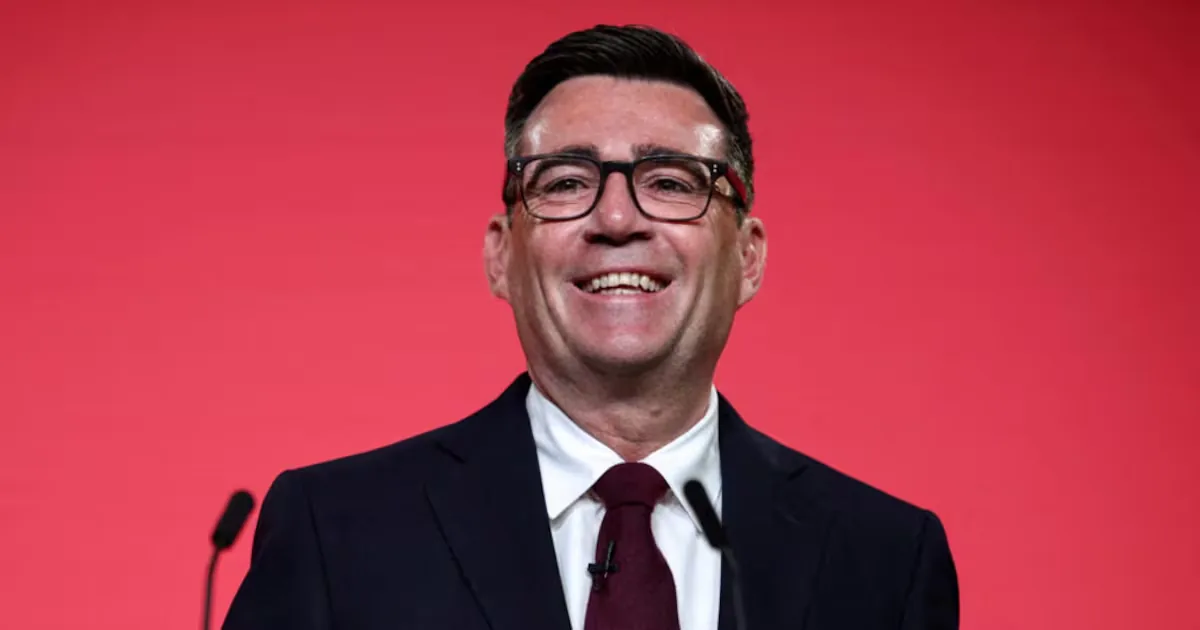
This Monday, King Charles III will formally ask Andy Burnham to form a government, as part of the protocol process following Keir Starmer’s resignation, and to become the 59th Prime Minister of the United Kingdom. The 56-year-old politician, who until just over a month ago led the Greater Manchester mayoralty and was elected last Friday as leader of the Labour Party, thus closes a journey of more than two decades marked by two defeats in the race for his party’s leadership and by almost a decade of distance from Westminster.
Read more The French center-right adjusts its strategy in response to Le Pen’s advance ahead of 2027
Burnham’s arrival at 10 Downing Street comes after the wear and tear of Starmer, one of the most unpopular British leaders in recent history – according to YouGov, the former premier’s disapproval reached 62% and almost a third of the British population rates his mandate as “terrible” – punished in the last May municipal elections where the populist right represented by Reform UK prevailed and weakened by the scandal surrounding Peter Mandelson, Jeffrey Epstein’s associate whom Starmer had appointed ambassador to the United States.
In contrast, Burnham is preparing to take office with a reputation built on his connection with the working classes of northern England. However, he comes to government with doubts about his ability to translate his closeness to the popular classes into the main challenges facing the United Kingdom.
“Andy Burnham is, fundamentally, an instinctive politician,” said The Manchester Mill founder Joshi Herrmann to The New York Times, who has followed his career for years. “It is a valuable skill, but it is naive to think that a better communicator can overcome these fundamental problems of British life.”
Andrew Murray Burnham was born in 1970. He grew up in Culcheth, a town located between Manchester and Liverpool, two declining post-industrial cities. From a Catholic working-class family, Burnham himself wrote in his memoir Head North: “Our lifestyle was modest and we never had family holidays abroad.”
That background would have conditioned his relationship with elite education. At 17, he was rejected in an interview at the University of Cambridge and assumed that environment was out of his reach. According to his English teacher who told the BBC, his initial reaction was to refuse with a “that’s not for people like me.” A year later, in 1988, he entered Fitzwilliam College and graduated in English Literature.
His political ambition was early. After working as an assistant to then Labour MP Tessa Jowell, he ran as an MP for the town of Leigh and won his seat in June 2001, at 31 years old.
His rise was rapid. He served as a minister in the governments of Tony Blair and Gordon Brown, with portfolios such as Culture and Health. His two attempts to lead Labour ended in defeat, in 2010 and 2015. After the second loss, added to his disenchantment with London politics, he decided to leave Westminster in 2017 to run for the Greater Manchester mayoralty.
The turning point in his career was the Hillsborough tragedy, the 1989 sports disaster in which nearly 100 Liverpool fans died and whose responsibility was attributed by the press and police to the fans. At a commemorative event in 2009, while minister, Burnham was booed by a crowd still demanding justice.
This episode led him to support the reopening of the investigation, which years later confirmed police errors and achieved the exoneration of the convicted fans. In his memoirs, he described that date as the moment he understood that the British political system “fails people in a very personal way,” a conviction that guided the rest of his career.
As mayor of Manchester, he consolidated a profile of closeness to the citizenry. He committed to donating 15% of his salary to organizations helping homeless people and maintained that practice during his nine years in office, although the promise to eradicate homelessness remained unfulfilled.
His most recognized legacy as mayor was the management of public transport through the creation of the integrated “Bee Network” system, which regained municipal control over bus lines, against the objections of private companies, and managed to freeze fares and improve punctuality. “It made a huge and very visible difference for people,” summarized former Manchester Municipality member Luke Raikes to The Times.
His projection for a national term came in October 2020, when he publicly confronted Boris Johnson’s Conservative government over health restrictions imposed on his region without the £87 million funding he demanded to support low-income workers. The widely publicized episode earned him the nickname “King of the North,” popularly associated with the A Song of Ice and Fire saga (adapted as Game of Thrones), where the ancestral title is “King in the North.”
With Starmer’s government permanently in crisis, his projection to premier accelerated. A Labour MP from Makerfield resigned his seat to allow him to compete for it, an election Burnham won comfortably. Thus, last week he was elected Labour leader with 379 votes – out of 407 – from Labour parliamentarians.
In his acceptance speech as leader of the leftist party, he criticized Margaret Thatcher’s legacy, accusing her of having “cruelly stripped” the economic power from traditional working-class strongholds through the deindustrialization of the 1980s.
In the speech, Burnham stated that in that decade the country made “a series of wrong decisions,” with the centralization of political power and the privatization of essential services such as housing, water, energy, and transport. “The right uses the phrase ‘take back control,’ but they were the ones who gave it up in the first place,” he said, and promised to end “the culture of cover-up” and transfer power to communities.
Read more Zelenski claims attacks against logistics facilities and an oil depot in the Moscow region
However, the political capital resulting from the closeness and confrontation that brought him to power will begin to be tested. The country Burnham inherits carries structural problems that have not been resolved by either the weakened Starmer or the Conservative governments that preceded him.
The first front is social assistance spending. According to BBC Verify, the cost of sickness and disability benefits for working-age people is around £58 billion annually and is projected to reach £78 billion by 2030.
The main factor is the increase in recipients of the Personal Independence Payment – a disability pension given to working-age people – which would rise from four to five million by the end of the decade, with a sharp increase among young people with mental health problems or neurodevelopmental disorders.
Starmer’s government tried to cut £5 billion annually by tightening requirements, the British media reported. But the measure was reversed due to resistance from its own MPs. An official report acknowledged that the pension “does not fulfill its function.”
Burnham has stated that he will seek to reduce spending by encouraging labor reintegration and not through direct cuts.
The second challenge is defense. The investment plan published in June by Starmer raised military spending only to 2.7% of GDP by 2030. Pressure to raise it to 3% – which would mean an additional £9 billion per year – comes from within the party. Former Defense Secretary John Healey demanded the increase and, upon refusal, resigned.
Added to this is NATO’s new target of reaching 3.5% by 2035, which would imply an additional cost of £24 billion annually for the United Kingdom.
Next is social care for the elderly, a system Burnham himself has called “failed.” Mostly managed by private providers, it currently leaves about two million elderly people with unmet needs, while nearly 10% of those over 65 face care costs exceeding £100,000 over their lifetime.
According to BBC Verify, the 2024 Labour program promised a “national care service.” Starmer postponed that reform and commissioned a report originally due in 2028. Burnham suggested bringing this report forward to the end of this year. The main problem would be funding. In the past, he proposed a 10% inheritance tax and recently suggested eliminating the inheritance tax to instead tax the wealth of the wealthiest sectors during their lifetime.
Fourth is housing. The government committed to building 1.5 million homes in five years, an average of 300,000 annually, and in the 12 months prior to March 2026 only delivered 204,000.
According to the British network, Burnham has announced his intention to promote the largest social housing program since the postwar period, without yet specifying its scope. In 2025, English municipalities built only 1,970 homes, compared to nearly 200,000 annually in the 1950s. Achieving a significant increase would require about £13 billion more per year in subsidies, above the current £4 billion, and financing it through debt would contravene the fiscal rules he himself has committed to maintaining.
The fifth “headache” for Burnham, according to the BBC, will be youth unemployment. More than one million young people aged 16 to 24 neither study, work, nor receive training – called “ni-ni” or NEET – approximately one in seven.
In 2015, the UK was at the European Union average and by 2025 had risen to second place in youth unemployment, only behind Romania. Among the causes cited by the British media is a 20% drop in the start of vocational training courses. A report commissioned by former British Health Minister Alan Milburn described the phenomenon as an “urgent national crisis.”
Burnham has argued that the education system is too focused on the university path and could bet on strengthening technical training, a priority that previous governments also aimed for but never concretized.