







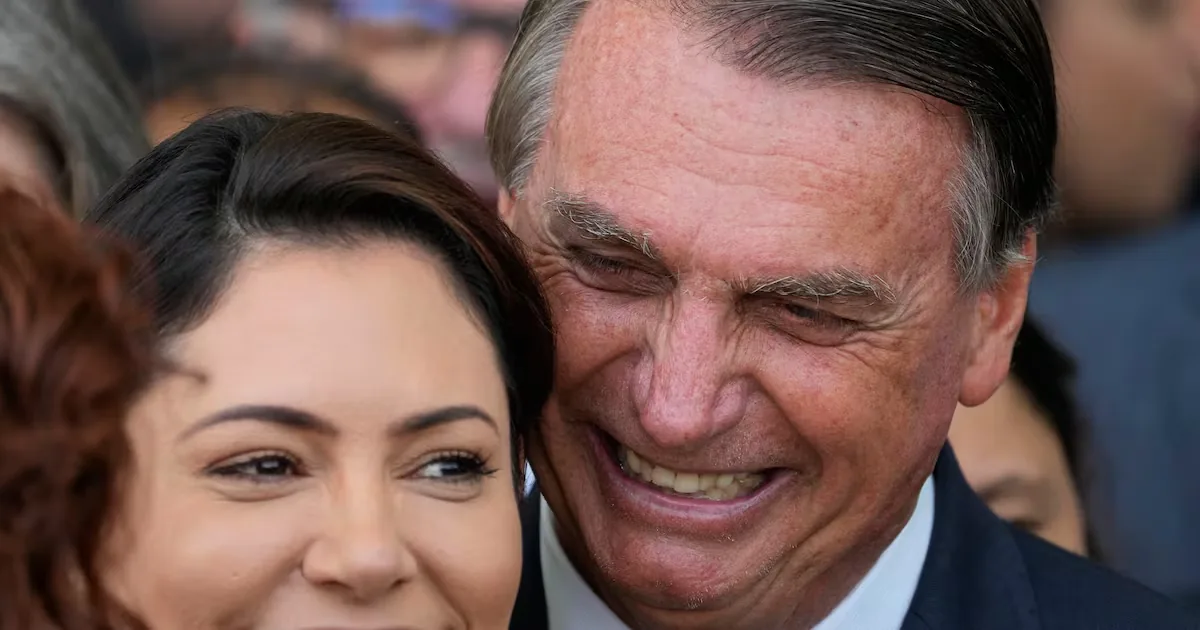
Controversy is brewing for Brazil’s presidential elections on the far-right side. The wife of former president Jair Bolsonaro, convicted of coup plotting, recently decided to drop a media bombshell by publishing two videos in which she reproached her stepson Flávio Bolsonaro, a pre-candidate for the Presidency, for having humiliated her.
Read more U.S. Magistrate sets start of drug trafficking trial against Nicolás Maduro for June 1, 2027
Since then, the right has been going through a moment of deep division, awaiting Flávio Bolsonaro, chosen by his father as his successor, to formalize his candidacy this July 25.
Little prone to granting interviews, Michelle Bolsonaro has a different trajectory from other former first ladies. Since the end of her husband’s term, she has not stopped starring in political acts. However, much of what the public knows about her childhood and career is the version she has told. For analysts, Michelle remains the owner of her narrative, with a story marked by gaps.
After leaving the presidency of PL Mulheres, the department of the conservative Liberal Party that calls itself Brazil’s main female party movement, and after freezing her candidacy for the Senate, Michelle has just launched another movement called Imparables (Unstoppables).
The PL considered her a central figure to attract the evangelical vote and reduce female rejection of Flávio Bolsonaro. But, after her breakup with the pre-candidate, everything indicates that she will not participate in his electoral campaign. Some analysts even believe that she might already be working on a hypothetical candidacy for 2030.
Who is Michelle Bolsonaro? Unlike her husband, an impulsive man not given to diplomacy, she is described as “sober and enigmatic” by journalist Adriana Negreiros, author of a podcast documentary about the former first lady.
Her childhood and adolescence took place in Ceilândia, a city of 500,000 inhabitants near Brasília that houses one of the largest concentrations of low-income and extremely poor populations.
“We didn’t go hungry, but we did face many difficulties. I grew up among drug traffickers, many were my friends,” Michelle recounts in an interview with journalist Alexandre Garcia, who was spokesman for the Presidency of Brazil during the dictatorship, between 1979 and 1980.
Still a child, she sold oranges at a traffic light. “My mother was a housewife, then she had to start working as a cleaner. And I didn’t want to follow the same path, to see that it was going to perpetuate itself, as I saw with my cousins, with my uncles… that life. I wanted to work and have my own things. And I didn’t want to give in to drug trafficking,” Michelle relates.
“I come from a dysfunctional family. I didn’t have bread, you know? But I think it was a fundamental factor for the woman I am today,” she said in the videocast “Pode atualizar?” (Can you update?).
Several of her relatives had problems with the law. Her grandmother, Maria Aparecida Firmo Ferreira, was imprisoned for drug trafficking in 1997. The police found 169 packages of “merla,” a cocaine derivative, in her house. At that time she was 57 years old and Michelle was 15. She spent two and a half years in prison. Until 2020, when Maria Aparecida died of coronavirus at the age of 81, the two barely maintained contact.
When Michelle was six years old, her mother, Maria das Graças Firmo Ferreira, was investigated for falsifying her birth certificate, in which she appeared nine years younger. In addition, she omitted her father’s name, Ibraim Firmo Ferreira, because he had abandoned the family.
Her uncle, João Batista Firmo Ferreira, a retired sergeant of the Brasília Military Police, was arrested on charges of belonging to a militia operating in the Sol Nascente favela, the second largest in Brazil, where he resided with his mother, Maria Aparecida, Michelle’s grandmother. According to the Public Prosecutor’s Office, João Batista, one of the few relatives of the former first lady invited to the presidential inauguration, participated in an illegal land sale scheme in the favela.
Another uncle, her mother’s younger brother, Gilberto Firmo Ferreira, was sentenced in 2018 to 14 years, 4 months, and 24 days in maximum security prison for raping a 10-year-old girl, his wife’s niece. Initially a fugitive from justice, he was arrested in 2020. He was later imprisoned for receiving stolen cars and for possession of child sexual abuse material. The former first lady always settled the controversies by claiming that she had no relationship with these relatives.
Her first formal job was in a supermarket. She even did advertising dressed as a pasta package.
In one of the few interviews granted in 2018, her mother recounted that Michelle had a brief modeling career and gave up very soon because she refused to lose weight. At 20, she became pregnant with her first daughter, Letícia, the result of a relationship with electrical engineer Macos Santos da Silva. Two years later, she began working as a salesperson for a wine company in Brasília.
There she met Átila Maia, a former pilot and head of the Aeronautical Parliamentary Advisory Office of Congress, who helped her get a job in the Chamber of Deputies. The Brazilian Air Force reserve brigadier was 48 years old and Michelle was 23: for him it was an insurmountable obstacle, despite being a year younger than Jair Bolsonaro himself.
The two separated, but before that, the former pilot got her a job as secretary to neurosurgeon and federal deputy Marco Aurélio Ubiali, a convinced socialist.
In his office there was a mirror: whoever passed through the corridor saw Michelle’s reflection. One of them was Jair Bolsonaro, who occupied the adjoining office. He was immediately enchanted by the young woman and sent her a huge bouquet of red roses. It was 2007. Bolsonaro sought out Átila Maia to play cupid and promised him he would marry Michelle.
Bolsonaro, who was in his fifth term as a deputy, was still a politician of little relevance in Brasília.
Shortly after starting this relationship, Michelle became a secretary in Bolsonaro’s cabinet. Nine days later, she signed a prenuptial agreement for the total separation of assets, including those that would be accumulated throughout the marriage. On November 28, 2007, they formalized their common-law partnership.
“When I got married, I would never have imagined that I would marry a politician, even because I had an aversion to politicians,” Michelle acknowledged.
In the podcast, deputy Sóstenes Cavalcante, from the PL, reveals a curious detail: Michelle told him that Bolsonaro didn’t know how to kiss and that she had to teach him.
However, her career in that field did not last long. In November 2008, she was fired after the Supreme Court banned nepotism in public service.
At that time, her daughter Letícia was six years old and three of Bolsonaro’s four children were already politicians. Michelle wanted to have another child and had to convince Bolsonaro to reverse his vasectomy. “It was a test of love,” the former first lady commented.
After four sons, Bolsonaro had a daughter, Laura, who was born in 2010. He publicly defined her as “a moment of weakness.” This phrase cost him an avalanche of criticism and armed his political adversaries with ammunition.
After moving to Rio de Janeiro, Michelle began attending the Assembly of God Vitória em Cristo of Pastor Silas Malafaia. Jair Bolsonaro was never evangelical, but his closeness to this pastor allowed him to gain the trust and support of that religion.
Malafaia, who had supported Lula in the 2002 and 2006 elections, found in Bolsonaro an ally in defending conservative agendas in Congress. It was he, along with his wife Elizete, who convinced Bolsonaro to hold an official wedding in March 2013. Bolsonaro was 58 and Michelle 31. Malafaia himself officiated the ceremony.
Michelle entered politics during the 2018 election campaign, three days before the second round. Bolsonaro faced fierce opposition from progressive women, who had founded the “Ele Não” (Not Him) movement. Michelle appeared on TV, during propaganda time, to downplay the controversies about her husband, who was attacked for his misogynistic statements. Once, Bolsonaro even told a Workers’ Party deputy: “I don’t rape you because you don’t deserve it.”
From the beginning of her political career, the former first lady showed interest in the deaf community. Her sensitivity to this disability is due to her deaf uncle, Gilberto Firmo, the same one who was arrested for rape and for storing child pornography material and with whom she would later say she did not maintain a close relationship. Michelle studied sign language as a self-taught learner.
During Jair Bolsonaro’s inauguration on January 1, 2019, her pink dress and toned shoulders attracted attention. It was the first time a Brazilian first lady spoke at the ceremony: she did so in sign language.
The then first lady promised to help the deaf community and, yielding to public request, kissed her husband. As a result of that episode, many thought that Michelle “would be a first lady with her own light,” but it was not so. Little by little, her role was reduced.
The first scandal came with the investigation of the so-called “rachadinha,” a practice of embezzlement attributed to Flávio Bolsonaro that consists of forcing advisors to return part of their salary.
Because of this investigation, the Justice ordered the lifting of banking secrecy and it was discovered that Flávio Bolsonaro’s former advisor in the Legislative Assembly of Rio de Janeiro, Fabrício Queiroz, and his wife Márcia had deposited 89,000 reais (17,444 dollars) into Michelle’s account, who was immediately nicknamed “Micheque” by the press. The former president defended his wife and claimed it was the repayment of a loan. The case was dismissed by the Justice.
Michelle was never very close to her husband’s children. Pastor Malafaia has stated that her stepchildren do not consider her a family member. In fact, in Bolsonaro’s groups, the former first lady is called Michelle Firmo. People close to the family have said that the children see Michelle as an opportunist interested in social climbing.
For example, the relationship with former councilman Carlos Bolsonaro, now a pre-candidate for the Senate, was always tense.
“He had an issue with me because I was 27 years younger than him (Jair). I don’t think he liked it very much. He has his character and I have mine, he has his truth and I have mine. I don’t wish him anything bad, but he is a person I prefer not to live with. (…) The Bible gives me that backing,” Michelle recounts in the interview with Alexandre Garcia. Michelle even banned Carlos Bolsonaro from accessing the Alvorada Palace, the official residence of the president.
In recent years, Michelle changed her attitude. “She went from being a shy first lady, subordinate to the clan, to an increasingly central figure in Jair Bolsonaro’s political future, and began to claim prominence,” says journalist Adriana Negreiros in the podcast. Her enormous potential did not go unnoticed and the president of the PL, Valdemar Costa Neto, decided to take advantage of it by entrusting her with the leadership of PL Mulheres.
On July 18, Romeu Zema, governor of the state of Minas Gerais, publicly hinted that Michelle could be his vice in a hypothetical presidential candidacy, but she immediately declined the offer.
“There is no possibility of that happening. At this moment, I continue to prioritize caring for my husband,” she wrote on her social media.
Now that Judge Alexandre de Moraes has prohibited Flávio and his brothers from visiting their father for 90 days, following the disclosure of a letter of support for the senator, Michelle has become his only contact with the outside world.
Time will tell if this will strengthen her politically or if it will again reduce her role to that of mother and caregiver of a former president under house arrest with weakened health.
Read more Flávio Bolsonaro emulates his father and gathers foreign diplomats to question the electoral system