

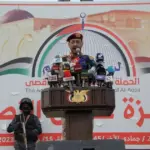


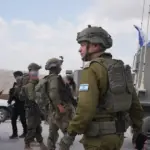



One day after Donald Trump announced an agreement to begin the disarmament of Hamas, his Peace Council published on Friday a 15-point roadmap demanding that Israel end its attacks and the Palestinian armed organization surrender its weapons.
Read more Trump announces new talks with Iran this Monday
The difference between the two conditions triggered doubts about the feasibility of implementing the pact. Hamas conditioned the delivery of its “heavy weaponry” on an Israeli withdrawal and other demands, while the Israeli government remained silent and warned, through anonymous sources, that it will not move its troops without “genuine” disarmament.
The Peace Council’s plan would leave key doubts about whether Hamas and Israel will comply with the agreement, according to The New York Times. The text gives the parties two weeks to determine a schedule, a deadline that an international verification committee can extend.
The ceasefire from October last year already required the Israeli Army to stop its attacks, but since then Israeli forces have maintained frequent airstrikes against targets attributed to Hamas and the Palestinian Islamic Jihad. More than 1,200 people have died in the territory since that truce, according to Gaza’s Ministry of Health.
The announcement came after months of efforts to sustain the truce sealed last year in Sharm el-Sheikh. According to Reuters, Trump called the pact a “major breakthrough” despite signs from Hamas and Israel that significant obstacles remained before its implementation.
“It is a great step for the Middle East, and people are really impressed and surprised,” said the U.S. president, one day after describing the understanding as an “important milestone” toward ending the war.
Mistrust in the pact originates from the order in which its demands should be fulfilled. In its first response, Hamas held that the “first step” should be Israel’s commitment to end the attacks, and linked the delivery of its “heavy weaponry” to the withdrawal from Gaza, reconstruction, the establishment of a Palestinian state, and other conditions. The Islamist group insisted that Israel must make concessions to move forward, according to the Times.
For its part, the Israeli government held the opposite position. An official source told Reuters that “there will be no withdrawal of the Israel Defense Forces (IDF) from the current Yellow Line unless Hamas submits to genuine disarmament,” referring to the demarcation line set in the ceasefire. Under that agreement, Israeli troops withdrew to that line and left about half of the territory under occupation, although since then they have advanced further into the enclave.
Hamas negotiator Ghazi Hamad told the agency that the group was willing to accept a “difficult and painful” pact. He avoided the word disarmament and described the understanding as a “comprehensive framework” subject to Israel implementing the first phase of the Sharm el-Sheikh agreement, which requires stopping attacks, pulling back forces to the October position, and increasing aid to the Palestinian enclave.
Only then would Hamas hand over its weapons for storage by the National Committee for the Administration of Gaza, the technocratic body created to manage the territory.
In the strip, skepticism abounds. “Trump should start on his part. Ceasefire, stop the killings, and complete the withdrawal of the Israeli Army from the Gaza Strip,” said Samir Ayad, 60, in a tent camp in Gaza City, in statements to Reuters.
“We don’t see any agreement, nothing of what he (Trump) says,” he stated. A few hours after the announcement, local medical authorities reported one Palestinian dead and several injured in at least two Israeli attacks.
Hamas’s arsenal has been the point of friction during months of talks in Egypt, one of the main mediators in the negotiations.
The Peace Council demanded that the group gradually hand over all its weaponry, a stance that, according to Israeli officials, Hamas will not accept. Armed struggle is central to the Islamist movement’s ideology and many of its members equate handing over weapons with surrender.
The text calls for the disarmament of factions once Israel fulfills the commitments of the October 2025 ceasefire, which include suspending military operations, pulling troops back to an agreed line, and allowing access for debris removal teams.
The document also states that the technocratic council will oversee a process to “dismantle and store heavy weaponry, military production facilities, weapons depots, and tunnels,” and specifies that no weapons will be handed over to Israel or any other non-Palestinian party.
Hamas’s statement mentioned only “heavy weaponry,” while the roadmap refers to all weapons, with an exception for personal weapons registered with the committee.
Regarding this, RAND Corporation’s head of Israel policy, Shira Efron, told The New York Times that Hamas’s maneuver seeks to shift the pressure. “For months, the narrative has been that Hamas does not want to disarm,” she said.
“Based on the information available so far, it seems that Hamas is evading responsibility, aware of how difficult it will be for the Israeli government to execute this agreement, especially any kind of withdrawal of its forces.” Efron anticipated that both parties could soon return to “a recurring blame game,” accusing each other of non-compliance without much changing in practice.
Meanwhile, Palestinian analyst close to Hamas, Ibrahim Al-Madhoun, said the group sought to end the war, although it feared Israel would evade compliance. “Hamas did everything possible to achieve an agreement based on reciprocity and simultaneous implementation,” he said. “Still, there is fear that Israel might obstruct it.”
The official Israeli response did not come immediately. Prime Minister Benjamin Netanyahu’s office did not issue a formal statement, and the ruler, facing elections on October 27 with probable support from his right-wing partners, also did not comment.
Itamar Ben-Gvir, Minister of National Security and leader of the far-right Jewish Power party, called the text “unacceptable for Israel” and stated on social media that selective killings in Gaza “must continue.” The Religious Zionism party minister, Orit Strouk, called the agreement “dangerous.”
Several analysts doubted that Israel would withdraw before the October elections. Nickolay Mladenov, senior representative of the Peace Council for Gaza, warned that “implementation and verification must be real” and that “withdrawal must go hand in hand with disarmament.”
UN Secretary-General António Guterres urged all parties to follow the roadmap “without doubts, skepticism, or intent to undermine it” and said “now is the time for both parties to implement what was agreed.”
According to an analysis by the Israeli newspaper Haaretz, Netanyahu would have been forced to accept the framework, perhaps as a condition for his visit to the United States last week, and trusts that the gaps in the roadmap will eventually sink it.
Before his trip, the security cabinet had already approved the entry of the technocratic government and the international stabilization force into Gaza, after conditioning that entry on Hamas’s disarmament. The Israeli newspaper added that the government has an interest in the agreement, for reasons different from Washington’s, and that Netanyahu cannot alienate Trump at this moment.
Thus, according to Haaretz, the pact would contain several points of friction for the Israeli government. Israel demands the delivery of rifles and rockets, the continued destruction of tunnels, and that disarmament be completed before the full withdrawal of the IDF, which controls about 60% of the Palestinian enclave.
The international stabilization force is currently limited to about 200 soldiers from Uganda and Morocco, with deployment planned near the Rafah crossing and the initial task of facilitating humanitarian aid. The plan also includes dismantling local militias opposed to Hamas, which upon handing over their weapons might seek protection in Israel.
Michael Milshtein, a researcher at the Moshe Dayan Center of Tel Aviv University, told the Israeli newspaper that he doubts Hamas has abandoned its resistance ideology or will hand over all its weapons. Therefore, he fears the implementation of the agreement will stall.
He attributed the decisive role to the three mediating countries, Egypt, Qatar, and Turkey, concerned by Netanyahu’s threats to conquer all of Gaza.
Thus, according to Haaretz, Prime Minister Netanyahu would have yielded to U.S. pressure, although the solutions under discussion are far from the “total victory” he promised during the last three years since the October 7, 2023 attack carried out by Hamas.
Reactions from the international community ranged from support to warnings about the pact’s implementation. Trump celebrated “a historic agreement for the complete disarmament of Hamas and all other armed groups in Gaza” and defined it as “a groundbreaking step toward lasting peace and security.”
On his Truth Social network, he presented it as “a crucial step for Gaza to finally be governed by a new Palestinian government that will work closely with the Peace Council,” and added that “Israel will have the security it deserves, as Gaza will cease to be a base for terrorist attacks.”
From Israel, internal rejection was heard again. Ben-Gvir called the commitment to stop the killings of Hamas leaders “equivalent to consenting to Hamas organizing the next massacre” and demanded that “the killings in Gaza must continue, immigration must be encouraged, Israel must win.”
Meanwhile, former Chief of Staff Gadi Eisenkot—one of the contenders to succeed Netanyahu—said the draft shows the “huge gap” between the prime minister’s promises and reality. “The State of Israel must not accept a reality in which Hamas survives, re-arms, and waits for the opportunity to perpetrate the next massacre,” he wrote, according to Al Jazeera.
Hamas reiterated that disarmament depends on Israel ceasing hostilities and withdrawing. “The occupation’s commitment to stop the killing is the fundamental requirement to proceed with implementation and establish a schedule for what was agreed,” declared the Islamist group.
Its negotiator Ghazi Hamad described the understanding as a “comprehensive package” covering the end of the offensive, troop withdrawal, deployment of the National Committee, and reconstruction, and said the group “made concessions for the good of the Palestinian people.” The Palestinian Islamic Jihad, however, expressed “reservations about the agreement in its current form.”
Among mediators and governments, the tone was somewhat more hopeful. Nickolay Mladenov acknowledged that “there were several moments when I doubted we would succeed” and warned that what happens next “matters even more” than the pact itself.
EU foreign policy chief Kaja Kallas called the plan, “if fully implemented,” a “constructive step toward peace,” although she warned that “many things must happen for this to work.” Pakistan’s Prime Minister Shehbaz Sharif trusted progress toward “an independent, sovereign, and contiguous Palestinian state based on pre-1967 borders.” Germany demanded that Hamas “must never again pose a threat to Israel,” while Belgium called for the framework to pave the way “for the return of the Palestinian government in Gaza and a new push toward a negotiated two-state solution.”