






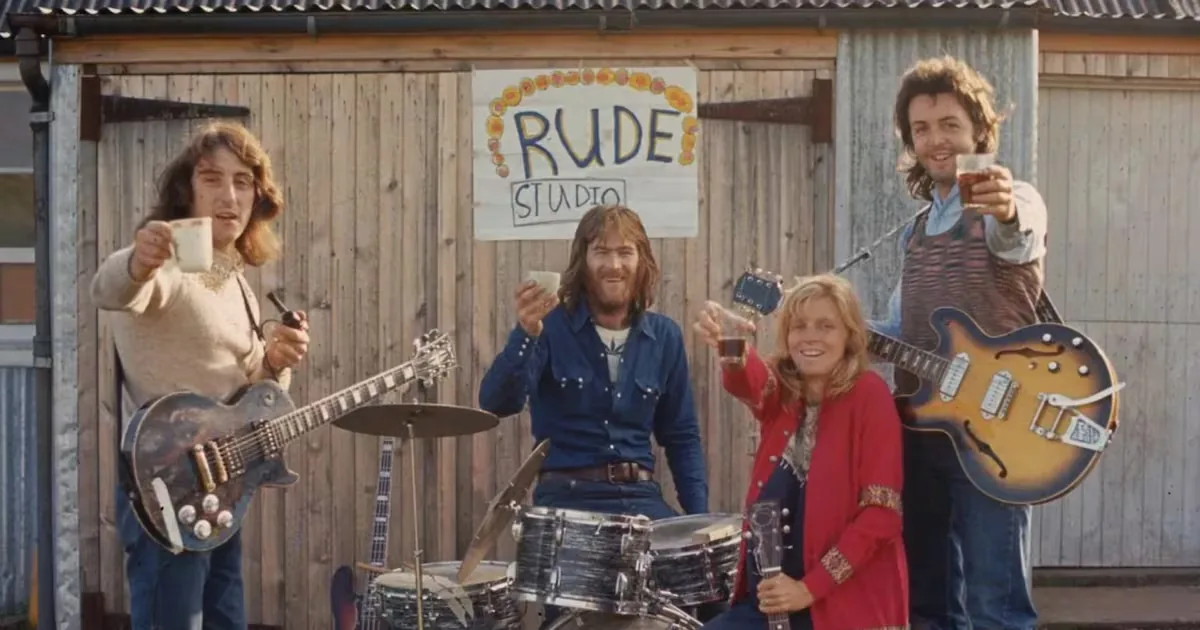
The idea of escape crosses some of Wings’ most famous themes, as in the immortal Band on the run. And it is because somehow, the project found Paul McCartney at a time when he was trying to be someone else; he left London to try the life of a farmer in the lands of Campbeltown, Scotland.
That life is the one narrated in Wings: A band on the run (Libros Cúpula), an oral history of the band with which McCartney resurfaced after the breakup of the Beatles. In fact, that is the starting point of the story, the separation of the Fab and the new life as a farmer, which he admits was difficult to handle. “I think we were not at all prepared for this wild adventure -he says in the prologue-. There were so many things we didn’t know.”
Worked on by writer Ted Widmer, who had access to the full recordings of Morgan Neville’s documentary Man on the Run, it also includes valuable testimonies from “Macca’s” circle, including his daughters Mary and Stella, his brother Michael, as well as musicians who passed through Wings like Denny Laine, Henry McCullough, among others.
Also included are brief biographies of all the musicians who passed through Wings and profiles of their entire discography, displayed in singles and albums.
Whether as an act of historical vindication or an exercise in memory, the book also profiles Linda McCartney, Paul’s wife who passed away in 1998 and a key figure in the period. She was not only a surprising member of Wings as a competent keyboardist, but according to “Macca” her drive was decisive in the most complex moments. “Linda’s spirit never faltered. She was that kind of woman”, he recalls.
Of course, the book addresses key milestones of the group, such as the complex recording of the album Band on the Run in Lagos, Nigeria. That was the pivotal moment for the band, when they began to have success. “We lived with just enough, we looked like a gang of teenagers playing guitar in the garage, but we were one of the best bands in the world,” remembers drummer Denny Seiwell.
For that record, Geoff Emerick was called, the sound engineer who met McCartney during his years working for the Beatles at Abbey Road studio. Although he acknowledges the work, he does not hesitate to detail how difficult it was to get used to the lack of comforts. “The EMI studio in Lagos was very small and had no acoustic panels, so we asked for them to be made”, he recalls.
Read more Is Texas close to becoming a Democratic state?
Actually, the technical difficulties were not the most complex. “I don’t like lizards, snakes, or insects -says Emerick-. Unfortunately, those are three things that abound in Nigeria.”
The review of the history ends in the early 80s, when Wings’ success began to gradually decline, conditioned by the low sales of London Town and Back to the Egg. Also, they were already beginning to be overwhelmed by the new generation of British bands.
That’s when the famous trip to Japan happened. A tour that promised much since the group had never played there and tickets for the shows had sold out. But, surprisingly, they did not manage to play because Paul was arrested and jailed for 9 days for possession of half a kilo of marijuana.
In the book, McCartney recounts that even before, there were things that made him uneasy. “I felt we hadn’t rehearsed enough and I don’t like that feeling (…) But we had already agreed and were going to rehearse in Tokyo. It seemed very rushed to me and I started to get very nervous. And then they caught me. I don’t know, it was all very strange. As if, deep down, I wanted to get caught to get out of it.”
The whole incident and the time in prison are narrated in detail even with the perspective of the artist’s daughters. “When my mother came back, she told us that dad was fine, but it was inevitable to think ‘what’s going to happen?’ ‘how long are we going to be here?’. I think, given the case, my mother would have moved to Japan with the whole family,” recalls Mary McCartney.
The book ends with Paul, back, working on his solo album McCartney II (1980), almost in a way analogous to what he did with his first solo album, amid the Beatles’ disintegration and the end of the 60s. The story doesn’t repeat, but it rhymes.