









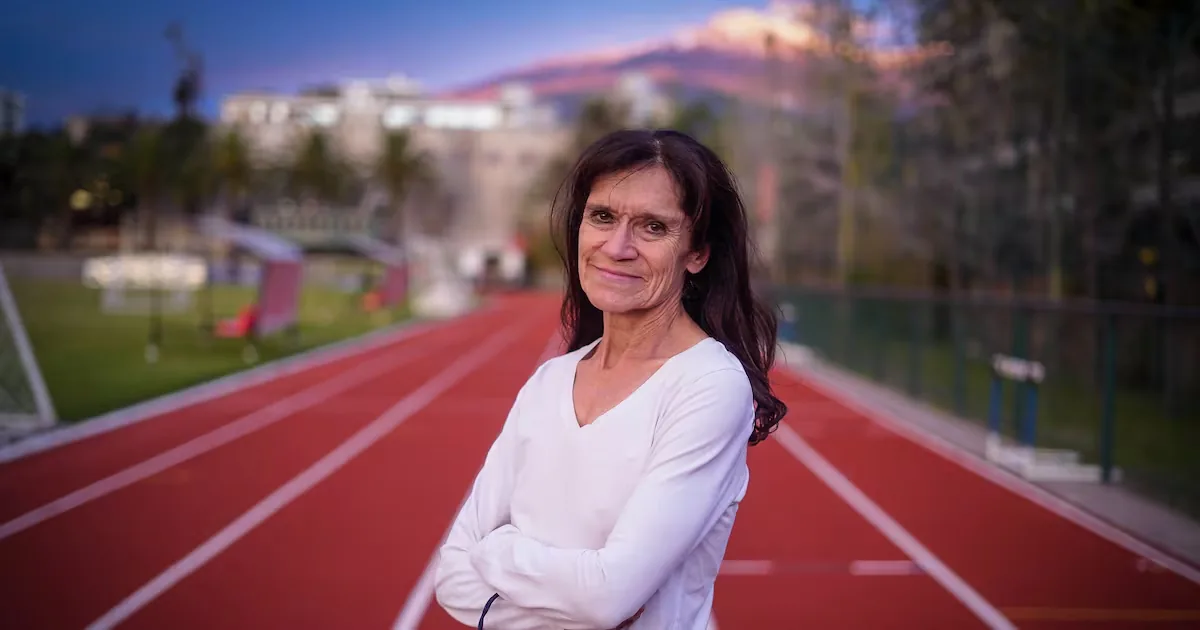
It was the mid-60s and Sara was ready to run her first race. Back then, the track at the National Stadium was ash, a surface made of fine, compacted material, much more uneven than today’s synthetic tracks. When she got into the starting position and placed her feet on the ground, she immediately felt the friction. “My knees hurt,” she recalls with a laugh. “What a drag,” she thought. But the race started and she ran as if nothing else mattered, not knowing that this race would mark the beginning of a passion that, more than six decades later, led her to win the gold at the World Masters Athletics Championship, in the W70 category, which includes women between 70 and 74 years old.
At 72 years old, Sara Montecinos has just returned from South Korea with that title. She won the 200 meters flat with a time of 30.33 seconds and, in the process, defended the gold she had won in the same event at the 2024 World Masters in Gothenburg, Sweden.
“I actually expected to win, maybe not by such a wide margin as it was, but I expected to have a good time and win. So, I wasn’t surprised to win. What excites me is representing your country. That’s the beautiful part,” she says. And for her, there is something that stands above the medal: “All the emotional part of the award ceremony, the national anthem, wearing the jersey, that is the most exciting part of all,” she assures.
Her relationship with athletics began long before she could imagine that one day she would be competing internationally at 72 years old. She was just 10 when her school teachers noticed she ran fast and included her in the athletics team. She started in sprint events and soon the first results came. “I always stood out in school tournaments. I won the 50 meters, the 80 meters, the 100 meters,” she recalls.
Since then, sport became a part of her life, although not always continuously. At 18, when she started studying Medicine, she had to quit: “It became impossible to balance studies with sport, because of schedules, study load, and the distances that had to be traveled at that time.” She finished her degree, did her residency, got married, and started a family. Athletics, however, remained present: “I always had that desire in my heart to do sports again, because I had a very nice experience doing youth athletics.”
She started jogging again around age 30, leading to one of her best sporting phases, in which she held the national record for the 400 meters flat in the adult female category, a record she held for more than two decades until athlete Martina Weil broke it in 2024.
Athletics was never Sara’s only life. While training and competing, she continued working as an anesthesiologist, raised a family, and kept her friends close. She explains it with an image: “Those are the four legs of my table,” she says. And there were times when holding them all up was difficult. After fifteen years of sporting success, work and family responsibilities eventually pulled her away from the tracks again. “In the meantime, I had kept jogging, but not competing,” she says.
At 60, that break became much deeper. Her husband, who was also her coach, passed away and Sara completely left athletics for about three years. But there was something that remained. That “desire, that vital need to do sports,” as she describes it, eventually brought her back. At 63, she resumed competing. Since then, she hasn’t stopped.
Read more Elections in Brazil: The role of Donald Trump and the ghost of João Goulart
Today she still works as an anesthesiologist and many of her days start in the operating room at seven in the morning. Athletics has to find space in between. “In the end, you always make time. It’s just a matter of organizing yourself,” she says. In an ideal week, she trains three days on the track and two in the gym; in a real week, she adjusts. If work runs late or a family commitment arises, she adapts her training.
At 72, Sara knows perfectly well how old she is. Another thing is how she lives it. “I don’t feel my age,” she says. She doesn’t hurt anywhere, feels good, and still plans her career as an athlete. “I’ve never felt that age is a barrier. Others try to make me feel that way, but I don’t feel it.”
That doesn’t mean she ignores the years or the care that comes with them. She talks about diet, rest, and physical activity, but above all about staying active. “The body is very grateful when treated well. If you treat it well, the body responds well,” she states.
And when she talks about moving, she’s not necessarily thinking about running 200 meters or winning a medal. It can be walking, dancing, cycling, or exercising, always gradually and according to each age. “I would say that at any age you can start doing sports. The important thing is to move.”
Because if there is one thing Sara cannot conceive, it is a completely sedentary life. She knows that one day she might stop competing; stopping moving is another thing. “When I was 40, I didn’t imagine that at 60 I would be running. And when I was 60, I didn’t imagine that at 70 I would be running. The possibilities decrease as you get older, but as long as I can, I will do it,” she says.
For now, she can and is already thinking about the next World Masters Athletics Championship, held every two years. Although when she talks about the future, her wish has nothing to do with times, medals, or records. After more than six decades of running, what she hopes is that this relationship with sport continues beyond her. “I hope my descendants will be athletes too,” she concludes.
Read more Falklands War: What was Chile’s role and secret aid to the United Kingdom?