





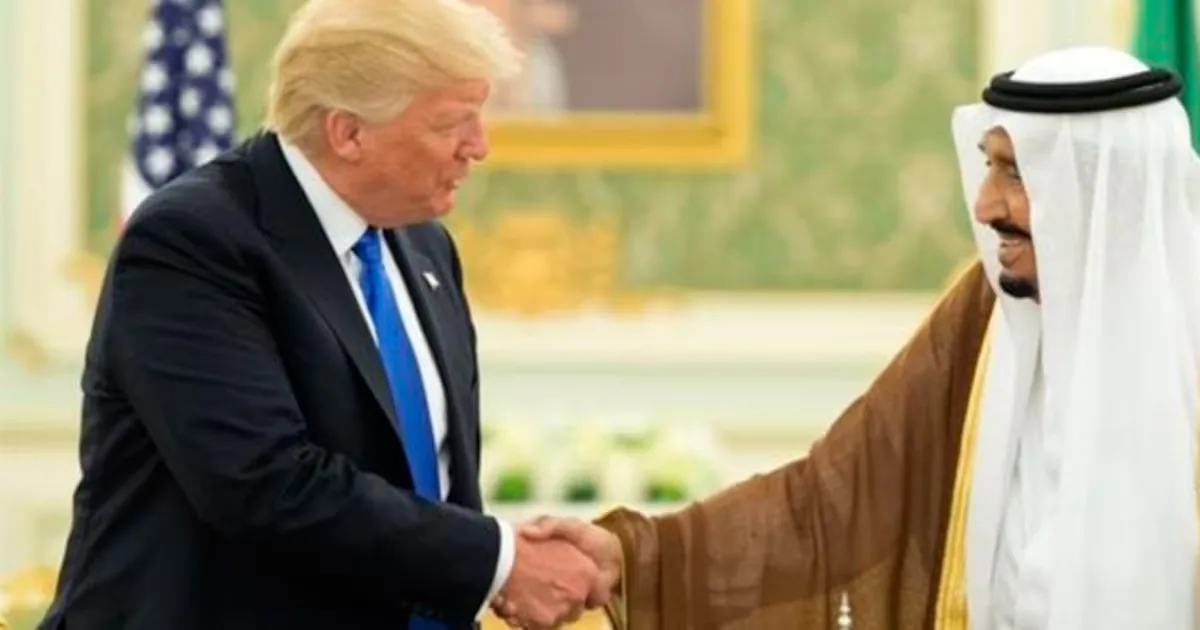
Donald Trump’s administration announced a broad nuclear agreement with Saudi Arabia that could lead the Arab kingdom to enrich its own reactor fuel, a concession that breaks decades-old restrictions imposed by the United States and revives fears of an arms race in the Middle East.
Read more Flávio Bolsonaro emulates his father and gathers foreign diplomats to question the electoral system
The news, according to The New York Times, surprised Israel and ignited opposition from U.S. lawmakers, both Democrats and Republicans.
The pact was signed under Section 123 of the U.S. Atomic Energy Act, the legally binding framework that sets non-proliferation obligations in nuclear cooperation.
However, the problem would lie in the information omitted from the agreement. According to two sources told Reuters, the text does not include the “gold standard” that prohibits Saudi Arabia from enriching uranium and reprocessing spent atomic fuel, the two ways to obtain material for the development of a warhead, nor an “additional protocol” for reinforced international oversight.
According to The New York Times, to close the deal with Crown Prince Mohammed bin Salman Al Saud, the country’s 40-year-old de facto leader, Trump had to accept conditions that could limit international inspectors’ access to any facility in the country that they believe could serve as a way to divert fuel to weapons projects.
Furthermore, the White House occupant would have agreed that, after a joint study with Saudi Arabia on the economic viability of nuclear fuel production, the Saudis could be allowed to enrich uranium or reprocess plutonium on their territory.
Thus, the conditions of the agreement differ from similar precedents. In its pact with the United Arab Emirates, in force since 2009, Abu Dhabi accepted rigorous inspections and renounced producing its own fuel, which eliminated the infrastructure to manufacture a weapon. That agreement became the benchmark for non-proliferation, and with Riyadh, Trump deviates from those restrictions.
Secretary of State, Marco Rubio, avoided confirming the pact to journalists accompanying him in Manila. “Perhaps today, when Washington wakes up, there will be an announcement,” he said. “I promise you will know.” And, asked about the risk of developing a Saudi arms program, he replied that “suffice it to say that the United States will not enter into any agreement with any country in the world that entails the risk of proliferation.”
However, the questioning is based on the Arab country’s own statements. Prince Mohammed has promised that he will build nuclear weapons if Iran does, and even stated in an interview that he would do so “without a doubt.”
The kingdom, which possesses uranium ore reserves, announced in January 2025 that it would enrich uranium to produce electricity fuel. Without strict guarantees, according to analysts consulted by Reuters, that capacity could be used to obtain highly enriched uranium, suitable for fissile material.
With this, Washington’s consistency is called into question, because one of the justifications for its war against Iran this year was Tehran’s refusal to renounce its own enrichment.
The announcement reportedly took Israel by surprise, which maintains a secret nuclear weapons program and a public research reactor, The New York Times noted.
Joe Biden’s administration had conditioned Saudi access to U.S. technology on Riyadh establishing diplomatic relations with Israel, one of Israeli Premier Benjamin Netanyahu’s main goals.
Read more France investigates the death of Daniel Siad, alleged recruiter of women for Epstein
However, Trump disengaged from both issues and moved forward with an agreement that, according to the U.S. newspaper, seems to completely bypass Israel. Analysts warn that it could encourage other countries, such as Turkey, to develop their own enrichment programs, and the Israeli opposition read it as a new sign of the country’s deteriorating influence in Washington.
In a radio interview, Israeli Economy Minister Nir Barkat commented on the Washington-Riyadh agreement. “If they want it for peaceful purposes, to cover their energy needs, we can manage it,” he declared, adding that normalization with Riyadh “is still on the table” and that Netanyahu and Trump “would not take risks for the State of Israel.”
At the same time, the Israeli opposition also reacted to the pact. “Every military nuclear program begins with a civilian one,” affirmed Avigdor Liberman, former Defense Minister, who asked Congress to stop an agreement capable of unleashing an arms race.
Former Defense Minister Benny Gantz also called it “a huge lost opportunity.” He then added: “Time and again, this extremist government loses opportunities to change the Middle East,” he wrote on social media. For his part, former Israeli Ambassador to Washington, Michael Herzog, pointed to the safeguards. “The fact that it is not linked to normalization, nor that the safeguards to prevent Saudi Arabia from starting a military program are not clear, are reasons for concern in Israel,” he declared.
The agreement requires review by the U.S. Congress, which can reject it under the Atomic Energy Act. There could be opposition in the American Congress where, according to Reuters, some members have previously demanded strict safeguards for any agreement involving the development of nuclear energy.
Despite the above -the agency noted- the agreement is likely to succeed because the opposition would not gather enough votes to overturn the presidential initiative. The text includes two secret supplementary letters, and some lawmakers anticipate they will not vote until these are published.
According to the same agency, Riyadh justifies its atomic gamble with the Vision 2030 plan, which seeks to reduce domestic crude consumption to free it up for export. Washington would also gain, as the agreement allows its industry to capture multi-million dollar contracts and closely monitor the Saudi program.
If the pact fails, Riyadh already has options. Should the pact between the United States and Saudi Arabia not succeed, even at this advanced stage, several countries with consolidated nuclear industries have expressed interest or are considered potential partners for the Saudi nuclear program.
According to reports cited by Reuters, the Chinese state-owned company China National Nuclear Corp (CNNC) submitted a bid in 2023 to build a nuclear power plant.
The Russian state-owned company Rosatom, which built a nuclear power plant in Egypt, has also signed preliminary cooperation agreements with Riyadh. Other potential candidates include South Korea, which built reactors in the United Arab Emirates, and France.
The choice of partner will likely depend on technological offers, financing, and geopolitical alignment, including conditions related to nuclear fuel management, Reuters noted.
Read more Yogi tea