


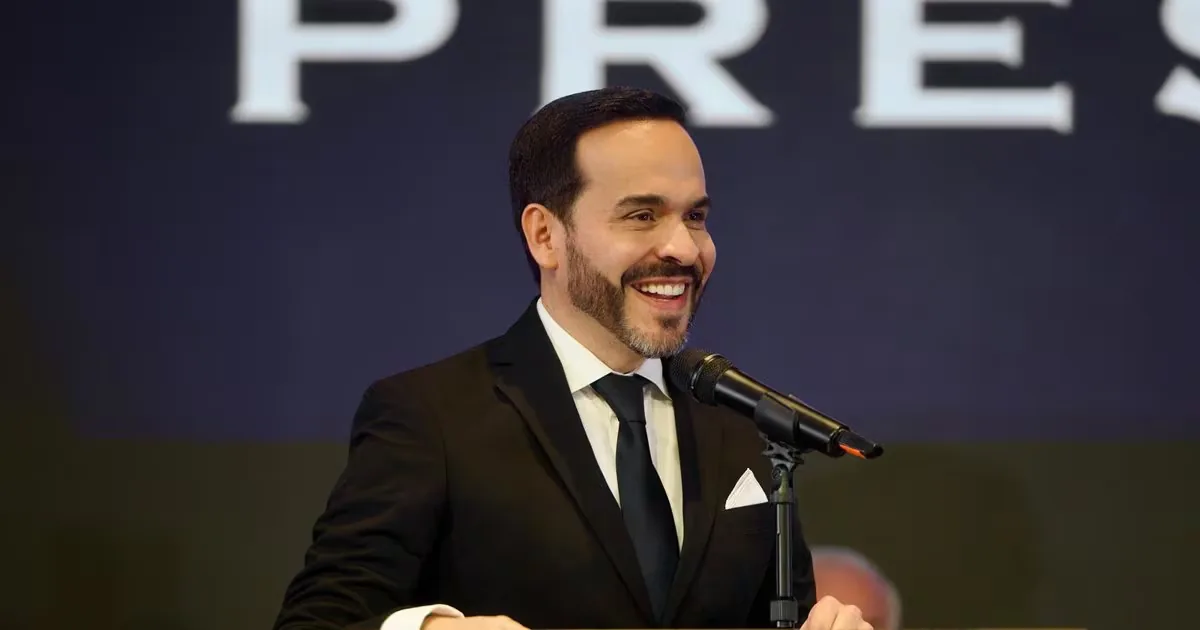
As the days go by, the president-elect of Colombia, Abelardo De La Espriella, is giving clues about what his government will be like once he takes office on August 7.
Read more China asks Trump to stop making «baseless accusations» after election interference complaint
“From Bucaramanga I reaffirm a principle of government: less talk and more action. I am not a merchant of illusions; I am a businessman of realities,” promised the far-right politician this Thursday through his X account.
But already this Monday De la Espriella caused controversy by announcing the elimination of advisory councils and agencies linked to the presidency of the Republic, including the Commissioner for Peace, who has led negotiations with illegal armed groups.
“The Commissioner for Peace is over, because there will be no more false peace processes in my government,” said the president-elect in a message to the country through his social networks.
In an interview with La Tercera, Colombian political scientist and Master’s in Government academic at the Autonomous University of Chile, Iván Garzón, analyzes the impact of De la Espriella’s announcements on Colombian peace policy and their effects on regional stability.
What does the decision of president-elect Abelardo de la Espriella to eliminate the Commissioner for Peace and end dialogues with illegal armed groups imply?
A further message that the center of his administration will be security policies and territorial control. And at the same time a new staging of the public trial of punishment against Gustavo Petro’s government.
De la Espriella has stated that he seeks to dismantle what he calls a “system of impunity” associated with negotiating bodies. How effective have dialogue processes with armed groups been in reducing violence and advancing towards sustainable peace in Colombia? Could their elimination strengthen or weaken those objectives?
Between 1990 and 2017, peace processes in Colombia have taken about 50,000 combatants out of violence. Without a doubt, this is a successful balance, beyond the post-demobilization scenarios of each one. Contrary to this tradition, De la Espriella’s hardline discourse rides on an incontrovertible fact: in almost four years, the ‘total peace’ policy promoted by Petro and designed by Iván Cepeda did not achieve the demobilization of a single armed man.
Does this shift represent a break with Petro’s “total peace” policy?
The shift is radical (zero negotiation) and the elimination of the historic figure of the Commissioner for Peace, a kind of Minister responsible for promoting negotiation processes with insurgents and criminal gangs, confirms it. It is, moreover, a pendular issue in Colombian politics: Pastrana (negotiation), Uribe 1 and 2 (military approach), Santos 1 and 2 (negotiation), Duque (military approach), Petro (negotiation), De la Espriella (military approach). The country has tried as many times peace as all-out war against insurgents and criminals.
Does the President have the legal powers to implement these changes or will he require legal reforms or support from Congress?
He has the executive powers to project a security policy as pacification and submission to justice. Rather, it is the peace policies that have traditionally sought regulation and political support in Congress.
What impact could the new security policy have on regional stability and Colombia’s relationship with neighboring countries?
The resumption of glyphosate spraying on the southern border could reopen old conflicts with Ecuador, although the ideological closeness between Daniel Noboa and De la Espriella suggests that if so, it will not be handled in a hostile manner. With Venezuela, since the intervention of the United States it is clear that the ELN’s strategic rear has been weakened and the government of Delcy Rodríguez does not have the political capital to play any mediating or diplomatic role as Chávez and Maduro did in the past. Now, it can be anticipated that if urban security indicators begin to improve from the next month he takes office, organized crime and common delinquency involving Venezuelan citizens will produce a balloon effect, that is, it will displace to other countries, at least relatively, since Colombia still has many perverse incentives for illegal economies and violent crime.