


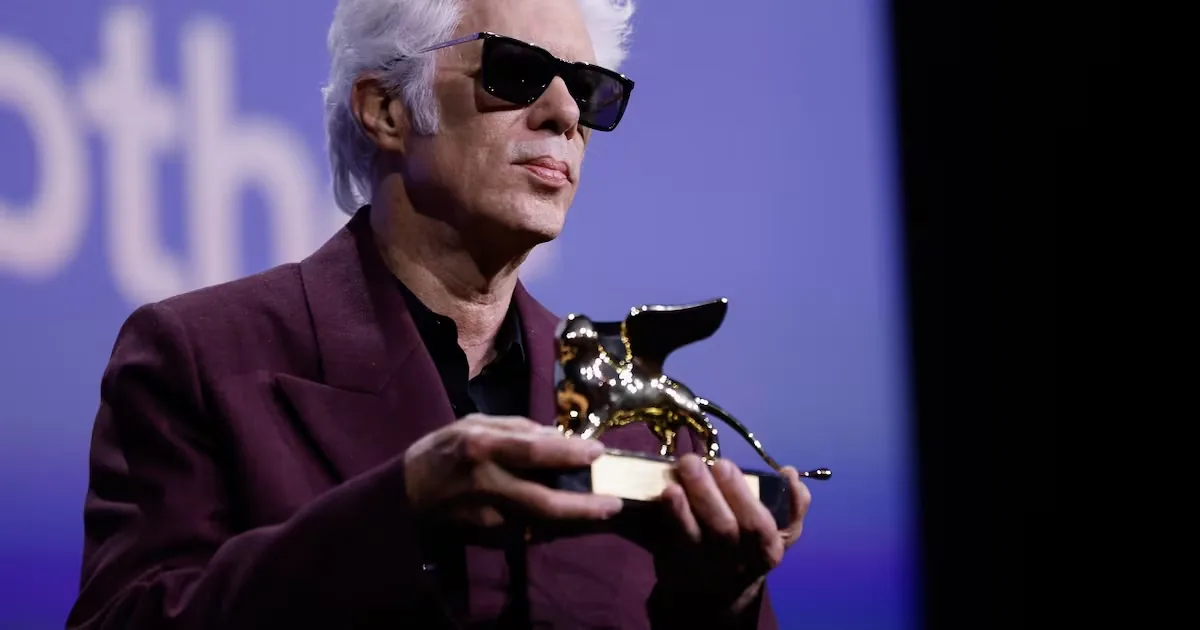
Jim Jarmusch (Ohio, 1953) was always closer to his mother, a film critic, than to his father, a businessman of German descent who never accepted his dedication to filmmaking and with whom he had friction from an early age.
Read more Pentagon chief urges Europe to act against ‘migratory invasion’ during D-Day event
Perhaps, if he were an artist who thinks and lives cinema as a means to exorcise his demons, he would have embarked on making a film about the explosive relationship between a son and his father. However, Jarmusch, a director who has forged his own language since the 80s, has conceived a body of work filled with a serenity characteristic of his style.
With Father Mother Sister Brother, his most recent feature film, the author of Stranger than paradise (1984) set out to do what he calls “three small floral arrangements”, that is, three stories that revolve around children and parents who share a difficult (or outright absent) relationship. An exercise dominated by unspoken words and a thin layer of humor.
His idea, he explains to Culto from his apartment in New York, was for them to be “observational, not critical or judgmental. All the characters have flaws, like all of us. And we see some of their flaws, we see their communication difficulties. But I just wanted to observe them with empathy. I don’t pretend to say anything in particular, except that empathy is important. I just wanted to encourage empathetic observation.”
Jarmusch’s creative process consists of writing with actors he has already worked with or would like to work with in mind, rather than a too-defined story or concept. Following the same logic again, this time the origin of the idea is linked to the fact that he began to imagine Tom Waits and Adam Driver as father and son. Then he proposed that actress Mayim Bialik – whom he identified as one of the hosts of the show Jeopardy! – could be the other member of that family, and so, little by little, he ended up weaving a film composed of three independent segments.
The second section stars Charlotte Rampling, Cate Blanchett, and Vicky Krieps, and the third is set in Paris and features Indya Moore and Luka Sabbat as two siblings dealing with the void left by the death of their parents. “It all happened somewhat unpredictably, so to speak,” he says.
Awarded the Golden Lion at the Venice Film Festival 2025 – and recently added to the Mubi platform’s catalog – the film is a return to the register where the director feels most comfortable: small, understated stories, full of humanity, where richness lies in details and subtle gestures rather than broad strokes. A new demonstration that there are few at his level when it comes to weaving, in principle, anti-dramatic situations.
“I didn’t really want to make a film about the complex dynamics of family interaction, but rather to observe the details without judging,” he emphasizes.
-On other occasions, you have said that you believe this film works as an accumulation. How concerned were you with maintaining cohesion between the three stories without anything being too obvious?
We built this film very delicately, starting from the details. And I appreciate that you see it, because it takes a lot of effort to make it seem easy. There are no big events, no drama, no action, no sex, no violence. There isn’t what you usually expect in plots. There’s no revenge, no conflict resolution, none of that. We simply observe small details between people and accumulate them. And that’s why the accumulation was so careful, as if composing a piece of music in three different movements. So yes, it took a lot of effort and I’m proud of this accumulation. This is a separate thing, but I find it interesting that it’s as if the parents (of the three chapters) were setting up small theatrical stages (…) That doesn’t exactly answer your question, but it’s another aspect I kept in mind as a kind of guide for accumulating visual and emotional details.
-Unlike the siblings in the first two chapters, the twins in the third segment seem very close. Where did that come from?
There’s a tenderness between them. My mother and her brother were twins, and they were quite telepathic, that’s where the idea came from. (This chapter) is not about miscommunication, but about absence. They face loss, and they have each other, and they have a very close, even telepathic, connection to some extent. Therefore, that story delves into slightly different territory than miscommunication. It’s really about loss, in a way about grief and tenderness. So that was a slight change in the musical tone of things, because each chapter has a different musical tone.
Read more Julieta Venegas and her love letter to Tijuana
-How did you work with the film’s sense of time?
For me, time is quite naturalistic. Time is very important in this film because everything happens in a short period, basically one afternoon. Just like in music, the notes that are not played affect those that are. What is omitted, like the rhythm of the dialogues or the pauses, becomes very important for the overall music. In these three chapters, this sense of time resides in the rhythm of things and in what is left unsaid.
Perhaps the most ambitious gesture of his new feature film is that Father Mother Sister Brother was filmed between New Jersey, Dublin, and Paris. Quite a luxury for an initiative that, despite having big stars in its cast, remains an independent production.
“I love to travel. I also love being in places I don’t fully know, so having the opportunity to work in these other places was a great pleasure. And it was a challenge. Our teams were different in each place, though not entirely distinct,” he points out.
While he emphasizes that “in all three I found great beauty and interest,” the French capital stands out because he spent part of his youth there. “Paris is part of my life, so I was very careful and worked very carefully with Yorick (Le Saux), the cinematographer, and with Marco (Bittner Rosser), the production designer, not to show a touristy Paris, but a Paris that worked for the story. And I think we achieved that.”
The author of Broken Flowers (2005) marvels when talking about some accidents that occurred during the making of the film. A couple of examples? Originally Cate Blanchett and Vicky Krieps, sisters in the second section, were to play opposite characters, but he found that both actresses asked to embody the other’s role. Far from being complicated, he gladly accepted the request.
“Working with both was a real joy. And Charlotte Rampling, oh, God, what a gift to work with her. I just spent time with her in Paris doing some press and now I just sent her a message just to tell her I’m feeling separation anxiety, because I miss her. She’s a fantastic, amazing human being. I love Charlotte Rampling.”
-You had already worked with several of the actors participating in the film. What does that bring to your process?
You get a kind of shorthand, a kind of trust. I say this as a kind of compliment: when you work with actors, in a way you are a kind of parent. Because… How do I say this? The very fact of being an actor implies adopting a kind of childlike attitude that is imposed on them. That is, you are going to pretend to be someone else on demand, and the tools you use are your personal experiences and emotions. That’s like putting someone in a kind of precarious situation. And they have to be somewhat free and, on some level, childlike, so I have to guide them. I don’t say it as a negative thing. And if you’ve worked with them before, there’s a kind of established trust. That’s very valuable. I find it very interesting to have that trust from them.
-While the film talks about generations, we only see the younger generations through brief appearances of skaters. Was that intentional? How do you feel about the possibility of representing Generation Z?
I think one is ageless if one is interested in all age groups and doesn’t identify with any, which is my case. I have friends who are 85. I have friends who are 15. I just like to be open to all perspectives from different age groups, from different people. I’ve been in limousines with movie stars. I’ve been to fancy fashion parties in Paris. I’ve been to punk rock clubs with floors covered in vomit. I’ve worked in a steel mill. I’ve seen a lot of things and I like to observe different perspectives of how people live in the world. And this also applies to their ages. I love skaters because, for me, they represent a kind of freedom. They live as they want. They move around with a small device with wheels that makes them free. They dress in their own style. They don’t like authorities. They don’t like being told what to do. They are often non-binary and anti-authoritarian. I am very attracted to their spirit. That’s why I liked including them in the film, as a kind of respite, as a kind of homage to their freedom.
Read more Díaz-Canel accuses the US of strengthening the blockade after new sanctions against Cuba