
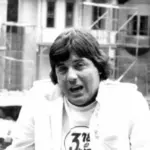







The series Moria, the new production from Netflix, is already in the top 3 most-watched series on the “Big N” in Chile. Directed by Javier Van de Couter, it tells the story of the famous Argentine vedette and television figure Moria Casán in different stages of her life across eight episodes.
Read more The race for the 2026 National History Award: who are the candidates competing for the prize
The diva is portrayed by different actresses, who represent her at different moments. Sofía Gala Castiglione (Moria’s daughter) as young Moria; Griselda Siciliani as adult Moria; Cecilia Roth as elderly Moria; and also Moria herself plays herself in the present day.
The media have already begun commenting on it. The prestigious Clarín, from Buenos Aires, states: “It is not just another audiovisual biography: it is a gem between the subtle and the kitsch, the real and the dreamlike, love and chaos, with an aesthetic approach that breaks all the molds of the genre. Tailored: monumental. It is ‘the series about Moria,’ in which she is seen shining, but also suffering, overflowing, neglecting herself, overdoing it, she is seen as few figures are shown in an authorized biography. She is seen as a complex creature.”
“The three Morias rise to the challenge, with Sofía Gala performing it almost by heart, masterfully: her daughter knows all the movements, gestures, silences, posture, emotions, everything. She embodies her – quite a paradox – in the first three episodes, where she appears with her real name Ana María Casanova and also with her trademark.”
“Moria: a ‘mostra’ series for the ‘mostra’ diva – notes El País -. Moria shines more the further it moves away from historical events and the sanctification via LGTBIQ+ icon and the more it lets itself be swept away by its fantastic elements and the character’s contradictions.”
“Moria is an excessive, delirious, frivolous, and histrionic series – adds the Spanish daily -. That is, like its own protagonist, who loves to define herself as mostra. Thus, this string of adjectives, far from being a drawback, can be considered, to a greater or lesser extent, a compliment, especially if one is interested in the character. Coffee for very coffee lovers? Mate for very mate lovers. It shines more the further it moves away from historical events (to depict a cardboard dictatorship better not to depict it at all) and the sanctification via LGTBIQ+ icon and the more it lets itself be swept away by its fantastic elements and the contradictions of the character, played in her three stages by Sofía Gala Castiglione (who I hope has a good therapist after playing her mother), Griselda Siciliani (my favorite, protagonist of the most succulent era) and Cecilia Roth.”
The specialized site Micropsia Cine states: “Even within Netflix’s most conventional parameters, Moria is challenging, takes a point of view — here it is not so much the popular diva of massive reach but the ‘queen of the gays, lesbians, and trans women’ — and stays living inside it. Decision made and right. Any more conventional biopic would have fallen into endless discussions about mimesis, similarities or differences, recounts of years, facts and situations, and other trivialities of the plausibility universe. None of that matters here. Or rather, it matters insofar as it is coherent with fantasy and imagination.”
“Here there is no parody nor attempts at national sociology: Moria is a first-person portrait that has similar pretensions to those of its protagonist, believing that traditional media can be used to do something disruptive with them. Moria Casán was and is like that, taking advantage of the voluptuous sex symbol figure to make a transgressive icon out of it. And Van de Couter bets that his series will be part of that noble and radical heritage. Taking a structure (in his case, that of platform series) that is on its way to becoming a repetitive commercial format and making a personal and equally transgressive version with it. That is where Moria and Moria live: at the exact intersection between fantasy, science fiction, and what they call reality.”
Read more China insists to South Korea that the United States abandon its “hostile policy” towards Pyongyang
On the other hand, La Nación, from Argentina, bets: “Moria: tenderness, sex, drama, and humor in a biopic that completely breaks the mold” and adds: “How is Moria’s life told? How is the intimacy of a figure who always played at erasing the boundaries between public and private explored? How to peek into the skull of a ‘mostra woman’ who knew how to reinvent herself a thousand times? The only possible answer comes through a biopic with its own signature, emphasizing subjectivity, thus celebrating the most important bond the honoree herself has.”
“Here it is unavoidable to highlight the enormity of Sofía Gala Castiglione in the skin of a young Moria, the warmth of Mario Castiglione by Marco Antonio Caponi, the solidity of Olivia Nuss as Sofía Gala, or the immensity of Griselda Siciliani and Cecilia Roth to portray the diva in her adulthood. But reducing the series to its performances is not to grasp the essence of Moria herself, whom this fiction honors through the search to destroy established narrative canons.”
Despite favorable comments, the series faces a setback. It is a lawsuit that Ingrid Vadalá, the eldest daughter of Luis Vadalá – Moria’s ex-partner – is preparing against the production.
Luis Vadalá died in 2023 and in the series is portrayed by Joaquín Ferreira. Ingrid’s main objection points to the personality the fiction attributes to him: “My dad was not such a person, he was a gentleman, a polite and respectful man.” She added: “They have tried to show him as a grotesque, rude person.”
“Practically everything that has been shown has no relation to what really happened. Even the beginning of the story was presented in a way that does not match reality, the end of that relationship was not as they show it,” the woman told the Argentine media.
Also, the daughter rejects the insinuations the series makes about Luis Vadalá having kept something that did not belong to him after separating from Moria. “If what they try to insinuate had really happened, that is, that my dad had kept something that did not belong to him, he would not have gone through the economic hardships he had after the separation,” Ingrid said.