






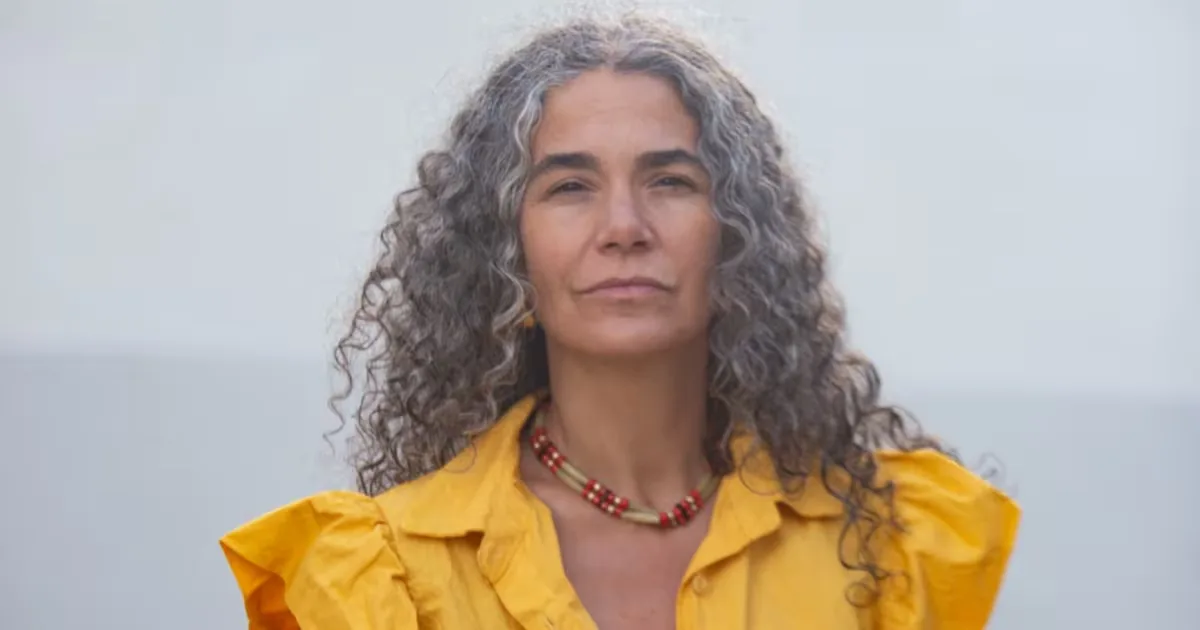
It all started with a trip. Natalia Contesse (48) had just finished high school. Her time at school had not completely fulfilled her, and therefore, the first thing she did upon graduating was to begin a personal search. Since she was a child, she had sung; music was always heard in her family, there were many musicians, but nothing folkloric. So she traveled north. She stayed there for three years, in the Atacama desert. She connected with community life in different territories where rituality and nature played a very important role. She learned trades because she had to make a living and began to sing, create songs, do goldsmithing and ceramics.
Read more How Sweden managed to reduce shootings amid a gang violence crisis
Of course, when she returned to Santiago, she was not the same. “I came back from that trip, I believe, with an internal decolonization,” she says. So she began a search, an inquiry through singing and poetic word, as she says, that led her to Violeta Parra.
Natalia had lived her whole life in the La Reina commune. Naturally, her research began nearby. During her years in the north, she had learned part of Violeta’s repertoire and, when she returned, she discovered that just a few blocks from where she herself had grown up, the Carpa de La Reina had been. So she began to investigate that history.
She often went to the block where she had been told the tent had been. She stayed there, composed, “breathed that place.” And in that wandering, she found, a few meters away, an abandoned municipal space that had previously been the Civil Registry and municipal library. She called on sculptor Marien Leible and together they sought advice, went to the municipal council, and presented a project to recover that place and continue, in some way, the work that Violeta had started in that very territory. They formed themselves as a community organization and managed to get the municipality to grant them the space on loan.
It was 2008. The place was abandoned, so they organized mingas to clean it and began holding music and poetry gatherings. Over time, however, a question began to arise: what was it really that Violeta Parra had wanted to do there? Because people talked about the peña, the Carpa de La Reina, but little about the project behind it.
The answer began to appear, in part, thanks to those who still kept that memory. One day, after one of the gatherings, some elderly people approached Natalia. They told her that years before they had decided to move to La Reina when they learned that Violeta would settle there with a tent. Such was the expectation generated by what could happen in that place. For Natalia, it was a turning point.
Some time later, Natalia secured funding and together with director Gastón Orellana made a documentary about the history of the Carpa de La Reina. They interviewed those who had known Violeta closely and had been in that place: Patricio Manns, Ángel Parra, Margot Loyola, Erick Pohlammer, among others. It was while making that documentary that Natalia truly understood Violeta’s dream: to create a great school of popular culture in Chile, a University of Folklore.
“In 2013 we had a tent made, presented a project, and everything came together. These are dreams that are there. One is only a mediator. One is there to give continuity to things, to the memory of a territory,” she reflects.
Read more The AI apocalypse: Experts debate how technology could rebel against humans
They spent ten years touring with that tent, which they called La Carpa de los Oficios, giving back to people education, trades, singing, the cueca, and the tonada. The first time they set it up was on September 18, 2014, in O’Higgins Park. “It was very revolutionary because the fondas were all about partying,” she recalls. La Carpa de los Oficios marked a milestone: workshops began to appear and today, Natalia says, they can be found in many fondas. “It’s wonderful. Now people don’t just go to party and drink,” she says. There is also space to learn a trade, sing, dance, or connect in another way with Chilean traditions.
Today La Carpa de los Oficios is on pause, after ten years of touring, but the Chilean School of Folklore and Trades continues to operate in the Aldea del Encuentro, in La Reina. For Natalia, that knowledge remains necessary. Perhaps even more than before. “I do not condemn the development of technologies, but what are the alternative paths? And trades are one of them. Because hands working with clay to mold, weaving on a loom, that is unique (…) What the hand gives and the strength of the hand is a continuity of the mind, the heart, the blood.” Today, she says, our main movement is sliding a finger over a screen. “The value of really being able to put your hands on fibers, touch and create, that today is a revolution for a child whose only wish is to be handed the phone,” she says and wonders: “How can we return to that totality of talents we have as a species that technology is atrophying?”
In trades, in folklore, and in the celebrations that keep them alive lies part of that answer. “Bringing back those memories ultimately connects us with another way of being on the earth, another way of caring for the community, of communal enjoyment, of shared celebration,” she says. A fiber leads to the animal it comes from; a weaving, to those who learned to make it before. “Everything has a story,” says Natalia. A story of lives raised together and where a ‘we’ appears above the individual.
And if there is a figure that gathers many of that knowledge, it is the singer, says Natalia. Women who not only sang but were also weavers, midwives, ceramists, or knew plants and their uses. “The singer is a woman connected to the earth. That is why she has that repertoire full of images of flowers and plants. She can, in a tonada, offer a bud because she knows which are the medicinal plants, their active principles, and what the person she is going to sing to needs.” A blue violet for sadness and, if sorrows increase, a lemon balm bud, as Violeta would say.
In the countryside, Natalia says, it was the women who had the guitars and often it was frowned upon for men to play the guitar or harp. But that freedom had its own limits. “Many singers, including my great-grandmother, had to stop being singers when they got married. Not just any man can live with a partner who is going to sing to the world, whom everyone will look at and who will officiate the celebration,” she says.
That is why, for Natalia, returning to folklore and trades in these National Holidays is also an opportunity to look beyond the tradition we celebrate every September and ask ourselves about the stories, knowledge, and ways of living behind it. To return to the singers, to the hands that weave, to the plants that heal, to the songs learned by listening to those who came before.
Violeta, for Natalia, is part of that chain. “Violeta is because the singers exist, their singer ancestors, and she saw the incomparable value that was there.” That is why, she says, when you listen to Violeta after having listened to the singers, “you realize there is a network, an indissoluble thread.”
Read more Cuba suffers its eighth massive blackout of the year: cellular phone and internet outages reported