





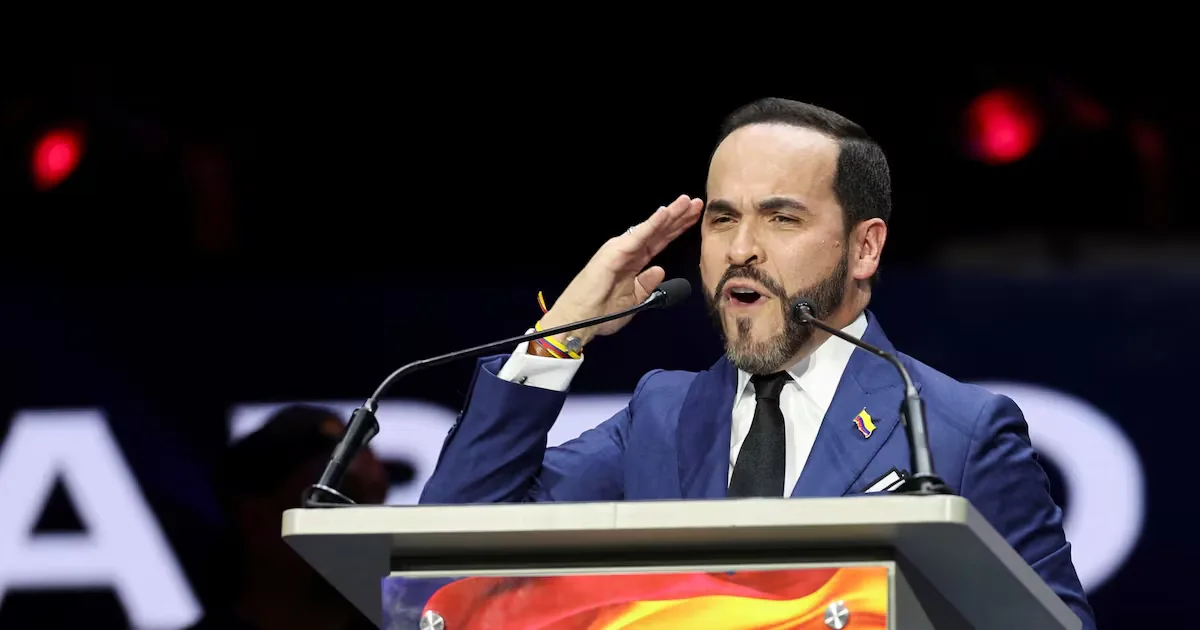
Abelardo de la Espriella, the controversial criminal lawyer running for the presidency of Colombia, took the lead in Sunday’s first round by surpassing Iván Cepeda, the candidate for the Casa de Nariño from the ruling party, Historic Pact.
Read more Def Leppard returns to Chile with Extreme as guest
Specifically, with all polling stations subjected to the preliminary count – a quick recount process without legal validity – and with more than 10,300,000 votes, the candidate from the far-right movement Defenders of the Homeland reached 43.74% of the preferences, while the official candidate got 40.9%.
With this, De la Espriella surprisingly exceeded voting expectations, as opinion polls prior to the election day indicated the president Gustavo Petro’s candidate as the one leading the preferences. Meanwhile, Paloma Valencia, the candidate from the Democratic Center – the Uribist party, the traditional Colombian right – failed to surpass 10% of the votes, falling out of the runoff scheduled for June 21.
According to the Colombian magazine Semana, this happened after several weeks of confrontation between De la Espriella and Valencia, in which there were attacks and criticisms between both campaigns. Additionally, there were questions raised against the Uribist candidate due to the support of questionable figures who announced their backing.
Despite the tension from the attacks, De la Espriella always expressed respect and admiration for the former Colombian president, Álvaro Uribe Vélez (2002-2010), showing affinity with his Uribist bases but distancing himself from the party structure and some figures who accompanied them.
In fact, in an interview with the Colombian magazine, the leader of the patriotic movement stated that the Uribist doctrine does not belong to former president Uribe or Paloma Valencia, but is a legacy that he has “embraced and updated” in his electoral discourse.
“The Uribist doctrine is no longer Uribe’s, nor Paloma’s, nor the Democratic Center’s. It is a legacy to Colombian democracy. It is a doctrine that has no owner and what I did was embrace and update it because it really served Colombia a lot in a very complex moment. We will never forget that,” De la Espriella said in the days before the first round.
In this way – Semana pointed out – the supposed path to “post-Uribism” would open, which aims to be a current that does not break with Uribe, but does break with the idea that his doctrine depends on the Democratic Center or its natural heirs. De la Espriella takes up the banners, updates them in a more direct discourse, and represents them without going through the party structure that for years managed that legacy.
Likewise, the stampede of support from the Uribist bases from Paloma Valencia’s campaign to De la Espriella’s suggests, as the lawyer himself warned, that the Democratic Center electorate ended up identifying with him.
“The bases of the Democratic Center have been here for a while and I thank them, and they are here because the true Uribist doctrine is no longer Uribe’s, nor Paloma’s, nor the Democratic Center’s,” De la Espriella told the Colombian media.
The former president now enters a new stage of his legacy. For the second consecutive time, the Uribist candidate loses in a presidential election (Óscar Iván Zuluaga renounced his presidential aspiration in 2022 to join the campaign of the Equipo por Colombia candidate, Federico Gutiérrez), undoubtedly – Semana noted – this could be the most resounding defeat of someone who has been considered one of the great kingmakers in Colombia.
For more than two decades, Álvaro Uribe dominated Colombian politics. He won presidential elections, promoted parties, built legislative majorities, and became the most influential figure of the right in Colombia.
But the political scenario of recent years, reported La Estrella de Panamá, is beginning to show signs of wear in that power that for years seemed unmovable. Presidential polls reflected a new uncomfortable reality for Uribism: while the former president was actively involved in Valencia’s campaign, she remained relegated to third place in voting intention.
At the forefront appeared – the Panamanian media noted – precisely one of his greatest political adversaries: Cepeda, the left-wing senator who led the judicial process that brought Uribe to the dock for alleged links with paramilitary organizations and witness manipulation.
For sectors close to the former president, this election represents much more than a political dispute. “For Uribe it is fundamental that the one who promoted the judicial process against him does not win,” Uribist sources admitted to La Estrella de Panamá.
However, the greatest threat to Uribe’s historic leadership seems to come from the right itself. Lawyer De la Espriella managed to position himself as an anti-system figure capable of disputing the conservative vote without depending on the former president’s support.
Thus, political analysts already talk about the emergence of a “post-Uribism”: a right that recognizes Uribe’s political legacy but seeks new forms, new discourses, and new leaderships.
“The ‘post-Uribism’ has begun, Abelardo with the Uribist base without Uribe,” said a person close to Valencia’s campaign and the Uribist bench to the media La Silla Vacía.
“If that stays like this, with Abelardo sweeping the other right-wing candidate, here the burial of Uribism and the birth of a new right where many people who say they are in this place of the spectrum will have to reconfigure positions is announced,” said the columnist supporting Valencia, Diego Santos, quoted by La Silla Vacía.
Read more Keiko Fujimori and Roberto Sánchez’s statements in their only debate before the runoff in Peru
One of the factors that could explain De la Espriella’s victory would be the way and the means in which he focused his campaign. Unlike the traditional style of the former president – based for years on appearances in public squares, community councils, and television – De la Espriella’s formula bet on extensive use of social networks, artificial intelligence, viral videos, and a narrative closer to leaders like Javier Milei, Nayib Bukele, and Donald Trump.
“The phenomenon represents a more modern and more aggressive right in digital terms,” experts cited by the Panamanian media explained.
“Abelardo de la Espriella is the ‘post-Uribism’,” said Luis Trejos, a Political Science professor at Universidad del Norte, to El País. “It is the right without Uribe, but without denying Uribe’s legacy. And it is a more modern right in its forms: its show, its staging of the platforms, its use of AI and social networks. In that sense, it is a more Milei, more Bukele, more Trump right. When Uribe was president, Twitter was incipient,” the academic recalled.
Uribe’s was the right of community councils on television. De la Espriella’s is the TikTok spectacle.
But Uribism also tried to adapt. For the first time, Uribe promoted a woman as a presidential candidate and backed a vice-presidential formula headed by the former director of the National Administrative Department of Statistics of Colombia (DANE), Juan Daniel Oviedo, who is openly homosexual and has better reach among centrist voters.
With this, the Democratic Center’s bet sought to show a renewed image of the conservative movement. But the preliminary count results showed that the bet did not end up connecting.
Paloma Valencia’s campaign faced difficulties in shedding the image of representing traditional politics and the establishment that Uribism itself had criticized for years.
Added to this is the political impact left by the 2025 assassination of senator and Democratic Center pre-candidate Miguel Uribe Turbay, who was considered by many as Uribe’s true political heir. Leaders close to the former president acknowledged to La Estrella de Panamá that the blow deeply affected the internal reorganization of the movement.
The former advisor to the right-wing former president, José Obdulio Gaviria, told El País that his party failed to recover after the assassination of its presidential pre-candidate last year. “Álvaro Uribe’s candidate was Miguel Uribe and, since they could not kill Álvaro Uribe, the Second Marquetalia – a dissident guerrilla group of the FARC – killed Miguel Uribe,” explained the former senator.
“The party did not know how to react to that excessive, catastrophic trauma,” Gaviria said.
But De la Espriella’s victory fits into the regional trend. What is currently happening in Colombia reflects a phenomenon already widespread in Latin America: the rise of outsider figures who capitalize on citizen disenchantment with traditional parties, especially regarding economic liberalization, reduction of the state, and the application of a “hard hand” against crime.
Paradoxically, Uribe came to power in 2002 precisely under that anti-system profile, confronting traditional political elites from a small independent movement.
Now, more than 20 years later, he is the one who represents the establishment and the right-wing tradition in Colombia. And De la Espriella tries to occupy the place that once belonged to Uribe himself: the candidate who promises to break with “the usual ones.”
On social media, radical sectors of the new right even present the former president as part of an outdated political system. The discourse of the Defenders of the Homeland representative, although controversial and often based on manipulated or exaggerated content, is beginning to have an impact among young voters and sectors tired of traditional politics.
Uribe remains a powerful figure within Congress and maintains a relevant political structure. But that dominance seems to be under threat. For years, the former president was considered the great kingmaker of the Colombian right.
However, the defeat of the Democratic Center candidate opens the inevitable debate about the current reach of his leadership which, judging by the weekend’s election results, seems limited.
And although Uribism will probably continue to be decisive within any conservative government in Colombia, the elections mark the beginning of a new political stage: a right less dependent on Álvaro Uribe and closer to the digital, anti-system, and media leaderships of Latin America.