






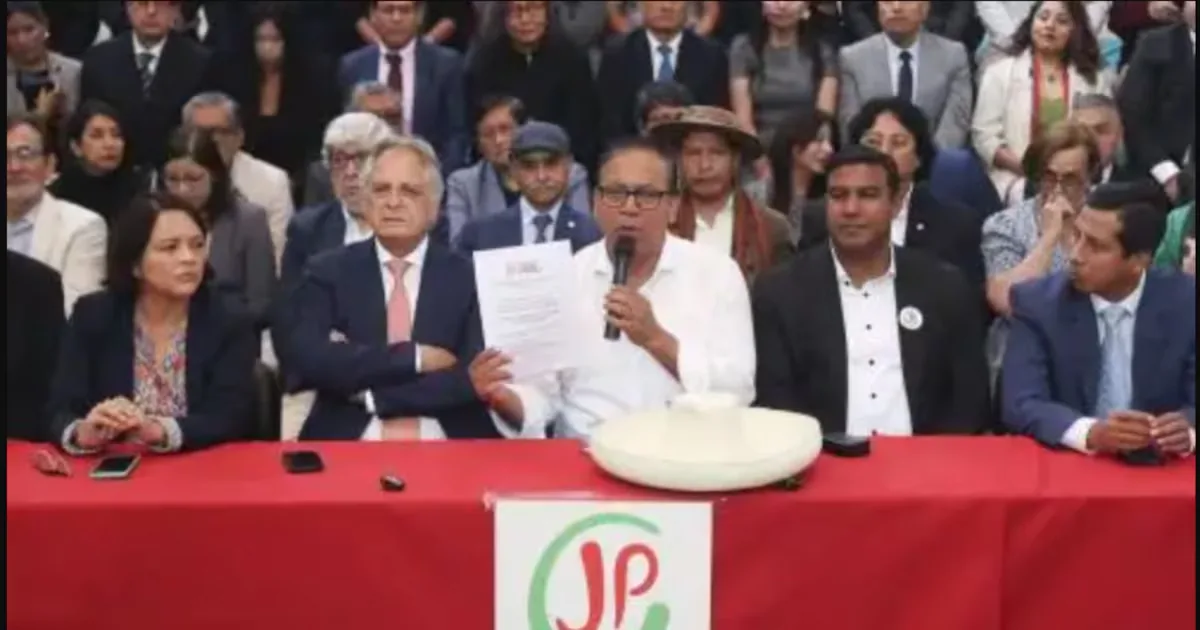
Less than a week before the presidential runoff, Roberto Sánchez’s Juntos Por el Perú party presented a new government plan aimed at easing concerns about his candidacy and proposes reforms in the economic, infrastructure and basic services, social, cultural-environmental, and international areas, as well as measures to strengthen the State.
Read more United States would seek to expand the deployment of nuclear weapons in Europe
Called “Second Round Government Program of Juntos por el Perú: Strategic Priorities for Governance and Development with Equity of the Peruvian Nation 2026-2031,” it contains 114 pages, 22 more than the original proposal submitted to the National Jury of Elections.
When asked during the program presentation what would guarantee that he would not change the program again if he reached the Government Palace, the leftist candidate did not respond directly and said that “this is the offer, the consensus program,” “the plan with which we will govern.”
The document — which Sánchez has described as a “consensus” program incorporating proposals from Ahora Nación, Primero la Gente, Obras, Venceremos, and other groups supporting his candidacy in the second round — seeks to distance itself from policies promoted in recent years and proposes greater State participation in areas considered strategic. Among the measures are changes in the political system, new rules for extractive activities, strengthening social programs, and a reform of Peruvian foreign policy.
The text also includes initiatives that have sparked debate in previous campaigns, such as the constitutional recognition of nature as a subject of rights, ratification of the Escazú Agreement, creation of a mandatory non-militarized civil service, and promotion of greater Latin American integration.
Additionally, the document proposes new public institutions, mechanisms for State control over strategic resources, and measures aimed at the more than three million Peruvians living abroad. The newspaper La República warned that several of these initiatives would require legal or constitutional reforms to be implemented.
One of the main axes of the document, the newspaper indicated, is strengthening the fight against corruption and restoring trust in public institutions by improving transparency, control, and accountability mechanisms at all levels of the State.
The proposal also includes measures to reinforce the independence of oversight and justice bodies. The goal is to ensure faster investigations and avoid political interference in processes related to corruption or abuse of power.
Regarding citizen participation, the plan contemplates expanding social oversight spaces and strengthening consultation mechanisms so that the population has greater influence on public decisions of national and regional scope. Unlike his first government plan, this new document does not include the proposal for a Constituent Assembly, but it does revive the idea of strengthening the right to referendum as a citizen consultation mechanism.
In the economic field, Juntos Por el Perú proposes a strategy aimed at increasing State participation in sectors considered strategic for national development. The document aims to promote industrialization and generate greater added value to natural resources.
Among the proposals is the application of taxes on extraordinary profits from extractive activities. Part of these resources would finance environmental restoration programs, infrastructure, and development projects in various regions of the country.
In economic matters, the new program states that it will respect the constitutional autonomy of the Central Reserve Bank of Peru (BCR) and will guarantee technical continuity and compliance with fiscal rules.
“The BCR has been and will be a key player in monetary stability, which complements fiscal stability. Therefore, from the government of Juntos por el Perú, we will safeguard the autonomy and independence that the BCRP has had for more than 30 years,” the document states.
The plan promotes strengthening small and medium-sized enterprises through credits, technical assistance, and access to new markets. It also proposes promoting productive chains linked to agriculture, manufacturing, technological innovation, and the circular economy.
The document notes that significant gaps persist in access to drinking water, sanitation, transportation, and connectivity. Therefore, it proposes a more active State intervention to expand the coverage of essential services.
One of the measures includes implementing wastewater treatment systems in all cities with more than 50,000 inhabitants. The proposal seeks to reduce river pollution and improve environmental quality in urban areas.
Additionally, it proposes strengthening infrastructure in rural and border areas through projects executed with the support of military engineering. The goal is to improve roads, communications, and access to basic services in territories with less State presence.
Read more “Traitors to the homeland”: Lula accuses Bolsonaro’s sons of the U.S. tariff proposal on Brazil
In social matters, the plan proposes expanding health coverage and strengthening care in vulnerable areas. It also aims to ensure compliance with programs directed at populations affected by contamination with heavy metals and other toxic substances.
Regarding education, the plan aims to improve teacher training, strengthen intercultural bilingual education, and expand programs aimed at indigenous communities and historically excluded sectors.
The text also includes proposals related to equal opportunities and the fight against discrimination. Among them is mandatory training for public servants in human rights and mechanisms to improve the handling of complaints about discriminatory acts.
One of the most striking proposals is the constitutional recognition of nature as a subject of rights. The proposal seeks to grant special protection to ecosystems, rivers, and watersheds, as well as prioritize access to water as a human right.
In culture, the document proposes creating the Ministry of Cultures, promoting a general law of Peruvian cuisine, strengthening public libraries, and promoting a screen quota for national film productions with regional representation.
In foreign policy, Juntos Por el Perú proposes a strategy based on Latin American integration, strengthening multilateralism, and defending human rights. The document proposes reinforcing spaces such as CELAC, promoting Peru’s return to UNASUR, and expanding its presence in Global South forums.
The plan also includes measures related to national defense. Among them are the declassification of information about acts of state violence that occurred between 1980 and 2000, as well as between 2022 and 2025, in addition to strengthening cyber defense and modernizing the Armed Forces.
For Peruvians residing abroad, the group proposes creating a Law on the Rights of Peruvians Abroad, implementing a census of Peruvian migrants, improving consular services, and establishing public mechanisms to facilitate remittance sending through the Banco de la Nación.
The International Monetary Fund (IMF) projects that Peru will grow 2.8% this year and identifies political uncertainty, social conflicts, extreme weather events, insecurity, and illegal mining as the main threats, as well as risks linked to the war in the Middle East and trade tensions.
Days before the ninth president of Peru in 10 years is known between Keiko Fujimori (Fuerza Popular) and Roberto Sánchez (Juntos por el Perú), the IMF warned in an analysis reviewed by the RPP network that the Peruvian economy faces at least nine relevant risks that could affect its growth in the coming years and that the new ruler will have on his agenda, despite solid macroeconomic fundamentals.
In its assessment of the Peruvian economy, the multilateral organization projected that the Gross Domestic Product (GDP) will grow 2.8% in 2026 driven by the labor market, the increase in real incomes, high metal prices, and a gradual credit recovery.
However, in its view, the risk balance for economic prospects remains tilted downward. Among the main internal threats identified by the International Monetary Fund is political uncertainty.
According to the organization, the persistence of polarization and political fragmentation could affect consumer and investor confidence, limiting the country’s potential growth.
The IMF also warned about the risk of social unrest resulting from a possible economic slowdown or deterioration of citizen security. According to its analysis, social conflicts could erode business confidence, discourage new investments, and generate capital outflows.
Additionally, it warned that Peru remains highly vulnerable to extreme weather phenomena, such as those associated with the El Niño phenomenon. These events could cause infrastructure damage, affect agriculture, and generate high economic and fiscal costs.
Citizen insecurity and the expansion of illegal mining also appear among the main concerns of the global financial institution.