




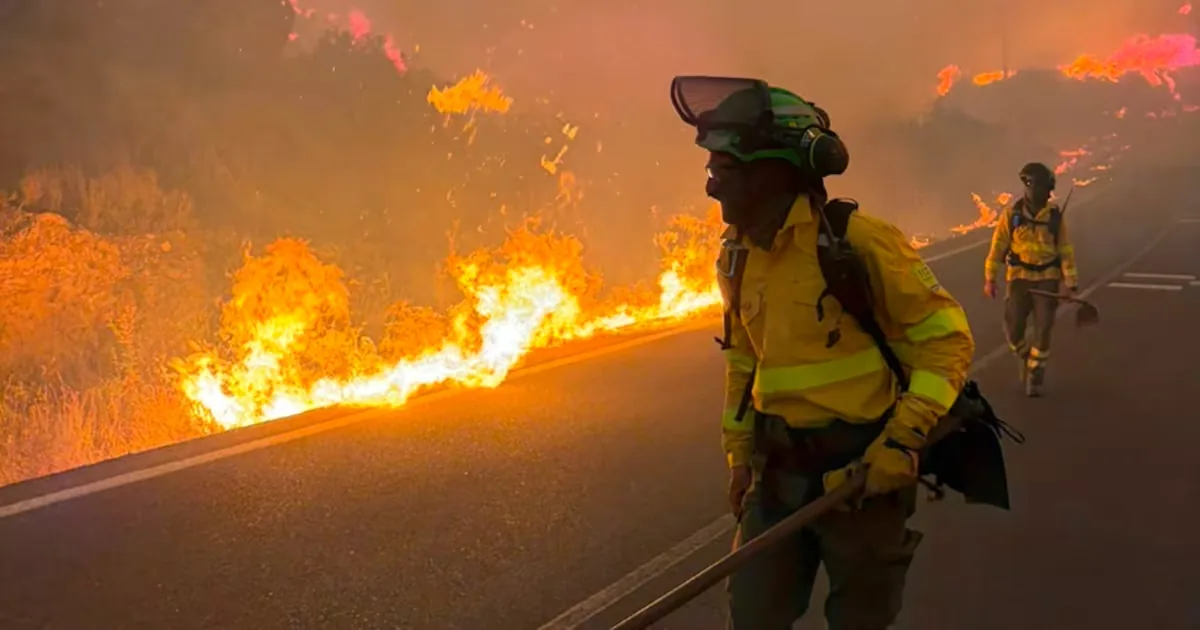
Climate change is making Europe more prone to wildfires, greatly increasing the likelihood of conditions favorable for the spread of fire that fueled the megafires in recent days in France and Spain, according to an international scientific study.
Huge fires have spread across Bordeaux and Madrid, forcing mass evacuations and destroying hundreds of homes. The fires, some of the worst ever seen in both countries, spread easily after persistent drought and heat.
Global warming has doubled the probability of the combination of high temperatures, dry soils, and strong winds occurring in France, and has multiplied it “by at least” 20 in Spain, according to a rapid analysis conducted by World Weather Attribution, a consortium of scientists using peer-reviewed methods to investigate the influence of climate change on specific disasters.
Likewise, the study shows that, with the current climate, a week with similar severity can recur approximately every six years in the central peninsula and every 20 years in the studied area of France.
Clair Barnes, a researcher at Imperial College London and co-author of the work, put it bluntly: “What we are seeing in France and Spain is not just bad luck, it is a clear sign of the growing impacts of anthropogenic warming.”
“Every fraction of a degree of warming pushes us into unknown territory, and these fires show exactly what that risk entails,” she added.
The scientist emphasized that a wet winter, followed by a dry summer and a succession of heat waves, has left forests loaded with fuel and persistent heat that created the conditions for any spark to turn into a massive and dangerous fire.
Scientists had already found that climate change increased the likelihood of the unprecedented heat wave that hit Western Europe at the end of June, as well as the spring drought; both events made the land more prone to fires, highlights the European edition of Politico.
“These megafires demonstrate how quickly extreme heat and dry landscapes, driven by climate, can turn wildfires into devastating national disasters,” said Simon Stiell, the UN climate chief, in a statement responding to the findings.
“Humanity continues to burn colossal amounts of coal, oil, and gas, which is warming our planet, making these conditions more dangerous and these megafires more deadly and destructive,” he added, calling for a faster transition from polluting fossil fuels to clean energy.
Read more Zelenski appoints Rustem Umerov as the new head of Ukraine’s Foreign Intelligence Service
The researchers analyzed historical weather observations to study how conditions favoring fires have evolved, without relying on climate models. For this, they used an indicator known as Daily Severity Rating (DSR), which combines factors such as high temperatures, dry environment, and wind to estimate the difficulty of controlling a fire once started.
The authors emphasize that their estimates are conservative and that the real risk could be even greater. The study also detected that the intensity of the DSR index increased by more than 40% in both countries compared to the pre-industrial scenario.
This is not the first time World Weather Attribution has reached this conclusion. In September 2025, the same group had already demonstrated that climate change worsened the fires recorded in Spain and Portugal during the previous year.
Gustavo Saiz, senior scientist at the National Institute for Agricultural and Food Research and Technology of Spain, recalls in statements taken up by Science Media Centre España (SMSC) that the fires recently occurring in Spain and France rank among the worst ever recorded in both countries, with a high number of deaths, thousands of homes destroyed, and the evacuation of more than 300,000 people.
In this regard, the specialist adds that the study shows that “climate change is not only intensifying individual fires, but also increasing their synchronicity across all regions, which worsens humanitarian and environmental consequences.”
In this regard, María José Sanz, director of the Basque Center for Climate Change Research, concludes that “the evidence indicates that we live in a new paradigm, in which these fires will already be our reality. Prevention through adaptive management to these new circumstances, early warnings, and cooperation for their control and extinction must be part of the response if we want to preserve our well-being,” according to a statement recorded by Science Media Centre España.
Augustin Colette, from the French Institute of Environment and Industrial Risks, warned that this sequence of accumulated climate risks (extreme heat, fire, and air pollution) should be “a wake-up call about upcoming adaptation challenges and a reason for ambitious climate action.”
Friederike Otto, professor of Climate Sciences at Imperial College London, sums up the diagnosis with an uncomfortable idea: “Europe’s climate is changing faster than governments are able to adapt,” she points out. The meteorological combination capable of creating a powder keg and turning it into a catastrophe, she adds, now appears much more frequently.
According to the SER network, the publication of these scientific conclusions could have a strong impact on the Spanish political landscape. During his usual summer briefing with King Felipe VI in Mallorca, the Prime Minister, Pedro Sánchez, reiterated the urgent need to reach a grand state pact against climate change. In his appearance before the media, the head of government directly labeled as “flat-earthers” those political forces that continue to deny the direct influence of the climate crisis on this type of natural disasters.
Read more Tragedy in Ceuta: the alleged alert from Spanish intelligence and the darts against Morocco