






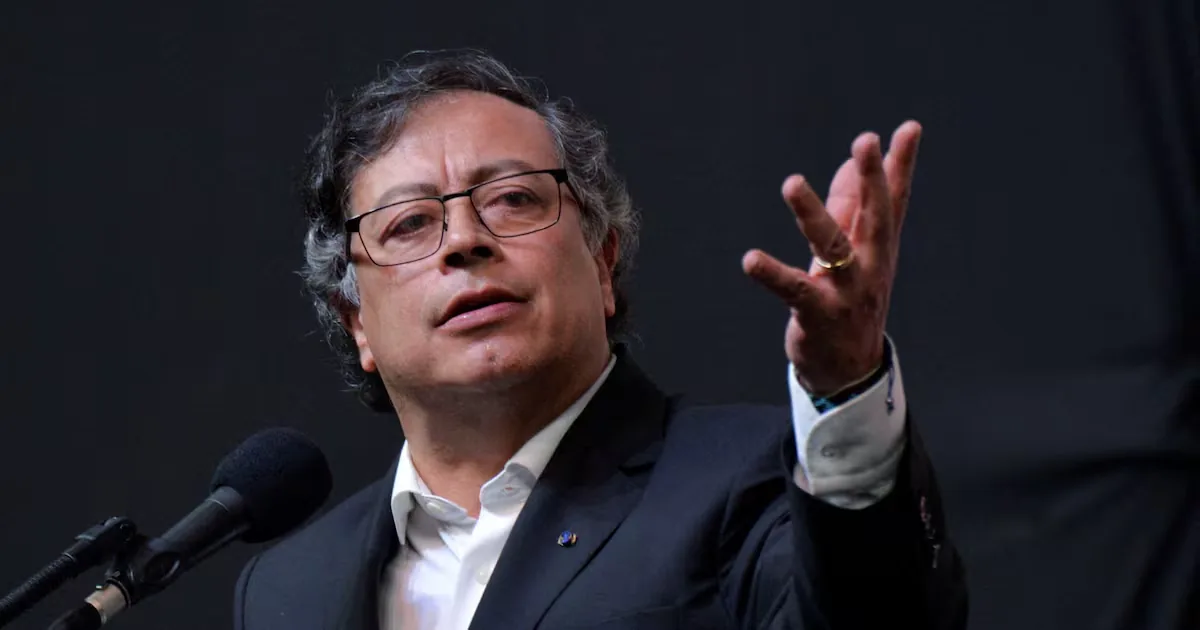
Just months away from concluding the first left-wing mandate in Colombia’s contemporary history, Gustavo Petro’s administration bids farewell with progress in some areas and evident setbacks in others, along with a great promise left unfulfilled: security.
Read more Trump postpones decision on Iran proposal
With approval ratings ranging between 45% and 50%, depending on the poll, the economist and former guerrilla managed to consolidate a support base thanks to various advances in social matters: 2.1 million people left poverty and the minimum wage increased by 23%, projected for 2026.
However, this solid political capital contrasts with widespread criticism in other areas, such as security and crime management. According to data from El País, last year the flagship policy of Petro’s administration, “Total Peace,” faced a 72% disapproval rate, mainly due to the return of kidnapping to levels seen two decades ago.
Regarding internal politics, instability was constant. During the four-year term, the ministerial team saw a total rotation of 62 ministers, and just months after taking office, the coalition that brought him to government broke apart following differences in a failed attempt to reform the health system.
This led the Colombian president to recently admit—in an interview with Caracol Noticias—that he was “naive” in trying to govern with a plural coalition that ended up blocking his structural reforms.
In this scenario, this Sunday’s elections are a kind of plebiscite for Colombia’s first leftist administration. But, despite the outgoing government’s political capital transferring to the campaign of the official candidate, Iván Cepeda, it might not be enough to ensure continuity.
Although the Historic Pact candidate leads the first-round voting intention with 44% of preferences according to the latest Invamer poll, Abelardo de la Espriella and Paloma Valencia—the strong right-wing candidates—could prevail in a possible runoff against the official candidate on June 21. This raises the question of whether Petro’s social achievements will be sufficient to secure the Historic Pact’s stay in the Casa de Nariño before a citizenry perceiving rising insecurity and a stagnant economy.
Gustavo Petro’s administration concludes its term with poverty and inequality reduction as its main achievements. According to data from the National Administrative Department of Statistics (DANE), between 2022 and 2024, nearly one million people left extreme poverty. With this, poverty in the South American country reached a historic low of 31.8%.
These indicators are directly linked to income policies, highlighting the increase in the minimum wage, reaching approximately 460 dollars per month to strengthen the purchasing power of popular sectors.
This support among popular bases, grounded in the perception of greater equity and the dignification of the worker, has become the main political asset for the ruling party ahead of this Sunday’s electoral contest, where the permanence of this social transformation model will be evaluated.
And, according to political science PhD and academic at the National University of Colombia (UNAL), Mary Luz Alzate, the justification for this popularity lies in the change of discourse prioritizing the worker.
“I don’t think Petro’s popularity is due to great results from his administration,” said the academic. “But rather where he manages to embody a clear symbolic struggle—people against elites, nation against extractivism—and remains steadfast. That coherence is the core of his unusual favorability,” she detailed.
Along the same lines, the director of the Department of Political Science at the Pontifical Javeriana University (PUJ), Humberto Librado, argued that—despite major scandals and instability in his political team—Petro’s great appeal lies in the fight against inequality, not only with advances in specific policies but also from the presidential narrative.
Thus, Librado stated that in the outgoing government’s administration “there is a very strong narrative about class differentiation in the country (…). Voters do not only interpret the Petro government based on specific measures but also with a project of differentiation between traditional national elites and emerging groups.”
UNAL political science academic Doris Gómez reinforced this idea. “It has to do,” she specified, “with an approach to popular bases that integrate the objective of much of his government strategy.”
The academic argued that President Petro resorts to “communication actions very oriented to showing himself as a leader close to the citizenry, especially to the poorest sectors.”
Petro’s main policy, the “Total Peace” strategy aimed at accelerating and expanding negotiations with armed organizations in the territory—the guerrillas and cartels—ended with an increase in the perception of insecurity, the expansion of coca cultivation hectares, and kidnappings.
Unlike the past, where historically the Colombian State sought to confront armed organizations directly, today the threat lies, according to experts, in highly mobile and fragmented criminal networks, such as the Gulf Clan, which despite military pressure managed to expand its bases from 4,000 to nearly 10,000 members between 2022 and 2026.
This new scenario directly impacted the perception of insecurity, where the rise in extortion and kidnapping cases has generated a climate of fear that has dominated the 2026 electoral agenda, benefiting right-wing candidates ahead of this Sunday’s elections.
Regarding this, associate researcher at the Ideas for Peace Foundation (FIP), Gerson Arias, was critical of Petro’s “Total Peace” strategy. The expert indicated that its implementation has been “unreflective” and with “high degrees of improvisation.”
“In terms of evaluation, the result is a failure. It leaves a country with more than 27,000 members in illegal armed groups (more than 80% of those there were in 2022), with presence in 646 municipalities,” Arias detailed.
“The result is critical and will be one of the great challenges for the next government,” added the FIP researcher.
Then, Arias argued that the Colombian president’s flagship project had—before a real ambition to be applied—electoral and propaganda purposes to ensure the continuity of the progressive project. “In that sense, it was a failed promise that created great expectations in the regions most affected by violence,” he commented.
“The most serious thing is that ‘Total Peace’ eroded the credibility of negotiation as a legitimate instrument of the State,” Arias assured.
He then argued that “Petro knew how to use this narrative and his credibility in these sectors and regions of the country to win the elections and have a high approval level, despite the deficiencies of ‘Total Peace,’ corruption problems, and various institutional incapacity issues to govern efficiently.”
“In this last sense, he is a great politician, as Álvaro Uribe was in his time,” affirmed the FIP researcher.
Thus, on the eve of the elections, the country is divided between the continuity of this model and break proposals that appeal to flashy or “tough on crime” solutions inspired by Nayib Bukele’s Salvadoran model, like those of the far-right Defenders of the Homeland candidate, Abelardo de la Espriella.
Unlike the confrontational style of the current president—a hallmark of his personality is using social media to openly confront his opponents—the official senator Iván Cepeda has a more conciliatory profile seeking peaceful solutions and aspires to represent the victims of violence.
Regarding this, Colombian social anthropologist and essayist Carlos Granés referred in a recent interview with La Tercera to Cepeda’s profile and the popularity transfer Petro has made to the official candidate. “(Cepeda) is a very gray character, very uncharismatic, who is not even capable of speaking in public without a paper. He reads his speeches. Despite all this, that popularity (of Petro) has been almost entirely passed on to him. So it is a direct transfer. And perhaps that has been Petro’s great achievement, that is, to unite and homogenize the left around the same project. Now the entire left is totally compact around the Historic Pact, which is not the case with the right, not at all. The right is very fragmented,” he explained.
Despite this, Cepeda’s arrival at the Casa de Nariño is not guaranteed. Various polls—such as Guarumo-Ecoanalítica, CNC, and Atlas Intel—give De la Espriella the victory in the second round.
This is because if the Defenders of the Homeland candidate positions himself as the second majority in this Sunday’s first round, in the runoff he would receive most of the votes from the Uribist Centro Democrático candidate, Paloma Valencia.
Regarding this, the director of the Department of Political Science at the Pontifical Javeriana University, Humberto Librado, stated that “at first glance, it can be said that all of Valencia’s votes—or at least the majority—would accompany De la Espriella’s project.”
But he later qualified this statement. “It is not necessarily the situation that will naturally occur,” he said.
Granés, for his part, predicted that “Cepeda will obviously win the first round, he will pass with great ease.” But in the runoff, he differs from Librado in the projection. “If he (De la Espriella) passes to the second round, it is most likely that Cepeda will win with some ease. If Paloma Valencia passes, Cepeda will have a harder time because all of De la Espriella’s vote will go to Valencia, but not all of Valencia’s vote will go to De la Espriella.”
In that sense, UNAL academic Doris Gómez explained about the far-right candidate: “He is an outsider to politics, but also a character with very little experience in public management. He is a reactionary candidate, with an extremist campaign that borders on illegality.”
“The right is debating in a very contemporary scenario, between a more institutional, more technocratic, more centrist right, and a new right of an outsider with all the vices of these new political offers: histrionics, political incorrectness, rampant machismo, promises of tough measures, paranoia regarding crime, promises of huge prisons like Bukele’s and, above all, lack of experience, lack of technical team, lack of moral criteria that provides some kind of trust to the electorate,” Granés commented.
Therefore, “in a second round it will be much more difficult for De la Espriella to get, for example, Valencia to join his candidacy. Or even for other sectors of the same right to support him, because he is a very risky candidate,” Gómez continued.
“There is a great opportunity for the Historic Pact in the second round. Probably, the issue is more of a ‘punishment vote,’” Librado argued. “To what extent do people consider the image of Cepeda or De la Espriella negative? Polls show that the situation is precisely in how competitive the second round can be with these two candidates,” concluded the director of the Department of Political Science at the Pontifical Javeriana University.
Read more Former California Mayor Pleads Guilty to Acting Secretly as an Agent of the Chinese Government