









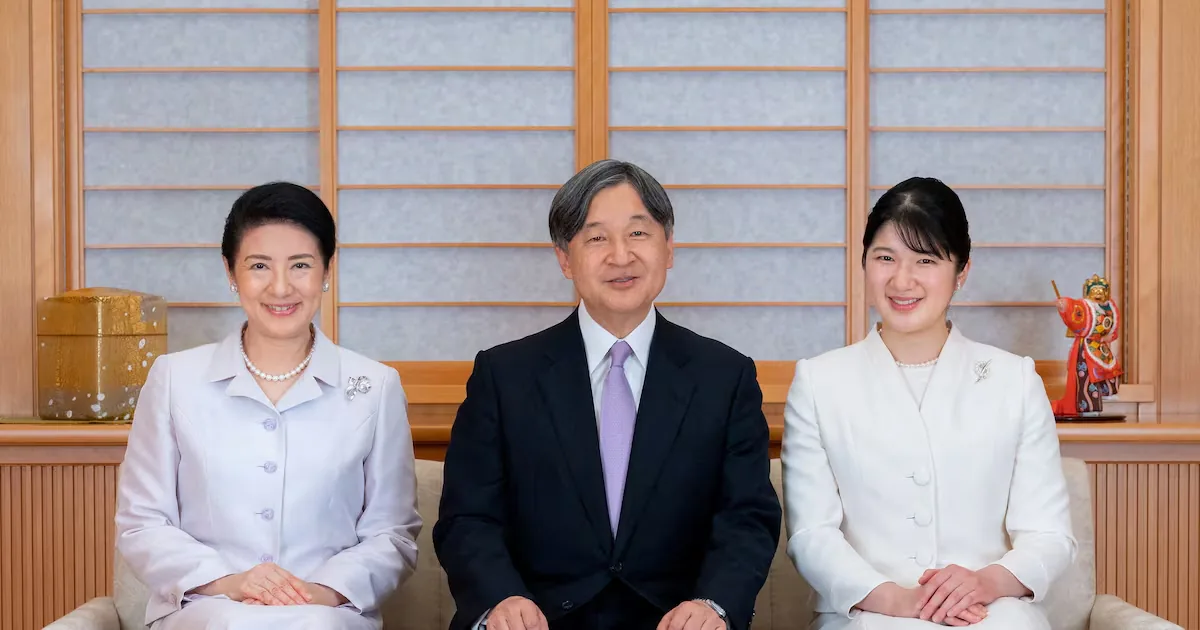
The current Emperor of Japan, Naruhito, stated at a press conference just a few weeks ago that the efforts underway by Prime Minister Sanae Takaichi’s government and Parliament to guarantee the future of the oldest reigning dynasty on the planet must “have the understanding of the people.”
Read more Iran calls Trump’s allegations of a supposed Tehran plan to assassinate him «psychological warfare»
It is not far-fetched to assume that he was thus showing his great concern about the proposed amendment to the Imperial House Law that the conservative Takaichi administration plans to finally enact this week, despite the fact that, to continue with Naruhito’s words, it seems that the public can hardly digest it.
As detailed by the newspaper El Mundo, the shortage of males in an imperial family where women are excluded from the line of succession and cannot transmit rights to the throne has become the biggest institutional problem in a country as ultramodern economically and technologically as it is conservative socially and politically.
Thus, after decades of debate, the Lower House approved last Friday the first significant amendment to the Imperial House Law aimed at addressing nothing less than the risk of extinction of the oldest reigning dynasty on the planet.
The deputies voted in favor of the government bill from Takaichi that would introduce two momentous changes to the rule governing the imperial family: one, allowing women to retain their imperial status after marrying commoners, a measure intended to guarantee a minimum adequate number of active members serving the institution; and another, even more relevant, allowing the reigning family to adopt males aged 15 or older who descend through the male line from the 11 former imperial branches that lost that status with the 1947 Constitution, imposed by the United States after Japan’s defeat in World War II.
The latter would not only add new blood to the Crown, since today there are only three active males—the current emperor, his brother and heir, Prince Akishino, and his son Hisahito—but would also be the emergency solution adopted to guarantee dynastic continuity in the future, since although the males adopted now would be excluded from the succession to the throne, their male children would be born with succession rights.
It should be clear that under no circumstances has the possibility been considered that women could become empresses or transmit those rights. The emperor, empress, emeritus emperors, as well as Akishino and his wife, Princess Kiko, have been excluded from the list of possible adoptive parents.
After the approval by the Lower House, the ruling Liberal Democratic Party (LDP) and its coalition ally, the Japan Innovation Party, intend for the reform of the Imperial House Law to be approved by the House of Councillors for enactment before the current parliamentary term ends on July 17.
But this Saturday, and with the countdown for the government to greenlight the law underway, one of the country’s largest-circulation newspapers, the Asahi Shimbun, could not have been clearer in its editorial titled: “The bill to amend the Imperial House Law must be stopped.” “Prime Minister Sanae Takaichi’s administration is recklessly advancing a revision of the Imperial House Law even without the consensus of the legislative power or the public,” reads the harsh text.
“This is an outrageous act by which the government is destroying the very ‘calm environment’ it said was necessary. If the bill is passed as it is, it will leave a black mark in history, as well as cause problems in the future. The government must revoke the measure and start deliberations anew from the beginning,” demands the editorial.
El Mundo recalls that the current emperors, Naruhito and Masako, have only one daughter, Princess Aiko. She was about to make history as a possible future empress, since when she was born, given the shortage of males in the dynasty, parliamentary debate began to abolish the Salic law. However, in 2006, the current emperor’s brother, Crown Prince Akishino, had a son, Prince Hisahito. And it is this young man who is called to be the future monarch of the Chrysanthemum Throne. His birth aborted that nascent process underway to allow women to reign.
Today Princess Aiko, the Spanish newspaper points out, would not even have her future in the dynasty assured. Although if the mentioned reform of the Imperial House Law is finally approved, she will at least be able to maintain her status even if she marries and will continue to represent the Crown. The opposite has happened to other princesses, such as her cousin Mako, who, after marrying in 2021, became an anonymous commoner, expelled from the imperial family—which she can now barely see—and has since lived as an ordinary citizen in New York.
This issue generates deep divisions among politicians and Japanese citizens. According to a survey conducted by Kyodo News in May, 83% of Japanese support the idea that a woman can become empress. This stance also has the backing of the opposition and numerous academics.
Meanwhile, 32% of respondents in a national opinion poll conducted by the Mainichi Shimbun on June 20 and 21 opposed the proposal to “adopt male descendants through the paternal line from former imperial branches,” surpassing the 28% who were in favor. Another 39% said they were unsure.
Likewise, support for the proposal to allow women of the Imperial Family to retain their status reached 60%, far exceeding the 12% who opposed it.
In response to a question about the possibility of a woman becoming empress, 40%, the largest group, said they supported both an empress and an emperor through the maternal line or whose paternal lineage is not connected to the imperial line, while 33% said they supported an empress but opposed an emperor through the maternal line. Overall, 73% expressed support for an empress, while 6% were against it.
The controversy has intensified in recent days following statements by Hirofumi Nakasone, former Minister of Foreign Affairs and current leader of the LDP group in charge of constitutional reform.
According to the conservative politician, son of former Prime Minister Yasuhiro Nakasone (1982-1987), the ascension of the princess to the throne would be unthinkable, and if she were to become empress, “no one would want to marry her” due to the enormous pressure that would fall on her husband and the obligation to give him a male heir.