








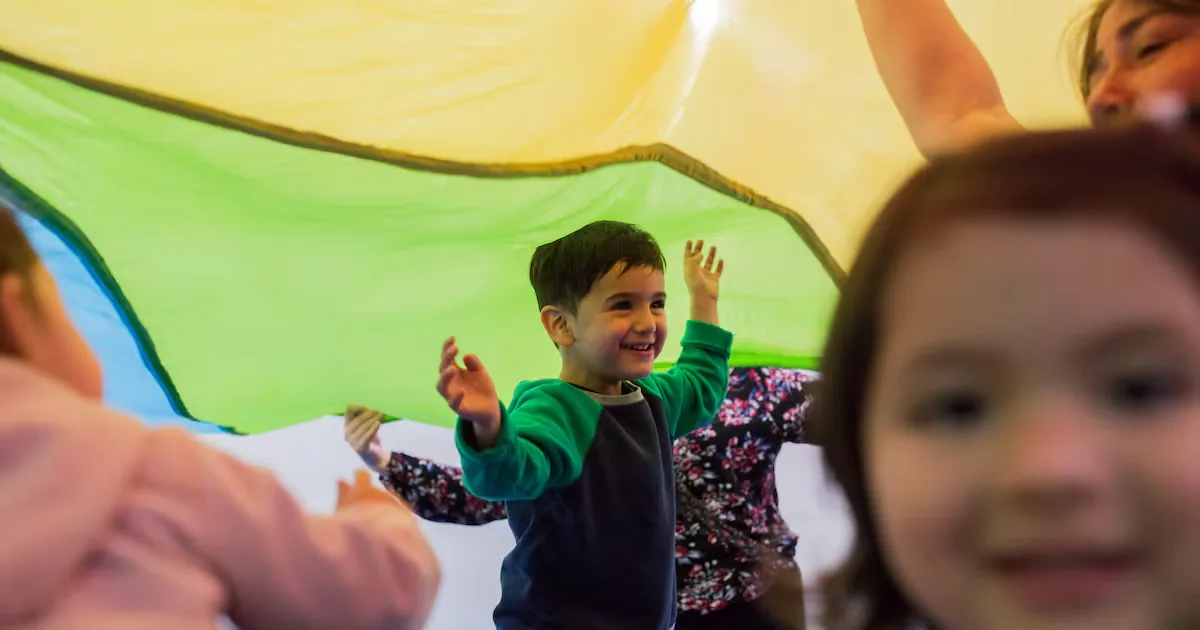
Shoes are always left at the entrance, alongside backpacks and cell phones. The floor is covered with tatamis, the music is calm, and the room is filled with blocks, kitchen playsets, colorful balls, stories, and baskets full of toys waiting for girls and boys, and their caregivers. At the initial moment, the youngest explore the room freely. The adults, generally women – moms, aunts, grandmothers who care for them – just follow them.
Read more The story of the KGB spy who worked as a nanny in Uruguay
Among them is Evelyn Peña (42), attentive to every step of Jeremías (one and a half years old). He has Down syndrome, and at six months he was not doing the same as other babies his age. It was that concern for his development that brought her here: the referral came from CESFAM Bicentenario, in the Renca commune, and she says she did not hesitate to enroll. “I saw it as an opportunity to learn, socialize, and share experiences,” she says today.
The place she arrived at is Crecer Jugando, a program of the Infancia Primero foundation – part of the Pacto Niñez network – that brings together each week girls and boys from 0 to 4 years old along with their caregivers. Through play, for an hour, it seeks to strengthen child development, the bond between both, and support networks among participating families.
Not all families come to Crecer Jugando for the same reason. While Evelyn came worried about her son’s development, Fabiola Soto (36) was looking for something else: company for raising her child. Before knowing the program, her days passed completely alone with Ferran, who is now almost two years old: she sang to him, read to him, played with him nonstop, but there was no one to share a doubt or a tantrum with until her husband arrived, already at night. “I was 24/7 destined only to think about him, about his development,” she says. She had tried to go to a play space in Ñuñoa, far from her home in San Miguel. “But we couldn’t interact among moms or with the children,” she recalls. There, silence was the rule.
Fabiola emphasizes that what she was looking for was not just a place to play with her son. She also needed a network. And that need is far from exceptional. According to the Early Childhood agenda that the Fundación Colunga Childhood Observatory will present at the end of July, one in seven households with preschool children has no kind of support for raising them. Neither family, nor community, nor institutional. And when that support is missing, only 8% of those families report receiving institutional support, compared to 20% among those who do have a family network.
Crecer Jugando starts from a simple premise: to promote child development it is not enough to work directly with girls and boys. It is also necessary to strengthen the bond with those who care for them.
Evidence supports this approach. In fact, one of the findings of the Early Childhood agenda from the Fundación Colunga Childhood Observatory is that developmental gaps increase as girls and boys grow. After reviewing data from various surveys, the document shows that while during the first months of life the detected delays affect about 5% of children, after two years that proportion reaches 25%. For Paloma del Villar, director of the Fundación Colunga Childhood Observatory, these data show the importance of early intervention, before those gaps consolidate.
“A girl or boy who has a good bond with their primary caregiver has a better developmental trajectory,” explains Magdalena Mongillo, social director of the Infancia Primero foundation and who leads the coordination of the Crecer Jugando program. That bond is built in everyday gestures. That a child vocalizes and the adult responds. That they point to an object and someone follows their gaze. That a smile finds another smile. These are brief exchanges, explains Mongillo, which repeated hundreds of times during the first years of life, shape socioemotional and cognitive development.
This is where play appears. “It’s not that play is important because it entertains. It is the language of children,” says Mongillo. Through play they explore the world, express what they still cannot say with words, and build bonds with those around them.
That is why, in Crecer Jugando nothing is left to chance. The arrangement of the room, the selection of materials, the songs that accompany transitions, the stories, and conversations among caregivers are part of a methodology designed to strengthen those daily interactions between girls, boys, and their caregivers.
“We don’t want the adult to teach the child to play, but to learn to follow them. Here the child is in charge,” explains Magdalena Mongillo. That is why each session of the program begins without instructions. On the contrary: as soon as they enter the room, girls and boys and their caregivers – almost always women, although dads can come – take off their shoes and freely explore among the materials, chosen according to the age of the group. Those who accompany them do not direct the play: they observe, follow their children’s initiative, and participate when invited.
Fabiola Soto noticed it from the first day: unlike kindergarten, where you have to say goodbye at the door, here the adults stayed inside. “You were with them all the time in the same space, and they gradually gained the confidence to detach from you,” she says.
That moment of exploration is also information: facilitators observe what sparks curiosity in each child and how the adult responds to their initiatives. That’s where Fabiola discovered that Ferran was fascinated by a wooden kitchen set that she, she admits, would never have thought to buy him. “You learn their tastes, their interests,” she says.
Then, a song plays in the room. It not only announces that one of the activities structuring the session has ended and another is about to begin. It also helps girls and boys anticipate the routine and transition between moments with greater security. The same happens with stories and group dynamics: each seeks to strengthen different skills, always through interaction between girls, boys, and their caregivers. One story – “The Rabbit” – was enough for Ferran to ask for it session after session until he memorized it. “I’m going to give it to him for his birthday, which is coming soon, because he loved it,” says Fabiola.
At the end of the session, roles change. While facilitators stay playing with the girls and boys, the caregivers move to another stage, where they can talk about everyday parenting situations. What begins as a guided conversation often ends up becoming a space to share doubts, strategies, and experiences that continue throughout the week.
That is where the program completes the circle. While girls and boys learn through play, their caregivers discover they are not alone. Doubts that seemed individual become shared and, little by little, the networks that Crecer Jugando seeks to strengthen begin to be built.
After going through the program, Evelyn Peña stopped measuring every progress of Jeremías against other children. For a long time, she had felt she was always one step behind. Crecer Jugando, she acknowledges, taught her to do the opposite: today she no longer expects her son to keep up with the pace of others. She learned to recognize his timing.
“We have learned to understand his needs, when he is sad, when he is angry, his sad little face,” she says. Although he still does not speak, she can tell when he cries because he hurt himself, when he is sleepy, or when he simply needs to be hugged. “I understood that he would achieve it in his own time, that I didn’t have to rush his processes.”
That change also transformed how Evelyn sees herself as a mother. “They made me feel that with my tools I was a good enough mom,” she says. The guilt for not always knowing what to do began to give way to confidence. And the conversations that used to happen only during sessions continued afterward, through WhatsApp messages, meetings in the park, or shared advice with other mothers going through similar concerns.
It is not just an individual experience. According to the Early Childhood agenda of the Fundación Colunga Childhood Observatory, 9% of caregivers in Chile face parenting with high levels of stress: that is 33,400 girls and boys whose caregivers live day to day with low self-confidence, emotional distress, and a feeling of overwhelm. An additional 26% present moderate levels of stress.
For Magdalena Mongillo, social director of Infancia Primero, that pressure also affects child development. When an adult feels overwhelmed, she explains, it becomes much harder to stop and observe, interpret a child’s signals, and respond calmly to what they need. That is why Crecer Jugando does not only seek to support girls and boys. It also tries to help caregivers regain confidence in their own abilities.
And that is where the program seeks to go beyond the room. Because what is learned during ten sessions – observing, following, playing – begins to settle into everyday life, where development really happens.
The stories of Evelyn and Fabiola are not isolated cases. For more than ten years, the Infancia Primero foundation has implemented Crecer Jugando in 27 communes across the country and has supported more than 4,800 families.
But, to know if the changes observed in families really responded to the program, they decided to subject it to an evaluation.
The study, conducted by SUMMA, the Research and Innovation Laboratory in Education for Latin America and the Caribbean, together with Estudios y Consultorías Focus, confirmed improvements in child development, a decrease in parental stress, and a strengthening of parenting skills. One of its most relevant findings was the speed with which these changes began to appear: from the third session, improvements in parental skills and reduction of stress in those caring for girls and boys were already statistically significant.
For Paloma del Villar, director of the Fundación Colunga Childhood Observatory, this type of evidence is what allows distinguishing a good initiative from a solution with the potential to become public policy. “Childhood needs policies that prove they work. When we find an intervention capable of strengthening development from the earliest years and with evidence supporting its results, the challenge stops being to test it and becomes how to make it reach many more families.”
That was also the next step for Crecer Jugando: to move from a program run by the foundation to one that the territories themselves could sustain. In Renca, the municipality took on its implementation after a process of training and technical support from Infancia Primero, which certifies local teams and safeguards the quality of the methodology. It is this logic – building capacity in each commune – that allows the program to grow without depending on the foundation. For Elizabeth Maulén, communal coordinator, Crecer Jugando came to fill an important gap in early childhood offerings. “It not only enriches children, but also enriches the bond with the caregiver,” she explains.
Today it is the municipal teams themselves who carry out the sessions, while the foundation maintains an advisory role. The effects, says Maulén, continue to appear even after the program ends. She recalls a group of families who met in Crecer Jugando and who, some time later, organized a picnic on their own initiative in a park in Renca. “Interaction among caregivers was strengthened, but also among the families themselves,” she sums up.
Songs stop being sung only once a week. Games reappear at home. Doubts find others who share them too. And a space ends up transforming the way a girl, a boy, and their caregiver meet every day. There, in those daily interactions, the true impact of Crecer Jugando happens.