






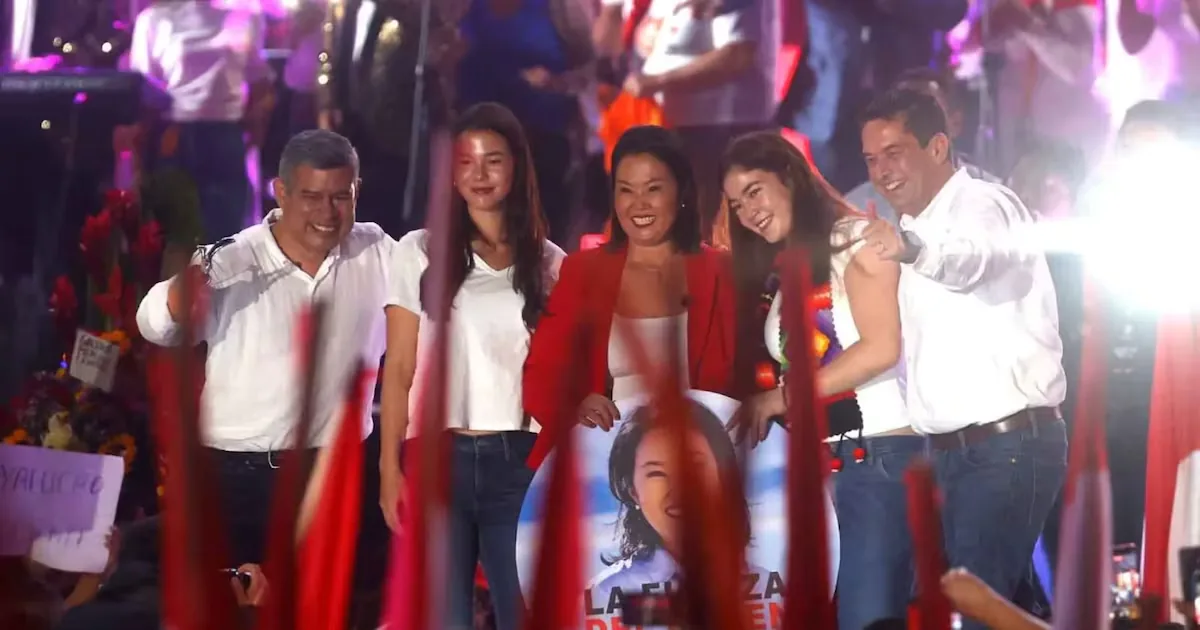
Despite the electoral polarization, there is nothing that reflects this climate in Lima ahead of this Sunday’s presidential runoff, which pits the leader of Fuerza Popular, Keiko Fujimori, against Roberto Sánchez, of Juntos por el Perú. There are no candidate posters or flyers on the streets; their faces can only be seen in newspapers hanging in the remaining newsstands in the city. No protests are observed either, and campaign closures did not take place in the center of the Peruvian capital.
Read more At least one dead and one injured after recent Ukrainian drone attacks in Russia
Although the electoral landscape resembles that of 2021, with a right-wing candidate facing a left-wing one, for many, this year’s electoral contest has been less heated than in those elections, when debates, even those among family and friends, became very intense. Back then, anti-Fujimori demonstrations and the phrase “Fujimori never again” – referring to the candidate’s father, former president Alberto Fujimori (1990-2000) – were heard and read on posters everywhere.
For analysts, anti-Fujimorism is not the same as five years ago, which does not mean it doesn’t exist. In fact, on Saturday, a demonstration was held in downtown Lima that gathered, under the slogan “Keiko no va, Fujimori nunca más,” about two thousand people, according to unofficial estimates, without seeming to have the same intensity as a few years ago.
Carmen, 26, who works in a café in Lima’s Plaza San Martín, already has her vote clear: anyone but Keiko Fujimori. “It’s not that I like the other candidate, I didn’t vote for him in the first round, but she controls Congress, she’s to blame for the problems we have, she’s a liar, I’m never going to vote for her,” she says. “Older people get scared, they believe in messages of hate, which seek to make one afraid, but young people are not scared,” she adds.
Experts agree that this anti-Fujimori vote usually awakens prior to elections, and this has been reflected in polls, which indicate that Sánchez has been gaining ground against the leader of Fuerza Popular, although both candidates remain statistically tied. This was revealed by the latest Ipsos poll – delivered to the international press due to the electoral ban in the country – which indicated that the leader of Juntos por el Perú has 43.8% of voting intention, while the daughter of former president Alberto Fujimori reaches 43.2%.
The poll was conducted on June 3 and has a margin of error of ±2.1%. A previous study by the same pollster, published on May 31, showed Fujimori with 38% and Sánchez with 35%, while 27% of voters were still undecided.
Sociologist and political analyst Fernando Tuesta, from the Pontificia Universidad Católica del Perú, pointed out that anti-Fujimorism has lost strength since 2021, the year it was divided between those who followed Pedro Castillo – former president who is imprisoned for the crime of conspiracy to rebel after the failed coup attempt on December 7, 2022 – and others who followed Keiko Fujimori, who were mostly people from the liberal right-wing sector.
“In the latest Ipsos simulation, there is a 0.6-point difference in favor of Roberto Sánchez, which implies that the trend has been in his favor and not Keiko’s. Since the first polls in April, where she appeared first, what matters is the trend, and it seems that anti-Fujimorism is reigniting in a generally low-intensity electoral process,” says Tuesta in conversation with La Tercera.
“If the trends continue, it would be her fourth defeat. This time, however, Keiko Fujimori is a candidate with the most experience of all politicians in this country. No one has ever reached the second round so many times. And that opportunity (to win) is always open, with her experience, both public and private economic resources, the approval of almost all media, and a relative majority already in Congress in her favor,” he adds.
In an interview with the portal of the Institute of Democracy and Human Rights of the Pontificia Universidad Católica del Perú, political scientist Martín Tanaka pointed out that anti-Fujimorism “has been wearing down over time.” “I am one of those who think that Keiko’s personal trajectory has helped humanize her image. The fact that she was imprisoned without the alleged crimes being proven, that some of her cases were dismissed, her divorce, the death of her parents… that helps weaken the anti-Fujimorist sentiment. There are even people who now say: ‘Well, poor thing, it’s her turn after four attempts.’ Those kinds of reasonings didn’t exist before and are now heard more frequently,” he indicated.
“Apparently, anti-Fujimorism is less intense than on other occasions, because it was an organized movement that held marches, with slogans like ‘No to Keiko Fujimori,’ which had phrases, symbols, etc. As a movement, it has toned down. What there is, is an atmosphere in digital conversation, conversation in media messages, a conversation of public opinion currents, family groups, the labor market, whatever. So there is indeed an atmosphere of discussion, of quite, quite strong polarization,” explained Luis Benavente, executive director of Vox Populi Consultoría, a Peruvian firm specializing in market research, public opinion, and political communication, to La Tercera.
Renowned Peruvian journalist and political analyst Fernando Vivas believes that if she loses the elections, it will not be the political end for Keiko, as she has a parliamentary group that will hold the first majority in Congress, which, although it does not enjoy the spectacular absolute majority it had in 2016, will have a significant bloc (with 22 seats in the Senate and 41 in the Chamber of Deputies), which, if allied in special circumstances with others like that of former candidate Rafael López Aliaga (from Renovación Popular, which has 8 senators and 15 deputies), can block several initiatives in the event of a Sánchez government.
Read more Colombia sends 100 tons of humanitarian aid to Cuba
“I believe that if she loses, she would dedicate herself to finding a successor, male or female, who is not so easily seen, but might not be on our radar right now and could be a challenge for her and Fujimorism,” Vivas points out. He adds: “Keiko has not reinvented herself. She is the same, more mature. But maturity, in case she loses, would not have to do with her defeat. Rather, it would help her continue in politics as a very important reference, seeking the future of Fujimorism.”
“There’s no one to vote for, they’re all the same, they only care about their own interests, what they can gain. They say they’re going to improve things, but in the end, nothing happens. I’m old now, I’ve seen many things. Always in elections they promise everything and in the end they don’t deliver,” complains Luz, 63, who works selling dollars in downtown Lima.
In Vivas’s opinion, what has lost strength in these elections is “the affection for political passions for and against political parties,” which is why he believes there is a percentage of undecided voters who, although he thinks it will decrease this Sunday, “can still be significant.” “The candidates who made it to the second round do not represent even a third of the national electorate. So those who did not vote for them are a large majority, among whom – in many cases – there will be disaffection, an indifference to the final results, a ‘I don’t care who wins, although I will probably decide on one of them’,” he tells La Tercera.
Fujimori won the first round of the presidential elections on April 12 with 17.18% of the votes. Sánchez came in second by a narrow margin, with 12.03% of the votes.
“There is 70% not represented in the second round. Something very similar happened in 2021, and the trend from 2000 to 2016 was that those who made it to the second round totaled 60% to 65%, they were two-thirds. So the percentage not represented in the second round is very high. But, on the other hand, those who reach the second round are the most radical on the left and right, and that makes them feel less support. It’s not that it’s harder to decide,” explained Benavente.
In this sense, many analysts believe that the Peruvian electorate will lean towards voting for what they consider to be the “lesser evil.” For example, they say, some will cast their vote for Keiko so that a left-wing government, like Castillo’s, is not repeated. Perhaps learning the lesson, Roberto Sánchez has added several government plans ahead of the second round, which has been interpreted as an approach or moderation on his part.
In fact, on Thursday, he held a press conference with various political leaders “for governability and to recover democracy.” At the conference held at the Hotel Bolívar in Plaza San Martín, Sánchez was accompanied by former candidates Alfonso López Chau (Ahora Nación), Ricardo Belmont (Obras), and George Forsyth (Somos Perú), the latter considered a kind of representative of “anti-Fujimorism.” At the meeting, he referred to the political instability the country has experienced in the last 10 years, which has led to eight presidents during this period, and for which Fuerza Popular is held responsible.
“This election is very similar to 2021; it has been a strategy that seemed unlikely to bear fruit, but which has worked very well for Roberto Sánchez, which is to be the bearer, the representative, a kind of beneficiary of Pedro Castillo, and he obviously doesn’t have his profile. Roberto Sánchez is a Lima native, a psychologist trained at the Universidad Nacional Mayor de San Marcos. He has more professional political training in general than Pedro Castillo. What Castillo achieved was the product of an identity vote from the most impoverished sectors,” explains Tuesta.
“In five years, there have been no drastic changes; rather, some trends towards political fragmentation, towards the deterioration of institutions, towards citizens’ distrust in institutions, including especially parties and leaders, have been reinforced. Fragmentation has caused the phenomenon we are seeing, where many parties, aware of this effect, have relied on reaching the second round with their hard cores, that is, without an open-arms policy to seek alliances. Roberto Sánchez has reached the second round with Castillo’s hard core, which is borrowed, and has now expanded it with a fairly broad left-wing coalition, which has even been joined by some figures like George Forsyth, who was a candidate for the Somos Perú party, which has not authorized him to do what he has done, which is to appear alongside Roberto Sánchez at a press conference, but who is an exponent of that anti-Fujimorism that has not died,” Vivas maintains.
As candidates burn their last cartridges, it is clear that the results would be close, and many fear that the idea of fraud will be fueled and challenges will arise, recalling not only the scenario of 2021 but also that of the first round, in which the official count was not available until 33 days later.
Read more Trump is optimistic about peace in Ukraine after Putin’s refusal to sit down with Zelensky