






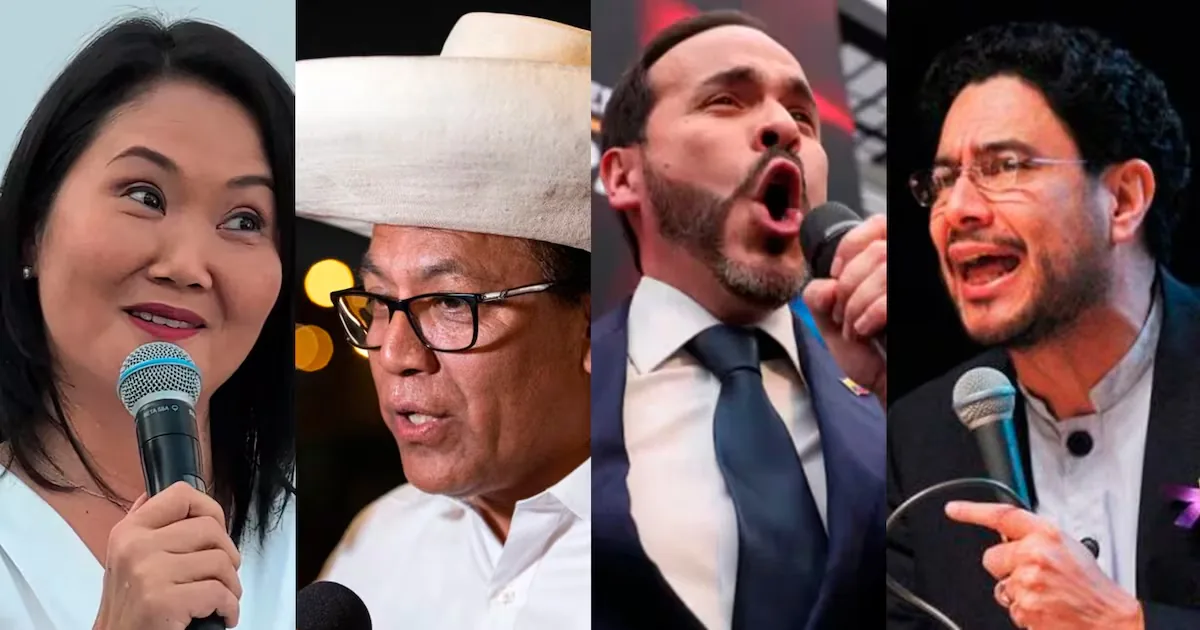
On May 31, far-right outsider Abelardo de la Espriella won the first round of elections in Colombia with 43.7% of the votes, while leftist Iván Cepeda surprisingly came in second, with 40.9%, according to the official preliminary count. Both will face each other in the second round on June 21. Conservative Paloma Valencia obtained barely 6.9%, “which represents a setback for the traditional Colombian political class and reflects the polarization of the country’s political landscape,” commented Americas Quarterly magazine, an influential publication dedicated to politics, business, and culture in the Americas.
Read more The weight of anti-Fujimorism facing the runoff in Peru
France 24 pointed in the same direction. “Colombia facing hyperpolarization?: De la Espriella and Cepeda, two political extremes go to the runoff,” it titled after the election results were known. “The two opposing figures show the marked polarization that the South American country is experiencing, with a weakened traditional right and a center with insufficient strength,” the media commented.
The regional graph showed that the Colombian periphery opted for the official candidate; meanwhile, the Andean zone turned to the far-rightist, another evidence of the polarization of the election. “The map is quite similar to that of the last four years, with the Pacto Histórico very strong in the margins, the coasts and the old territories, and Bogotá. But clearly that Andean Colombia went with Abelardo,” described Carlos Moreno, Professor of Political Science at the Pontificia Javeriana University. “It is a territorial polarization that has been repeated since the 2014 elections,” he added.
Indeed, the phenomenon of polarization has been repeating for more than a decade, not only in Colombia, but also in the region, and with greater intensity, analysts agree. For this reason, the use of the term hyperpolarization is already beginning to spread to refer to the issue.
The phenomenon was already seen with the narrow victory of Luiz Inácio Lula da Silva against Jair Bolsonaro in the 2022 elections in Brazil. Then would come the categorical victories of Javier Milei over Sergio Massa in Argentina in 2023 and that of José Antonio Kast against Jeannette Jara in 2025 in Chile.
The prospects are similar for this Sunday’s runoff in Peru, where right-winger Keiko Fujimori will seek to turn her luck and, in a fourth attempt, achieve the presidential chair, as long as leftist Roberto Sánchez does not say otherwise. In October, it will be Lula’s turn again, who this time will fight to remain in command of the Palacio de Planalto after facing Flávio Bolsonaro, son of the former president, at the polls.
Already in February 2023, the United Nations Development Programme (PNUD) warned about the intensification of political polarization in Latin America and the Caribbean, with a striking title: “With me or against me”.
Growing political polarization is a global trend; however, Latin America and the Caribbean is the region where polarization has increased the most in the last 20 years, the PNUD pointed out then. In the early 2000s, the region scored well below the global average and was the second least polarized region in the world, according to data from Variety of Democracies (V-Dem). However, from 2015 onwards, polarization began to grow faster than the global average, surpassing it around 2017.
A diagnosis that the UN has re-ratified in recent days. “Political polarization has intensified and has ceased to be a difference of opinions to become a dynamic of confrontation between an us and a them,” warns the study presented on June 1 in Madrid, which places Latin America as the most polarized region in the world.
The PNUD gives the continent a 3.4 in its polarization index, where 0 represents friendly coexistence among political actors and 4 signifies an extreme situation and maximum hostility, above the world average (2.9) and ahead of Eastern Europe and Central Asia (3.1), Asia-Pacific (2.9), Western Europe and North America (2.8), Middle East and North Africa (2.6), Sub-Saharan Africa (2.4) and the Caribbean (2).
In late 2024, academics Ernesto Tiburcio, from UC Berkeley, and Horacio Larreguy, from the Instituto Tecnológico Autónomo de México, wrote a research article titled “Political Polarization in the Global South,” where they address the phenomenon. “In the last two decades, in the Global South, especially in Latin America and Asia, an increase in ideological and affective polarization has been observed, as well as an associated democratic backsliding,” they warn.
Consulted by La Tercera, Tiburcio and Larreguy elaborate on the topic. “The increase in polarization is not exclusive to Latin America, but is a pattern in democratic societies worldwide. Evidence suggests that factors such as social media, the emergence of non-traditional (often biased) information media, and the proliferation of populist leaders explain this increase. In addition, there are country-specific factors, particular social divisions that have also contributed,” they explain.
“All these factors interact with each other. For example, the divisive success of Milei or Chávez is explained both by their discourse and by the strategic use of media. In terms of the demand for polarizing discourses and leaders, disillusionment with democracy and, therefore, the search for anti-system options is very relevant,” they add.
Daniel Zovatto, political scientist and expert in elections, governance, and democracy, as well as director and editor of Radar Latam 360, joins the discussion. In statements to this media, he comments: “Toxic hyperpolarization, as I call it, in Latin America is neither a cyclical nor an exclusively ideological phenomenon. It is the result of the convergence of several structural fractures that have deepened over the last decade and that the pandemic significantly accelerated”.
Read more At least one dead and one injured after recent Ukrainian drone attacks in Russia
“Firstly, the persistence of inequality and the exhaustion of traditional mechanisms of social mobility stand out. Latin America remains one of the most unequal regions in the world, and when broad sectors perceive that the system no longer offers real opportunities for progress, voting ceases to be a programmatic choice and becomes an instrument of rejection. The voter no longer necessarily votes for a proposal, but against an adversary whom they consider responsible for their frustrations,” explains the Argentine analyst.
“Secondly, there is a deep crisis of representation. Traditional parties have lost their capacity for intermediation, ideological identity, and credibility. This vacuum has been filled by disruptive leaders who offer simple answers to complex problems. Although from opposing ideological positions, phenomena such as Javier Milei in Argentina, Bukele in El Salvador, De la Espriella in Colombia, Noboa in Ecuador reflect the same dynamic: the rejection of traditional political elites and the search for alternatives perceived as transformative,” he continues.
And he adds: “A third factor is the growing concern for security, inflation, and the expansion of the informal economy. The combination of organized crime, economic deterioration, and job insecurity generates a social demand for quick and forceful solutions”.
In addition to these three factors, Zovatto points to the misuse of social media, now enhanced by artificial intelligence, which, he assures, “have amplified these trends”.
“More than a classic polarization between left and right, the region faces an affective and identity-based polarization. The political adversary ceases to be a legitimate competitor to become an existential threat, an enemy who is described and disqualified with the worst adjectives. Politics thus transforms into an emotional dispute where identities weigh more than government programs,” he adds.
Paulo Afonso Velasco Júnior, political scientist at the State University of Rio de Janeiro (UERJ), comments to La Tercera that “for at least 10-15 years now, this has been very noticeable, that people feel very poorly represented by the governments in power in general. And there is a tendency towards polarization in the sense that they seek new candidates. Who do not identify with politics directly or with traditional, more centrist parties, preferring more radical options, as a kind of rupture”.
In his opinion, “polarization or hyperpolarization is noticeable from there. It’s what we are seeing now in Colombia, it’s what we have seen in Chile, where the traditional right has lost, it’s what happened in Brazil with Bolsonaro or in Argentina with Milei”.
But Tiburcio and Larreguy warn about the use of the terms. “It is important to distinguish between ideological polarization and affective polarization. The former is the divergence of ideas and political priorities. This type of polarization (within the limits of the democratic state) is not intrinsically negative, as it indicates pluralism. Affective polarization is the dislike of people, ideas, or movements contrary to one’s own. This type of polarization is negative, as it prevents democratic coexistence, it invalidates the other”.
And what about the center? Tiburcio and Larreguy point out that the “center,” in terms of affective polarization, “is the set of platforms that recognize the plurality of ideas.” “It is, in some sense, democratic consensus, tolerance, dialogue, the recognition of the rules of the game. This type of platform is linked to traditional elites, who have great social discredit. Anti-system, polarizing options offer seemingly new ideas that contrast with old consensuses,” they explain.
For Zovatto, “the center is going through a deep crisis. Not because the citizen demand for moderation has disappeared, but because many centrist options fail to offer a powerful narrative of change. In contexts of anger, fear, and uncertainty, moderation can be perceived as continuity or lack of character”.
“The center usually has better institutional diagnoses, but less capacity for emotional connection. It speaks of gradual reforms when a large part of the electorate demands immediate answers,” he maintains. And he adds: “In an era of plebiscitary politics, the center appears too technical to excite and too cautious to mobilize. In none of the last Latin American elections did the center play a key role”.
“I do not believe that hyperpolarization is irreversible, but it will be a dominant characteristic of the regional political cycle in the coming years. As long as low growth, high inequality, insecurity, institutional distrust, and fragmented party systems persist, politics will continue to favor confrontational leaderships,” he concludes.
Read more Colombia sends 100 tons of humanitarian aid to Cuba