

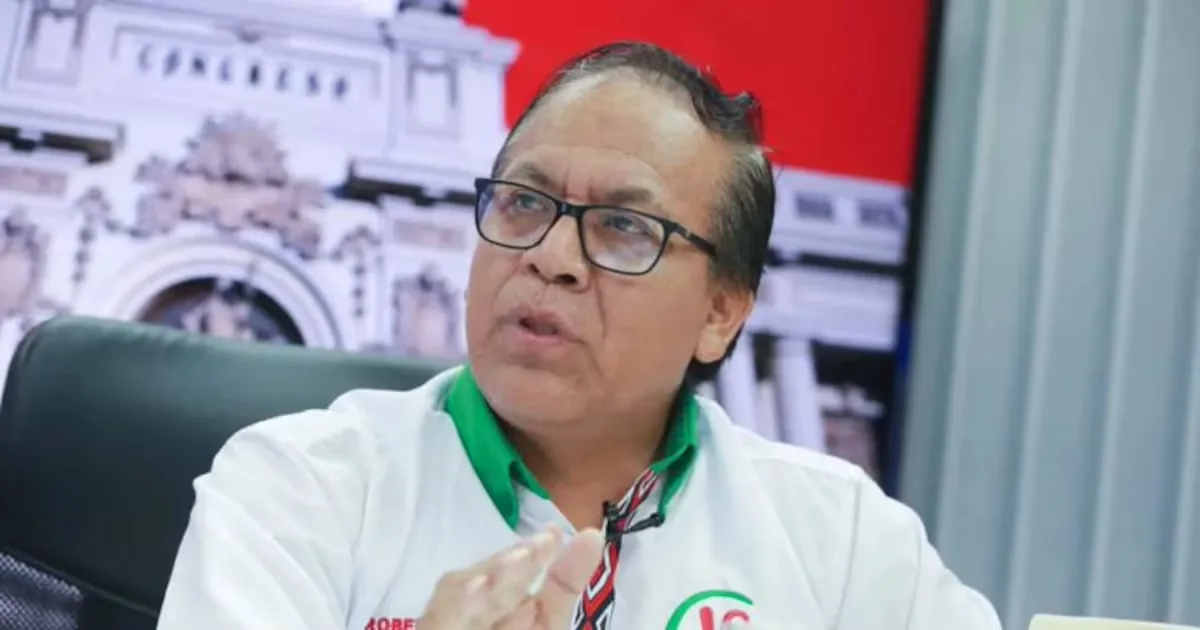
Despite having an extensive political career, the leader of Juntos por el Perú, Roberto Sánchez, was not, until the first round, very well known by most Peruvians. Sánchez is in a close competition with Keiko Fujimori, of Fuerza Popular, whom he faces today, amidst polls that give the advantage to one and then the other.
Read more The critical UN report that warns about the hidden costs of AI
Wearing the hat of the imprisoned former president Pedro Castillo, Sánchez has sought to win over the electorate with a discourse focused on alliances and Peru’s economic recovery.
In the days leading up to this Sunday’s runoff, he has met with different political forces. His campaign closing was on Thursday, in Lima. He also met with the foreign press and even took the time yesterday to accompany his daughter Qorianka, who is preparing for her first communion in catechism.
In conversation with La Tercera, he analyzed the challenges of his government should he win the elections.
Do you have any strategy planned in case you win the elections tomorrow and the leader of Fuerza Popular, Keiko Fujimori, does not recognize the defeat and challenges the ballots, as happened in 2021 and also in the first round?
-Certainly, we have organized with representatives for the defense of the vote’s meaning at each polling station. We have accredited our presence in the technical and monitoring bodies within the electoral system itself, and we welcome the presence of the international community from the OAS, the European Union, as electoral observers who have set high standards and, in the first round, allowed us to defeat the fraud narrative that hindered and affected us for 20 days at the start of the second round campaign.
Today, we have publicly expressed in recent days our respect for the electoral results, whether with political victory or not, we will endorse that gesture through the oversight that the law itself grants us. Peru needs a serious commitment to democracy and stability. I understand that this is the least the other political force can offer, but minimally there must be a serious, notable commitment to prevent misgovernance, especially when the electoral system itself has stated that electoral results and proclamation will only be given in a month. This puts a potential situation of upheaval at risk.
But we also have hope that these days we have not only achieved a solid political coalition that allows us to guarantee sufficient parliamentary presence to avoid misgovernance and presidential vacancy, but also the adherence of leaders from all sectors of the social, cultural, art, science, academia, and media sectors. That is to say, a series of leaders have said we must recover democracy, we must recover the parameters of separation of powers, of political stability to recover development and eliminate poverty. These are key aspects of this consensus we have achieved, and we go with hope, rising from below for a people who want democracy.
Peru has not had a president who finishes their term since Ollanta Humala (2011-2016). What do you plan to do as President if Congress wants to remove you? Do you have enough political agreements?
-Yes, we have achieved an important coalition that also allows us to improve parliamentary correlation, but we are still aiming for more and calling on other forces. The path we propose is to stop the confrontation. And I believe this electoral process has that task and that challenge. And at least we are willing to undertake it.
Read more U.S. destroys two Iranian drones operating in the Strait of Hormuz
If elected, what will be your relationship with Chilean President José Antonio Kast?
-Regardless of the government conjunctures that have one successor or another in office. During President Pedro Castillo’s government, we held several binational meetings with President Boric. Chile is our commercial partner. There is significant trade, not only because we are neighboring countries. We have resolved our border difficulties, we have none, we are in total peace, and our task is to deepen our commercial relations, our cooperation relations, the brotherhood of our peoples. The only path is development, trade. We absolutely respect this. We declare ourselves an internationalist country that believes in multilateralism. I am very sure that we will prioritize the development of our sister nations to deepen: as a son of the Andes Mountains, I believe in a shared future, as always, between Peru and Chile.
Do you have any measures planned for migration in southern Peru?
-Just as we have been welcomed by Chile during the difficult period of internal war in Peru, which led to a presence of Peruvians in our sister country, with incredible effort, we also believe in the right to immigration. But these must be, of course, within standards of legality, within standards of respect for justice and the laws of our countries.
We also criticize that the government of Pedro Pablo Kuczynski liberalized and simply allowed, indiscriminately and without any regulatory conditions, an overpopulation that now reaches almost two million Venezuelan brothers and sisters in Peru, and that, certainly, a minority is also involved in criminality. We believe that just as we will be relentless against national criminality, we will also apply the same standard to international illegality and proceed not only with investigation but also with expulsion from the country in cases of illegal activity. We must ensure adequate coordination that allows us not to jeopardize either the rights or the social life with the security we require in our Peru, which today is also heavily affected by crime, contract killings. Seven Peruvians are affected by death every day. A criminality where statistics tell us that the vast majority of crimes are of national origin. There is a minimal percentage of international character that we must also resolve. In this, there is no small dysfunction; the rule of law must be applied so that we can have peaceful coexistence.
You have been compared to former president Pedro Castillo, how do you differ from the former president?
-We are allies, fraternal brothers, comrades. We have focused on the recovery of democracy, on his freedom, on the reparation of justice. Those who have been murdered by this regime, 56 state crimes, seven of them minors. These are standards that today are in impunity and cannot be. This has motivated us to a political alliance precisely with this hat, which is President Pedro Castillo’s; I wear it, given by him with respect, affection, loyalty, and that vindication of the movement and the people whose vote was discriminated against, illegally removed from office, detained without a judicial order, while being president. Of course, because discrimination, racism are part of the elites in Peru. We work within the framework of constitutional law because the acting president has the capacity to grant presidential pardon. We say that the voice of the people is the voice of God, and the freedom of President Pedro Castillo, with victory this June 7, will be a political reality that we will uphold and that we will direct and issue.
You recently created a new program as a result of an alliance with other parties, but many have criticized it, saying it’s a maneuver to hide a more radical position. How do you respond to these people who criticize you?
-In reality, it is legitimate to form alliances if no single force has obtained a majority. One plus one equals two. Even to engage in politics, we need a social and political majority. And while it is true that they are not represented as requirements for a second-round candidacy, these are political facts to which we are committed. Signed and presented to the Peruvian people. What more legitimacy can a politician have than this coalition? If that is a criticism, it will be the criticism of the loser who has not dared, has not grown in achieving majorities, policies, and consensuses to recover democracy and healthy development with justice for Peru. We are indeed capable of saying we will slow down so that Peru wins, and that is our commitment.
What message do you want to send to Peruvians living in Chile?
-To address Peruvians abroad, my brothers, cousins, uncles, there in Santiago, San Felipe, Renca, and other cities. From here, to all Peruvians abroad, who are hundreds and thousands who have sacrificed themselves through work (chamba) and the empathetic welcome of our Chilean brothers, with monthly economic remittances, they have been able to help us endure the difficult years Peru has had. This historical contribution has not been well accompanied by a state policy that also defends Peruvians abroad in the consular aspect, to provide technical assistance for their formalization, regularization, and legal status, but also for repatriation and return. That is to say, we believe that political representation is something that must also improve for millions of Peruvians abroad who only have two parliamentary representation seats. That is not fair. We have to modify: from the Ministry of Foreign Affairs, we will create a Vice Ministry of Consular Affairs for the adaptation and the treaty and the extension of our rights to Peruvians abroad. That is the commitment. And today we urge you tomorrow (today) that on June 7, Flag Day, Dignity Day, together we recover democracy and use a marriage of brotherhood between our countries Peru and Chile.
Read more Kim Jong-un’s sister states that North Korea’s nuclear status is «irreversible»