





Daft, the blue cat, is one of the most representative works of visual artist Diana Camacho. It is present in the daily life of her family, proudly hanging on the main wall of her sister’s apartment, and it also opens her memory The animality that transcends us, which she presented at the Permanence Workshop II of the Bachelor of Arts at the Pontifical Catholic University of Chile, a degree from which she graduated in 2024 with two honors.
Read more North Korea criticizes US arms sales to South Korea: “It is proof of persistent hostility”
The cat, with a timeless gaze, seems to observe attentively. It observes, just like Diana. She creates art from emotions, the processes she has gone through throughout her life, encounters with others, and also from her moments of introspection.
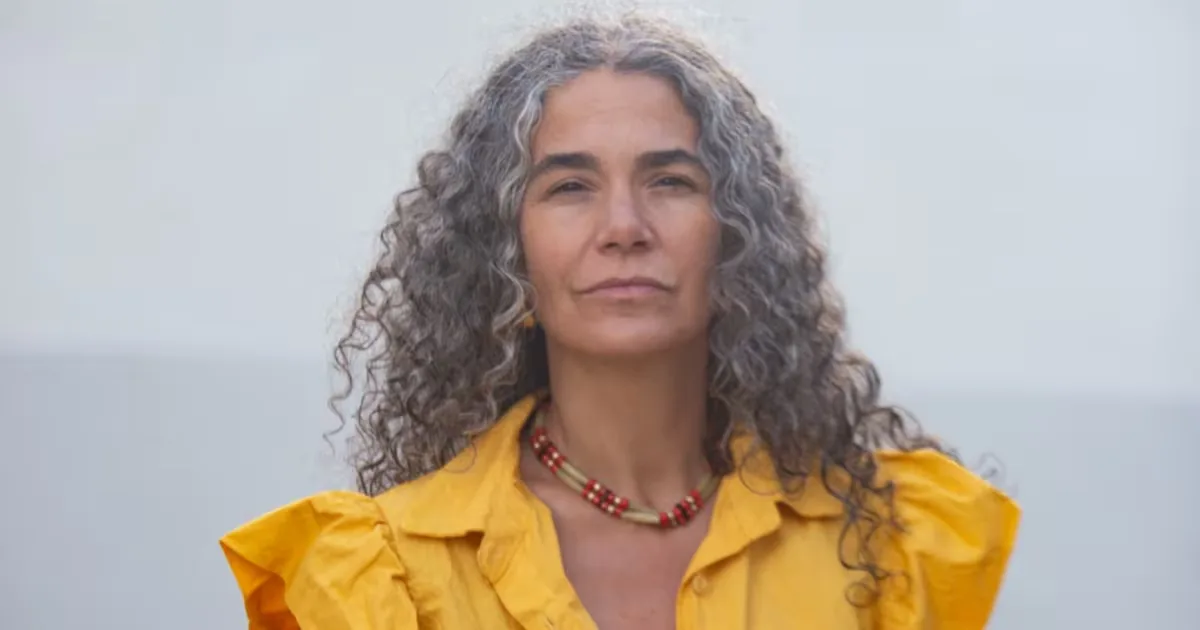
During her early childhood, she was diagnosed with Marfan syndrome. Later, neurodivergence and low vision were added. Today, at 52 years old, Diana has a career as a visual artist and is an expert in cultural mediation, non-formal education, and accessibility. Her work has been linked to museums, cultural centers, and organizations dedicated to inclusion.
With increasingly reduced vision, her work poses a paradox: dedicating herself to the visual arts when the eyes do not necessarily provide a complete image of what is in front of her. For Diana, however, creating has never depended exclusively on seeing.
—How has your relationship with art been?
I connected with drawing since I was little, even though I had low vision. My understanding of the world was born from that connection. Drawing has always been a way for me to release, to exorcise fears. So, beyond whether I saw well or not, I began to communicate by painting and drawing, and that reaffirmed me.
The first time I studied art, the concept of inclusion was not yet well developed, and that’s when I encountered the first obstacles. I had to draw a shoe and couldn’t distinguish it well, I only saw blots. I had a depression then and didn’t finish the first semester.
Later, I participated in classes with a teacher from the Santa Lucía School, a specialist in teaching art to people with low vision or blindness. She guided me a lot and told me: “Diana, you are an artist, study art.” I took it as a joke.
During those same classes, I realized that blind children also create art, but using other senses. There are codes that teachers teach to work with colors, and the material is also experienced through auditory, tactile, and even olfactory senses. Fundamentally, there only needs to be the desire to express, to create. It is very liberating and healing.
Then I was privileged when I entered to study Art at the Catholic University. I was at a stage of greater maturity and with absolute focus on the learning process. There was already a different conception of the student, the teachers were not demigods, and there was openness for me to develop working from the sensory.
—How does a person with low vision create a work?
I don’t construct objects from sight because every day I see worse. I take many photos because, when I’m looking, I’m never seeing, in quotes, exactly what it is. At that moment I sense things, take out my phone, and take pictures. Later, in my bed, I review what for some reason caught my attention.
There are works in a museum that call me, produce a vibration, give me pleasure, or shake me. Sometimes it has happened that I connect with a work and later discover it relates to my own life philosophy.
I look section by section, searching for suitable light and using memory a lot. The mind integrates and forms an image. Before entering university, my way of drawing was much more intuitive. I always drew profiles; I liked the human figure and faces. I drew because I felt overwhelmed. I did it almost as a form of survival: an outburst of anguish or anger would come, and I would draw. Some people create from curiosity or mystery; for me, it is a vital need that allows me to stabilize.
I get to know the environment through observation, segmenting and trying to understand the world. That can also be tricky for people with low vision because we try to complete all that information we don’t have clearly. We invent stories and often make mistakes. I can look far away and say: “Hey, that dog,” approach and discover it was a garbage bag. So it’s more about drawing than understanding, because sometimes you don’t see well what you’re doing. It also helps to work with a very contrasting color palette.
Read more United States blocks passage of 75 ships in Hormuz amid its perimeter lockdown
I have references, artists I like. I don’t seek for my works to be like theirs, but to establish a language with other creations, to generate a dialogue that I understand. Sometimes I’m very anxious and go to the library, look for children’s and youth books, which are my favorites. I have notebooks and draw what I like or what catches my attention. After a while, I relax and let go. It’s very rewarding. Other times I paint with anger, passion, and even desperation.
—What role does technology play in that way of creating?
Technologies help me a lot. I don’t know what I would rely on to save material and then work on it if photography or the phone recorder didn’t exist, or if I didn’t have immediate access to what I want to find to develop a work. I am fortunate to be in this era to make art.
With ChatGPT we philosophize a lot, it’s great! No human being would tolerate so many questions from me. For example, I’m painting something, I send a photo, and it can suggest changes, explain them with words, or show me an image with modifications, color palettes, and specifications.
Art today is not only visual, it is immersive.
—You paint many animals, where does that fascination come from?
Every day the ambiguity of human beings generates more conflict for me, and somehow I consider that animals are much more honest. They are more connected with nature and the wild. They are free and respect their own nature, they don’t question themselves and are governed by their own laws.
When you start researching the dynamics of insects, spiders, or fish at the bottom of the sea, you find extraordinary information. Animals captivate me with their essence.
—Daft, the blue cat that appears in one of your most representative works, what does it mean to you?
When I started studying, I went to live with my sister and took the cat with me. Then the pandemic came, and I went to live alone with him. Daft represents a healthy relationship. He was with me through all my processes. I could pet him, feel tenderness, and balance myself as a human being. The blue cat is containment and affection, but at the same time it implies caring for someone. It is a symbiosis.
The blue tones appear because Daft has lead-colored fur and sometimes looks blue. He is quite grumpy and has a lot of presence. Also, I like that color because of Picasso’s blue period, more figurative, without reaching the abstract. At the same time, for me, blue is concentration.
—After all your experience as an artist, what does seeing really mean to you?
For me, seeing means connecting with the essence of that presence in front of me. Feeling that it really occupies a space, observing it, constructing it, decoding it, connecting with it.
Seeing is opening the mind, spirit, and sensitivity. It is having an open mind and connecting through other senses. I have realized that the more I connect with a person, the easier it is to portray them. Logically, it won’t be faithful, but I can capture their gaze, their smile, a gesture. That is seeing: connecting with that infinite part of the other that remains as a continuum in me, because, fundamentally, we are all connected. That openness allows me to discover something that also vibrates with me, but respecting the other in their individuality and marveling at them.
Seeing is much more than the deception of the eyes. But, paradoxically, being an artist is also deceiving, because when I make a painting I use all the resources so that the other’s eye thinks what they are seeing is real. I have to learn to lie well with the techniques they teach me, so that the other believes they are seeing something familiar. An artist is a person who knows how to lie very well, who knows how to deceive, who knows how to do magic.
Read more Iran claims to be immersed in a «total economic war» and emphasizes that it will «defeat the enemy»