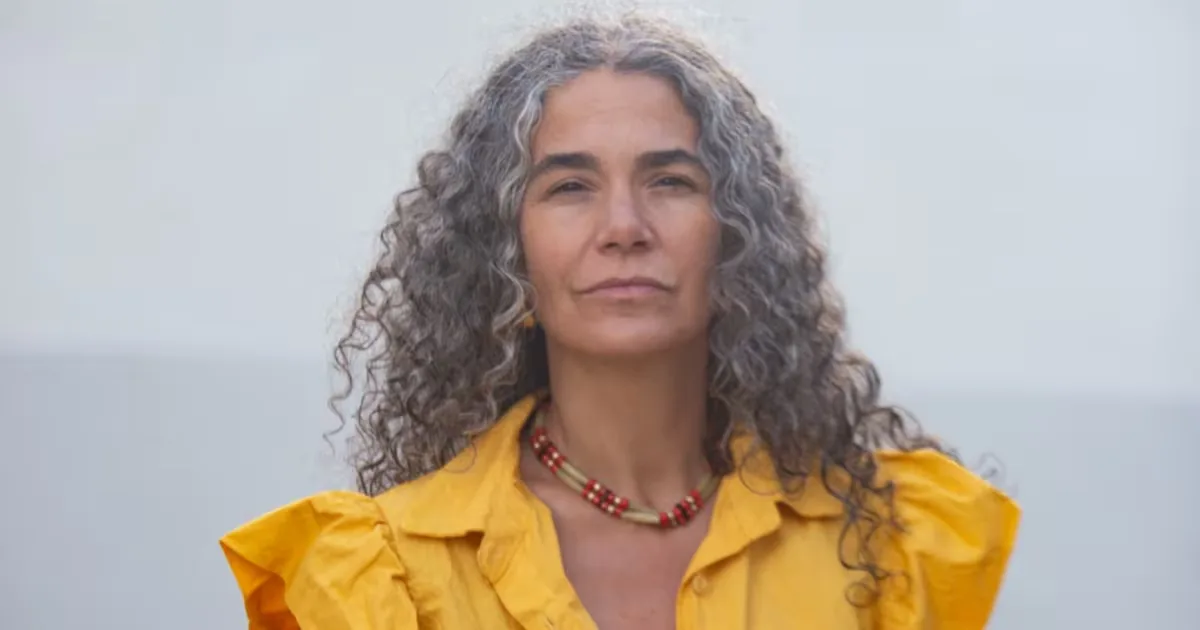





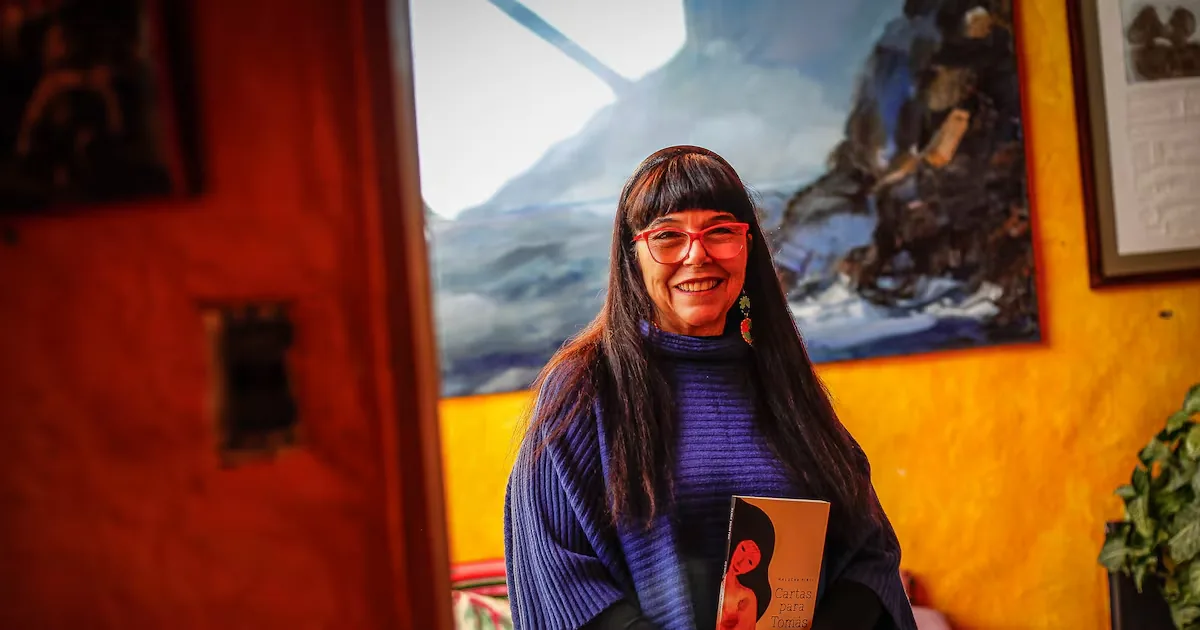
This year marks thirty years since the first edition of Letters for Tomás, the book Malucha Pinto wrote for her son. The anniversary prompted a conversation with editor Arturo Infante, responsible for the first edition, to consider its reissue. Initially, there was a practical reason: the book had been out of print for years and many people were still looking for it. “They told me ‘I need it.’ They showed me very worn copies from so much use,” Malucha recalls.
Read more The marine biologist who uses artificial intelligence to protect whales
But that conversation ended up giving the project a much deeper meaning. “He opened a window for me regarding why he wanted to reissue it. He told me something very beautiful: ‘Tomás has been an absolutely valuable human being in his particularity. If we were all valued like that, first by our family, then by our community, and finally by a country, we would have completely different societies’.”
When Tomás was a baby, doctors diagnosed him with cerebral palsy and told Malucha he probably wouldn’t live more than three years. When Letters for Tomás was first published, in 1996, he was already seven. “It was already a tremendous triumph that he was alive. Today he is 38,” she says.
That’s what Arturo was referring to. “‘Do you realize that you never wanted Tomás to do anything different from what he does? And I think that’s why he’s alive,’ he told me. And he was right. My energy was never focused on him moving his feet, standing up, or reaching certain goals. It was always focused on him. And I am deeply in love with Tomás. I love how he is, I love his energy, I love what he proposes, I love his way of being on earth. He has always been like that. I have never wanted to change him,” says Malucha.
“Books often contain mysteries that the author doesn’t know and appear later over time. Arturo saw that,” she adds. What he discovered was that, unintentionally, Letters for Tomás had helped many readers understand that true love does not correct difference. Rather, it embraces it, cares for it, and lets it flourish.
—Accepting a child as they are seems like a simple idea, but motherhood is also full of expectations and fears. How do those two things coexist?
—Yes, there is a part of that. We want them not to suffer. But there is also another part that has to do with us. We want them to be a certain way, to study certain careers, to meet certain expectations. Today I see many young people deeply unhappy studying what their parents dreamed for them. They medicate themselves, they have depression.
In the end, we all make a long journey to rediscover who we really are. I wish we could save them some of that path and simply accompany them to be who they are.
—What was that process like for you?
—At first it was difficult because the way others looked at us was very violent. We’re talking about thirty years ago. A child in a wheelchair who, moreover, was not only in a wheelchair. Sometimes Tomy’s head would fall, his drool would fall. People weren’t used to seeing him. They looked at him with that mix of pity and compassion that I hated. They said things like “poor thing” or “you carry your cross.”
But I think we are both very rebellious. Also, it was a time when I read a lot. There was a book that marked me: The Aquarius Conspiracy. It introduced the idea of the warrior’s journey, which is being who you are in the world. That made a lot of sense to me. I felt that Tomy came precisely for that: to be who he was, and he was like that. I always thought that if all our energy was put into making him fit into an idea of normality, we would lose all that powerful energy, because he, without moving from his bed or chair, has moved the world.
—When Letters for Tomás was published, motherhood was hardly spoken about from such an honest place. You didn’t hide fear, anger, or pain. How did you decide to write that way?
—It wasn’t a decision, honestly. It just happened. I was living through that process and I just wrote. I had already published a book and kept writing. Today I reread the book and think how brave I was. How honest. I don’t know if, had I been more aware, I would have dared to write some of those things. But I think that is one of the great values of the book. It hides nothing. There are passages I read today and say: “How intense!” Yet, precisely because of that, it opened many doors. And it can keep opening them, because you read and think: “If that happened to her, it can happen to me too.” It gives you permission to feel.
For a long time Malucha thought her book was about motherhood, inclusion, disability, but when she reread it, she was surprised that it is a text revolving around the question: what kind of society do we want to build? “For me, it has to be one that includes fragility not as a handicap, but as a great potential. Because it is from fragility that great questions and also great actions arise,” she assures. “I feel the book invites us to move from a paradigm of competition, in which we live today, to one of collaboration and interdependence. Not only among human beings, but with the entire universe. That was already in the book, although I hadn’t seen it.”
—You talk about interdependence almost as a way of understanding life. How much of that conviction comes from the experience of caring for Tomás?
Read more Work less and better: what the English experiment tells us about the future of work
—A lot. The first thing I learned was that this can’t be done alone. I think that’s a bow we have to bend, especially women, because we tend to believe we have to handle everything. We are not omnipotent. We need help, you can’t die trying. For you to sustain this experience for a long time, you need someone to take care of you too, to care for yourself, you need to have a life.
Then I understood something much bigger. There is an anthropologist, Margaret Mead, who was asked what was the first sign of civilization. She answered: a fractured femur that managed to heal. I died with that, because it means we exist thanks to someone who cared for us. We all have, somewhere deep in our brain, the memory, the experience of someone holding us in their arms and rocking us. Without that, nothing would exist. And yet, we have built and continue building with our backs turned to that absolute fact.
I always work with caregivers and tell them: imagine if we all raised our arms and said “I won’t care anymore.” The streets would be full of dying people. Yet, it remains invisible work.
The house where Malucha and Tomás live, in Peñalolén, was built with him in mind. There are ramps, wider doors for the wheelchair to pass through, and an adapted bathroom. But there are also small details that speak of a shared life: across the street lives a horse that Tomás loves to visit to bring carrots and apples; neighbors know him by name, and between the first and second floors, a small hole connects Malucha’s room with her son’s. She wanted them always to be able to hear each other.
—What is your life like today?
—I work during the day and try not to work after seven in the evening. If I want to go out, I have to hire someone to stay with him. I always say I’m like Cinderella, because I can never come back after twelve. I have to arrive to relieve whoever is taking care of him.
At seven I get home and that’s our moment. I read him something, we listen to music or watch a series that must have about four hundred episodes and we haven’t been able to stop because we love it. Tomy loves romantic movies. He gets very emotional.
Many times I end up sleeping right there. I have a recliner and suddenly I wake up at five in the morning thinking: ‘Where am I?’ We have our world. We talk a lot. We talk about powerful things. Last year, for example, Tomy was very ill, had a horrible year, was hospitalized twice and I truly believed he was going to pass. I remember and get emotional because it was very intense.
—Can one prepare for a moment like that?
—I thought so, because I had named that possibility many times. But last year I realized I wasn’t prepared for anything. Suddenly I don’t know who I am, if I am Tomy or I am me, or if he is part of me. We have a very powerful bond.
But it was also a moment to give permission. We had very deep conversations, made agreements. I told him: “Tommy, if you want to go, you can’t stay here for me either. You have to live your own path, your own process.” In the end, he crossed that river. He grabbed onto life again and today he is well again. Since summer, his humor and laughter have returned, because he is very good at laughing. Jokes make him laugh, tragedies… he doesn’t take anything seriously. “But Tomás!” I say to him.
And I have also had to accept, empathize with the idea that that powerful spirit lives in a body that has been deteriorating. His bones are more fragile, he already had a hip fracture. So I have also learned not to ask him for the impossible and to understand that there is also his freedom.
—Thirty years later, what would you like Letters for Tomás to continue provoking in those who read it?
—I would like this book to continue being a tool for families, for schools, and for anyone who wants to look at others from a different place. Many people who don’t have children with disabilities read it and start looking at their children differently, because all this appears: expectations, the “I want them to be like this, I want them to be like that.” And they say: “Damn, no. Better that we just accompany. That we allow the other to flourish.” In the end, that’s what love is about.
Read more Clashes over road clearing in Bolivia leave at least 35 injured