









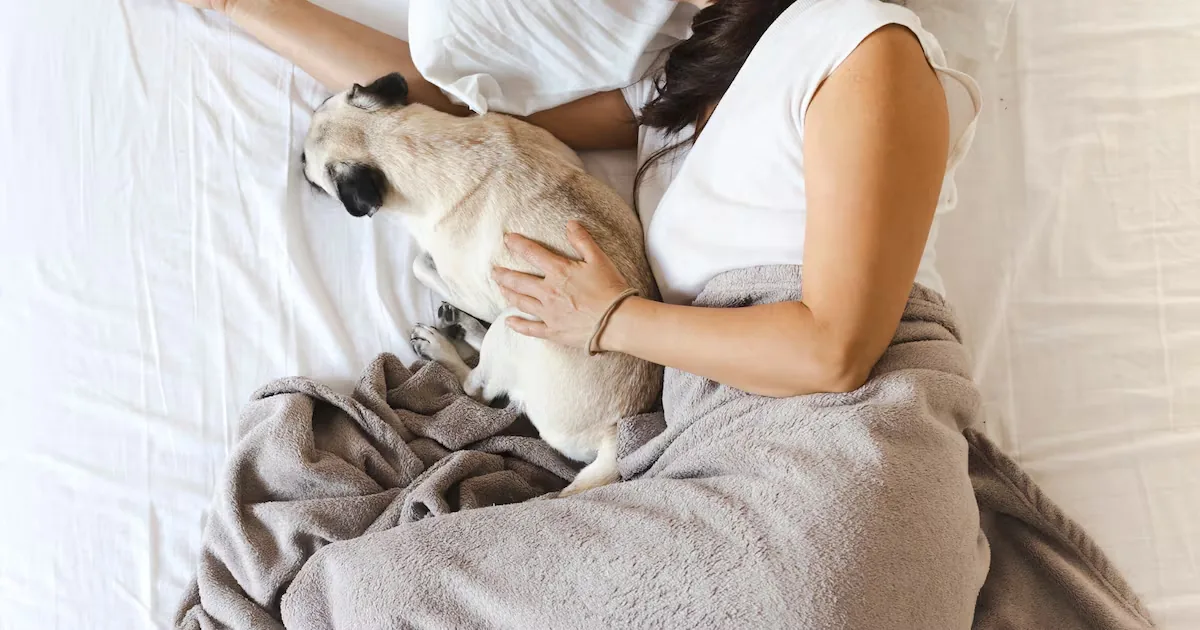
There are those who cannot conceive of a winter night without their dog curled up at the foot of the bed or a cat taking over the pillow. But there are also those who prefer to keep the room, and especially the mattress, free of paws and fur. Regardless of which team we are on, does sharing the bed with our pets promote rest or, in reality, can it harm it?
Read more Trump says he is “close” to making a decision on the “biggest attack” against Iran to date
According to data provided by SERNAC based on the Cadem survey “The Chile to Come”, 63% of people always or sometimes sleep with their pet, and even a third of them sleep in the bed. And it’s not surprising. Today, dogs and cats are another member of the family, and the companionship, warmth, and sense of containment they provide make it difficult to imagine bedtime without them.
Some do it for their warmth, because it’s true that a dog or a cat can provide the same affection as a hot water bottle; others do it because their company generates tranquility, reduces feelings of loneliness, and can help them relax before sleeping. It’s not just a perception. It has been shown that interacting with dogs and cats promotes the release of oxytocin, the so-called “bonding hormone,” and helps decrease cortisol levels, associated with stress.
In other words, for those who come to bed with their heads full of worries, a dog curled up at their feet or a cat on their legs can become a small ritual of calm. Dr. Larisa Fabres, a neurologist from the Sleep Medicine program at Clínica Universidad de los Andes, points out that “the feeling of companionship, security, and tranquility that a dog or cat provides can promote a greater sense of well-being at bedtime, especially for those who live alone or find emotional support in their pet.” In these cases, she explains, “if the animal’s presence does not interfere with sleep continuity, this practice can be perceived as positive.”
But this is not always reciprocal. Dr. Claudio Galleguillos, director of the Veterinary Clinical Hospital at Andrés Bello University, states that from the animal’s point of view, “it is not always a strict necessity; in many cases, it is a preference reinforced by learning.” However, he emphasizes that both dogs and cats, in their early stages of life, are accustomed to resting with their litter, so sharing the bed with their guardian “provides them with warmth, protection, and a sense of security, as sleeping accompanied is a social and biologically familiar behavior for them.”
While it is a topic that has not yet been fully investigated, some studies have suggested that sleeping next to a pet leads to poorer sleep quality and a higher probability of suffering from insomnia. In this regard, Dr. Fabres points out that, from a sleep medicine perspective, one of the main disadvantages is “awakenings during the night that make it difficult to maintain continuous and restorative sleep.” This occurs because animals have different sleep patterns than humans and tend to move, change position, or wake up several times during the night. “This fragmentation of rest can affect sleep quality and make the person not feel fully recovered the next day,” she adds. Therefore, the specialist warns that for people with sleep disorders, sharing a bed with a pet may be less advisable.
In addition, sharing a bed with a pet also implies a greater exposure to microorganisms. Dogs and cats can carry fleas, ticks, parasites, and some bacteria that, although rarely causing illness in healthy people, do represent a potential risk, especially for those with weakened immune systems. An article published by the New York Times states that these situations are rare and that the risk can be considerably reduced by keeping up-to-date with veterinary check-ups, deworming, and flea and tick prevention.
However, Douglas Wallace, a sleep specialist and clinical neurology professor at the University of Miami Miller School of Medicine, explained to the American media that the emotional support associated with sleeping with a pet could cause their guardians to overlook any negative effects this has on sleep quality.
Dr. Galleguillos emphasizes that it is also “important to observe if the animal has the ability to rest autonomously and adapt to different contexts.” He adds that “a problem could exist if it only manages to fall asleep in contact with its guardian, if it becomes intensely distressed when it cannot access the bed, or if it exhibits behaviors such as vocalization, scratching at doors, restlessness, or destruction when left alone.” Furthermore, he recommends considering that the resting place is also suitable for the animal: “It is important to observe if the pet can change position, get off the bed when it wishes, and choose another place to rest without impediments.”
If the nighttime coexistence is working, there is no reason to change it just because. But if every morning you wake up more tired than when you went to bed, it might be worth checking if your four-legged companion has something to do with it. If sleeping together becomes a problem, a good alternative is for the pet to have its own bed in the room, allowing for closeness and companionship without sacrificing either’s sleep.
Read more China conducts a series of live-fire military drills off Taiwan