


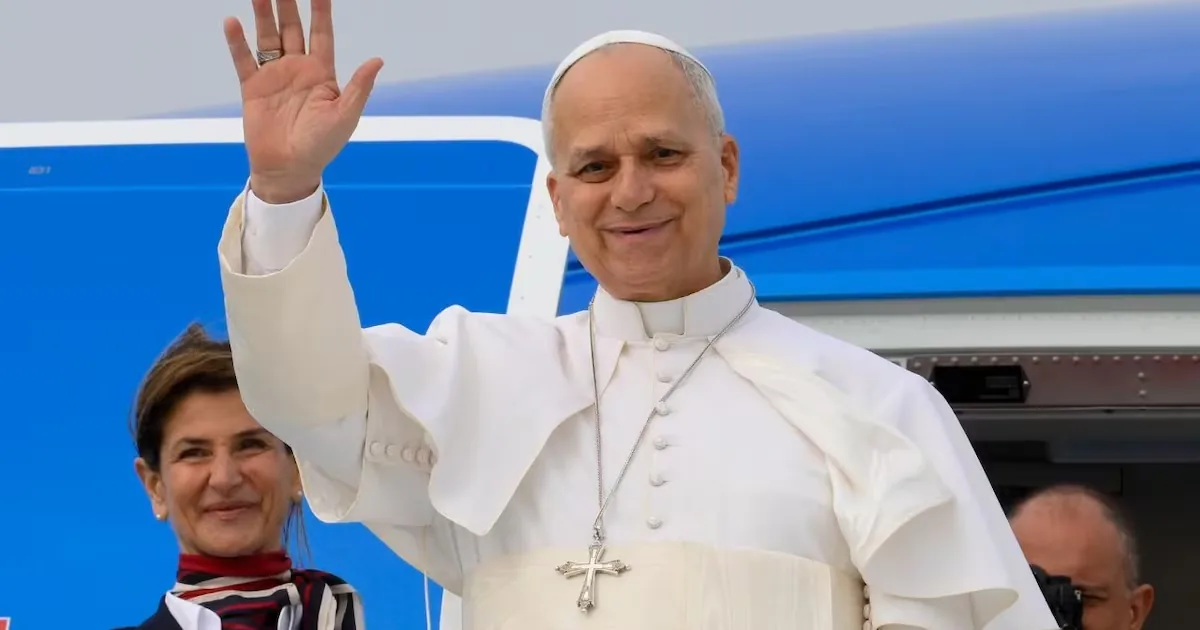
Pope Leo XIV begins an apostolic visit to Spain this Saturday, 15 years after Benedict XVI traveled to Madrid in 2011 for World Youth Day. The trip, which will last seven days and include four cities, is being followed with interest by Spaniards, who already have the Santiago Bernabeu and Movistar Arena full for one of the Pontiff’s events.
Read more NASA isolates its astronauts from the International Space Station while Russian agency repairs leaks
From June 6 to 12, the event is causing anticipation. The leader of the Catholic Church will visit Madrid, Barcelona, Gran Canaria, and Tenerife. In total, 600,000 people have already registered to take part in the mass events, although organizers suggest that the number could reach one and a half million.
Leo XIV, who lived for years in Peru, will deliver most of his speeches in Spanish, with the exception of two speeches: one he will offer at the Sagrada Familia in Barcelona, which will be delivered in Catalan, and another at a reception center in Tenerife, where he will speak in French, thus addressing migrants from Francophone Africa arriving on the islands.
Spain is the current Pope’s fourth international trip, following visits to Turkey, Lebanon, Monaco, and Africa. On this occasion, Leo XIV has about 21 events on his schedule, in a significant destination for the Vatican. The Spanish church has been trying for years to maintain its relevance as society secularizes and the voice of religious leaders declines in importance, according to local press.
In this sense, the Vatican has presented the trip to Spain as a return to a land of ancient Christian tradition, “a laboratory of dialogue in the Middle Ages, homeland of great saints and of the School of Salamanca,” where reflection on human rights and dignity was born.
The main reason for this trip stems precisely from the previous Pope, Francis, who had already planned to go to the Canary Islands to be with migrants. Thus, Leo XIV is carrying out that trip, continuing the legacy of his predecessor.
Likewise, the centenary of the death of architect and designer Antoni Gaudí, the greatest exponent of Catalan modernism, commemorated on June 10, is an important reason to visit Barcelona: the Sagrada Familia Basilica inaugurates one of its towers, the tower of Jesus Christ.
The trip’s motto is “lift up your eyes,” taken from the biblical quote John 4:35. The head of communication for the National Coordination Committee, Josetxo Vera, explained at its presentation conference that “in that ‘lift up’ lies the thirst for God, His recognition as a source of unity (Madrid), beauty (Barcelona), and charity (Canary Islands and Tenerife),” which are the stops on the trip.
During his visit to the Spanish capital, there are mass-reach events. On Sunday, the 7th, in the morning, there will be a multitudinous mass in Plaza de Cibeles, Madrid. In the afternoon, at the Movistar Arena, an event called “Weaving Networks” will take place, featuring personalities from the world of culture, art, and economy.
On Monday, the 8th, in the morning, he will receive the President of the Spanish Government, Pedro Sánchez, at the Nunciature. He will then attend the Congress of Deputies, where he will deliver a speech. In the afternoon, among other things, he will preside over an event with the diocesan community of Madrid at the Santiago Bernabéu stadium.
On Wednesday, the 10th, the anniversary of Gaudí’s death, he will visit the Brians 1 Penitentiary Center in Barcelona, then go to the Abbey of Our Lady of Montserrat and participate in the recitation of the Rosary. He will then celebrate mass in the Sagrada Familia Basilica.
In an interview with the newspaper La Vanguardia, the director of the Fundació Catalunya Religió, Jordi Llisterri, explained the key points of the visit. “Firstly, Llisterri points out that Pope (Robert Francis) Prevost will bring up the negative consequences of polarization for our society. In this sense, he recalls that Leo XIV had to deal with political, social, and economic polarization during his stay in Fujimori’s Peru,” the Spanish media outlet notes.
Read more 10 years after the black seals: are we learning to eat better?
In this regard, the expert points out that it is likely that the Pope’s speeches will be co-opted by local parties to “bring them to their position.” “Leo XIV’s position contrary to the administration of US President Donald Trump may please Spanish President Pedro Sánchez, who has positioned himself as an opponent of the White House occupant’s management,” he exemplifies.
The Pope’s visit to a prison seeks to remember “the discarded” by society and wants to convey the idea that “everyone has the right to a second chance,” Llisterri explained to La Vanguardia.
In Madrid alone, 300,000 faithful have already signed up for the mass in Plaza de Cibeles, and 220,000 in Plaza de Lima. Forecasts indicate that there will be more than half a million pilgrims at the vigil and one and a half million at the Eucharist.
Faced with this scenario, almost 22,000 volunteers have been mobilized to collaborate, who will be identified by the color of their shirts according to their responsibilities. Regarding security, the operation to protect the Pope includes 11,000 national police officers, 2,200 civil guards, 4,000 Madrid police agents, 500 Catalan, and 200 Canarian: in total, nearly 23,500 agents on the mission.
Organizers have estimated the cost of the papal visit at 25 million euros, with an economic impact exceeding 150 million euros. The figure, according to a study on religious tourism in Spain prepared by ObservaTUR, speaks of 90 and 125 million euros. It is lower than that recorded with Benedict XVI, when 354 million euros were injected. On that occasion, the Pontiff’s visit coincided with a World Youth Day.
The newspaper El País states that Pope Leo XIV’s arrival in Spain this Saturday inaugurates a new stage for the Spanish Catholic Church, which must manage its relationship with a pontiff with progressive tendencies considered an antagonist of Donald Trump.
During the pontificates of John Paul II (five visits to Spain) and Benedict XVI (three others), the episcopal leadership maintained close harmony with Rome, the Spanish newspaper states. That affinity fractured with Francis (2013-2025), whose openness met a cold reception among a high clergy with a deeply rooted conservative bias. The Argentine Pope never set foot in the country on a pastoral trip.
According to a 40dB. survey for El País and Cadena SER, almost seven out of 10 Spaniards support Leo XIV in his rejection of war and more than half in his criticism of Trump’s deportations. Meanwhile, 79% of respondents ask the Church to modernize. Spaniards show rather lukewarm interest in following the Pope’s visit to the country, with an average of four out of 10.
Cases of pedophilia within the Church are one of the issues that damage the institution’s image. 43% of respondents believe that the Church has protected aggressors instead of victims, just over 20% think it has improved but still has a lot to do, while barely 85% consider that it has acted transparently. A verdict shared by believers and non-believers, Cadena SER points out.
More than half of Spaniards believe that the cover-up of pedophilia is still active, and only 6% trust that the Church acts transparently today. Non-believers are more critical, but distrust also permeates among the faithful themselves.
In fact, for 32%, scandals like pedophilia are the main cause of religious decline in Spain, where 60% of the population identifies as Catholic, although only 15% admit to being practicing.
Read more Carcuro, school uniforms and the Revolt: Los Tres in five memorable shows