





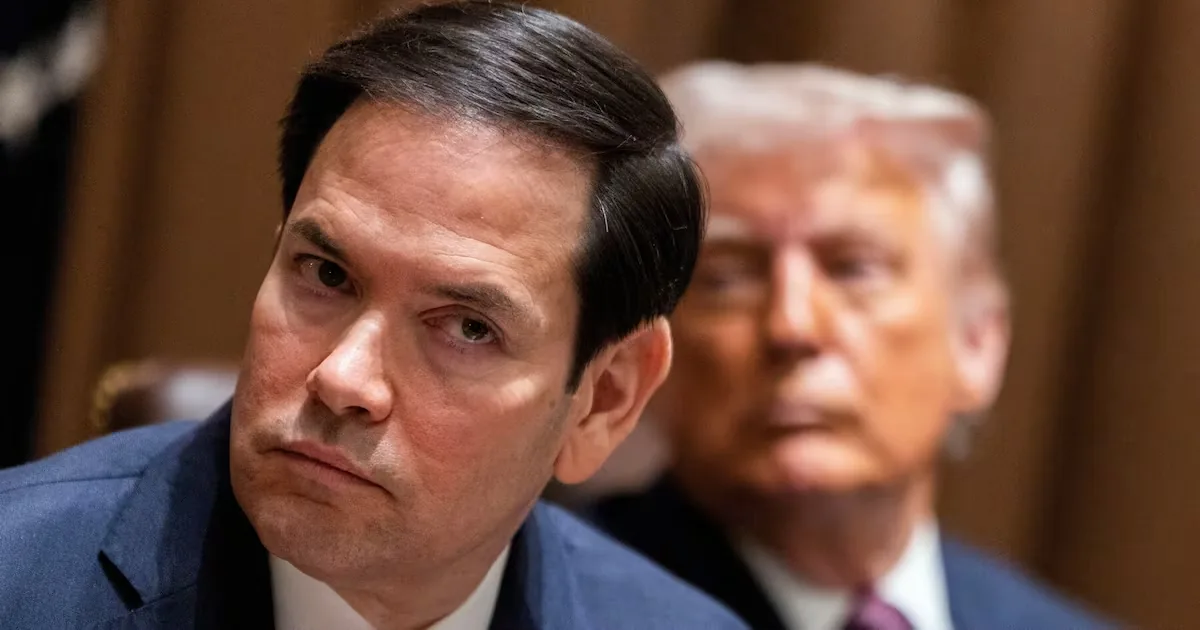
The US State Department launched a diplomatic and economic offensive to incapacitate the International Criminal Court (ICC). Secretary of State, Marco Rubio, is leading a campaign that includes sanctions, visa revocations, and pressure on the 125 signatory countries of the Rome Statute – the instrument that gives rise to the ICC – to withdraw from the body that prosecutes genocide, war crimes, crimes against humanity, and the crime of aggression.
Read more Trump warns China and Russia that if they deliver weapons to Iran, it «would be very bad» for both
The announcement was formalized in a State Department statement that described the ICC as a “threat to US sovereignty” and promised to systematically disable the court’s ability to operate and prosecute US military personnel or officials.
The same statement details the measures under consideration for implementation. These include diplomatic calls to urge other nations to withdraw from the ICC, pressure on countries that depend on Washington’s assistance or military protection, the revocation of visas for court personnel, and an increase in sanctions against the ICC and organizations associated with it.
Rubio outlined the campaign’s objective in an opinion piece published in The Wall Street Journal. “This is just the beginning. Using all the tools at our government’s disposal, working hand in hand with every ally with whom we can join forces, we will dismantle the ICC, brick by brick if necessary,” wrote the Secretary of State.
Furthermore, when consulted by Reuters news agency, the head of US diplomacy stated that there are “lunatics and deranged individuals” within the ICC, and that it was impossible for any US political or military official to be judged, as the country is not part of the treaty that gives rise to the international court.
The argument put forward by Rubio relies on the supremacy of its courts over an international body. “The United States never accepted a world court that could prevail over our own courts and the Constitution,” wrote the Secretary of State. Thus, Washington accuses the ICC of arrogating the authority to prosecute US military personnel and officials, a jurisdiction that all US presidents – since the ratification of the Rome Statute – have rejected.
Jurists consulted by El País see the campaign as an attempt to shield the United States from its foreign policy. Former ICC official, Asier Garrido Muñoz – consulted by the Spanish newspaper – maintains that “the propaganda (of Marco Rubio) is not based on the coherence of arguments but on power,” and contrasts what Washington reproaches the court with what it executes unilaterally, such as the capture of former Venezuelan president, Nicolás Maduro, to try him in the United States. US censorship, adds Garrido, relies “on the fallacy that only a national judge can judge their own citizen.”
US lawyer Reed Brody, specializing in war crimes, referred to Washington’s intention to act without being prosecuted for it. “Let no one be fooled. It’s not about defending its sovereignty, it’s about impunity,” he states.
In Brody’s opinion, Rubio’s campaign functions as an “insurance policy” to avoid in the future “accountability for crimes that the Trump administration is committing in broad daylight,” and adds that “sanctioning judges and prosecutors for doing their job is, in itself, obstruction of justice.”
Read more Trump and Netanyahu will meet next Tuesday at the White House
The ICC, which became operational in 2002, is the only permanent institution that judges crimes against humanity and war crimes. It acts only when a State cannot or does not want to do so and is empowered to prosecute citizens of non-member countries when they commit crimes in the territory of a member State. This territorial jurisdiction explains the arrest warrant against Israeli Prime Minister, Benjamin Netanyahu, accused of committing genocide in Gaza, as Palestine has been a member of the court since 2015, and the one issued against Russian leader, Vladimir Putin, for the deportation of Ukrainian children.
In addition to recent pressures, Washington applied sanctions in 2025 to 11 jurists of the court, including eight of its 18 judges and its three prosecutors, measures that prevent them from leading a normal life and extend to those who collaborate with them.
Despite US pressure against the court and its members, the court currently continues to operate in The Hague. Recently, judges unanimously confirmed 17 charges of war crimes and crimes against humanity against the Libyan Khaled Mohamed Ali El Hishri, and the opening of the trial against former Philippine president Rodrigo Duterte is expected by November, according to El País.
The court’s president, Tomoko Akane, responded to the offensive on July 17, during the celebration of International Criminal Justice Day. She recalled that the institution was created “to end impunity for perpetrators of the worst crimes” and emphasized that the pursuit of justice “is a shared responsibility.”
At the close of her speech, she assured that “the ICC remains firm in its mission to deliver justice to victims of the greatest crimes, even in the most difficult times.”
Brody attributes Rubio’s attack to the ICC’s prosecution of Washington’s allies. “Until 2024, the ICC almost exclusively prosecuted Africans and enemies of the West, such as Russian President Vladimir Putin. And the West applauded,” he asserts. “When the same law was applied to a US ally (referring to Netanyahu), Washington decided to strangle the court,” he maintains. The court, he concludes, “is not punished for its failures but for its impartiality.”
For his part, in response to the Secretary of State’s promise to dismantle the court “brick by brick,” former official Garrido Muñoz replied that “fortunately, the building is made of cement, metal, and glass.”
But the future of the institution depends on the commitment of the countries that support it financially, El País noted. Last year, Niger, Mali, and Burkina Faso began the procedure to withdraw from the Rome Statute, and some governments could reduce their contributions to the budget.
Read more United Kingdom responds to Iran that the Army is ready 24 hours a day to defend against an attack