




Donald Trump, in Washington, presented it as the “largest oil deal in history.” Delcy Rodríguez, the acting president of Venezuela, stated that it is the beginning of a new phase of recovery, growth, and prosperity.
The announcement from the United States comes amid a crisis caused by the war initiated by Trump against Iran, which has led to the closure of the strategic Strait of Hormuz and has pushed gasoline prices in the U.S. above $4 per gallon.
Between those two promises, according to Washington, there is an operation of enormous scale: 17 fields, 65 billion barrels of proven reserves, exploitation rights for 100 years, and an effective U.S. stake of about 55% of the production of the new company that will manage the business.
However, Delcy Rodríguez reported this Saturday that the oil agreement with the United States will have a duration of 25 years with a production target exceeding 1.5 million barrels per day.
For Washington, the benefits seem easier to identify. The agreement guarantees access to Venezuelan oil at cost, a nearby supply source for its refineries, and crude to replenish its Strategic Reserve and meet military needs.
For Venezuela, on the other hand, the equation seems more complicated: in exchange for opening a considerable part of its reserves, the government bets on the return of capital, technology, and operational capacity that its industry lost during years of decline.
The question is, then, what Venezuela actually receives and what oil model might remain afterward.
“For now, we are facing a political-commercial alliance,” explains Dr. César Mata, a Venezuelan specialist in oil law, to France 24. Despite the magnitude of the announcements, the full text of the agreement is not yet known, nor have its legal and contractual aspects been finalized.
Venezuela has 303.806 billion barrels of proven reserves, according to the Ministry of Hydrocarbons, the largest on the planet. The agreement commits about 65 billion, more than 21% of the total. But having oil underground and being able to generate wealth from it are two different things.
For Mata, that is Venezuela’s main gain.
“If this materializes, Venezuela begins to exploit resources that are worthless underground,” he points out. The country can monetize them through its own or foreign operations and regain income from assets that today largely remain unproductive.
Caracas estimates that the development of the 17 fields will attract more than $100 billion in investment and generate about $209 billion in fiscal revenues for the state.
U.S. Secretary of State Marco Rubio assures that it will create thousands of well-paid jobs and contribute to rebuilding the Venezuelan economy.
Mata considers the investment figure realistic. Estimates on how much it would cost to recover the Venezuelan industry have ranged over the years from tens of billions to up to $200 billion. Still, committing capital is one thing, and getting it to arrive and be executed is another.
“You have to make the disbursements, you have to create the contractual framework that provides legal security, you have to hire personnel.”
Added to that is a less visible problem than damaged pipelines or aging facilities: much of the specialized workforce left the country over the past two decades.
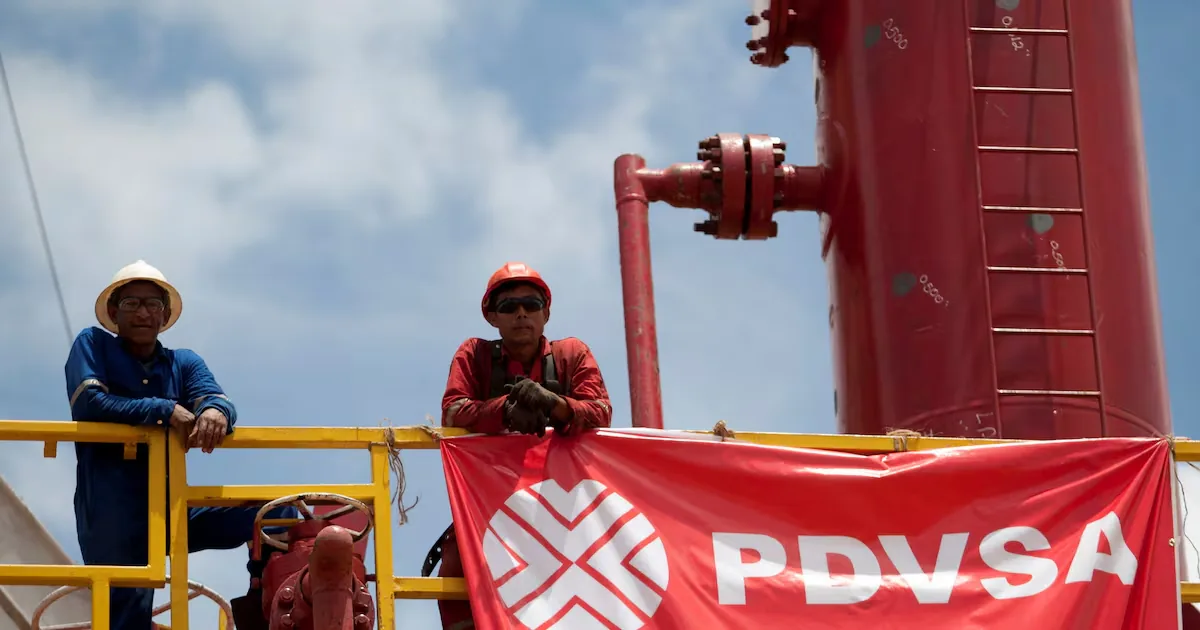
The industry, Mata clarifies, is not completely destroyed. It continues to operate but was “dismantled and cannibalized” in various areas due to lack of investment, management, and human capital, as well as the politicization of the state PDVSA and legal insecurity.
The production decline shows that deterioration: Venezuela currently pumps about 1.23 million barrels per day, according to Delcy Rodríguez, compared to the 3.1 million it produced in 1998, a year before Hugo Chávez came to power. Recovering capacity will require money, as well as years and sufficient guarantees to convince private companies to invest it.
For Mata, the discussion about what Venezuela gives up should not be limited to a question of sovereignty over the subsoil.
The pact also comes after a significant change in Venezuelan oil regulations. After the U.S. capture of Nicolás Maduro in January, Rodríguez’s government reformed the Organic Hydrocarbons Law to allow more space for private and foreign capital in an activity that during Chávez’s era had been strongly concentrated in the hands of the state.
According to the president, about fifty agreements have been signed since then for new investments in more than 76 productive areas.
For a long time, Venezuelan oil was not only conceived as a product for export. Part was marketed, and another part fed an industrial chain capable of generating employment, foreign currency, and economic activity within the country. The specialist worries that the new scheme alters that balance.
“It seems that Venezuela is becoming a 100% extractive country, perhaps leaving aside the industrialization of hydrocarbons a bit.”
Exporting more crude can quickly increase fiscal revenues, especially from such a depressed production base. But if much of the added value (processing, services, technology, and refining) remains outside Venezuela, the country risks recovering its production without simultaneously rebuilding a comprehensive oil industry.
This issue becomes even more important due to the extent of the agreement. According to a U.S. official cited by AP, the new company received rights to develop the fields for 100 years. The United States would obtain an effective 55% stake in its production, combining an equity stake with the right to purchase oil at cost.
A legal question also remains open. Oil exploitation has historically been an activity strongly reserved for the Venezuelan state. Reuters notes that doubts still exist about the compatibility of the new scheme with the country’s Constitution and hydrocarbon legislation.
Trump said the agreement would more than double the United States’ oil reserves. For Mata, that statement has more political than legal content.
“As long as it is underground, it cannot be considered a reserve for the United States,” he explains.
The reason lies in a difference between the systems of both countries. In Venezuela, the deposit belongs to the state while the resource remains underground. In the United States, there are also private rights over minerals and the subsoil. Having a stake in a company that exploits Venezuelan fields or securing part of its production does not, by itself, make that oil U.S. property.
What Washington does obtain is something possibly more useful in the short and medium term: guaranteed access to a huge source of crude.
And Venezuela presents an attractive characteristic for the U.S. refining system.
Much of its basket is composed of heavy and extra-heavy oil, particularly in the Orinoco Belt, which concentrates about 87% of the country’s reserves, according to PDVSA. These are complex crudes that require diluents and specific processes, but several refineries on the U.S. Gulf Coast were designed precisely to process heavy barrels.
Also, proximity matters. Compared to supplies that must traverse much longer and more vulnerable maritime routes, Venezuela is just a few days’ navigation from the Gulf refineries.
“You have access to the reserve, you extract the crude with much cheaper freight, and you inject it into the refineries,” summarizes Mata.
From that perspective, he argues, a greater Venezuelan supply could end up lowering U.S. fuel prices.
In any case, the results will not be immediate. To recover significant volumes, it will be necessary to repair infrastructure, find specialized personnel, and deploy billions of dollars in investment.
Experts consulted by AP warn that this process could take years. Even Trump, when presenting the agreement, spoke of the benefits of Venezuelan supply for the United States “in the long term.”
For Venezuela, the pact offers something it urgently needs: capital to produce again on a large scale and a way to transform its enormous reserves into fiscal revenues. But, at the same time, it implies giving up a stake in a considerable part of its main resource for years in exchange for a bet: that the arrival of money and increased extraction will end up rebuilding more than just the wells.