

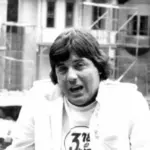







A good exercise to deconstruct Roberto Merino’s writing is to see him in one of his essay classes at Universidad Diego Portales. There he gives free rein to his ability to talk about any topic from an overlooked angle and that kind of verbal alchemy he is capable of putting into operation from one moment to the next: from an idea by Samuel Johnson he jumps to a song he heard on the taxi radio and, as if nothing, perhaps climbing another branch, ends with the anxiety about newspaper closing times.
In the same República neighborhood, Merino confesses a method for the weekly columns he published in places like LUN and Paula: having no guidelines whatsoever.
That is, at the last minute, when it’s time to write, to write with nothing in mind and without knowing what the text will be about. Edwards Bello, for whom he was in charge of the critical edition of his chronicles, already said it: whatever comes, the first thing that appears.
Something seen, something read, something remembered; any detail serves as a pretext to keep writing.
***
Roberto Merino was born in 1961 and his work is rather anthological: among them the books of chronicles and columns Todo Santiago, En busca del loro atrofiado, Por las ramas, Barrio República, Ciudad del olvido, Combustión espontánea and the lyrics of the group Ya se fueron, the poetry collections Transmigración and Melancolía artificial, the novel Mundos habitados, the essays Lihn, ensayos biográficos. Although it would also be fair to point out that part of his work has been that of a ghost, compiling the Antología del humor literario chileno and the complete columns and chronicles of Joaquín Edwards Bello, or editing the defunct magazines Apsi, Fibra and the newspaper El Metropolitano.
“The best Chilean prose,” Argentine writer Mauro Libertella recounts Alejandro Zambra telling him during a visit to Buenos Aires, when he learned that a book by Roberto Merino was going to be released with a local edition (En busca del loro atrofiado, Mansalva): “Merino’s texts are first-person texts that never sound egocentric, they are texts about Chile that never preach, they are texts about the present that never exhaust themselves in the conjunctural, they are texts about the past that never succumb to melancholy,” notes Libertella.
In Merino’s writing, the margins seem inexact. It can be the defense of a space of memory, like idle after-dinner conversation with common sense. There is astonishment but also nonchalance, the personal library, and the search for a truth – which is not absolute but the most useful.
Thus his columns are presented, as a digression until an unexpected point is reached, fueled by memories, experiences, and an unforeseen black humor like microwave grime.
As an author attentive to the flow of words, thought, and circumstances, Merino blends into the cafes of Providencia. There, between the noise and the solitude of anonymity, his writing lies down with musings and evaluations of his own work.
Along those lines, a few years ago he told the defunct cable program Trazo mi ciudad that the murmur of cafes “is the best sound to disconnect and be able to follow the line of thoughts.”
When reason fails us, we employ experience, Montaigne mused. And Merino, who made walking through Santiago one of his distinctive hallmarks, has specialized in pointing out the changes in the Chilean capital through his own associative interruptions.
Read more Von der Leyen offers European Union aid to Nepal after “devastating” floods
With the still-fresh news of his nomination for the National Literature Prize 2026, a handful of experts in his work tell Paula where to sink their teeth in and enter the universe of one of the most serious candidates for the award.
-I recommend Merino’s book titled En busca del loro atrofiado, which could be defined as a fragmentary, oblique autobiography. It is a book that stands out for its humor, acute observations on daily life, and literary sensibility. I consider it a portrait of maturity, a testament to the passage of time and its traces on character, body, and perception. It is written with a flowing prose that explains the unheard-of nature of the intimate condition without complication. There are few works that so skillfully combine intelligence, emotion, and the art of writing with lightness. It is an exceptional book.
–Mundos habitados is an exciting book, where we see the author’s private history and his particular memories from ages 3 to 16. It covers the houses he lived in, his relationship with his family, neighbors, classmates, his first love, and more. It not only reviews his own memory but also that of our country in the sixties and seventies. A literary gem that escapes his traditional role as a chronicler.
“Diario de hospital narrates the author’s stay in a common hospital ward for a year, interspersing humor and anguish. It tells very intimate and private details, ranging from physical to metaphysical discomfort. Never before in our country has such a profound account of that experience been seen, and how the memory of 1994 becomes present and relevant today”.
-There is no better way to wander the city streets than in the company of Merino and his privileged memory. The first book of his I read was a copy of Horas perdidas en las calles de Santiago that I found in a San Diego bookstore. At the time, I was impressed by the conjunction of historical, cultural, and literary themes concerning certain spaces and streets, without stridency, nostalgia, or tones of indignation. Later that book became Todo Santiago under Hueders and I sold it for years at Metales Pesados. I celebrate that Fondo de Cultura Económica has put it back into circulation. It is indispensable material for all ages, but above all, it is a book that has given an identity to Santiago, disputing in its chronicles the memory and past with urban planners of hard plazas and real estate developers who cultivate ugliness and inhumanity.
-I would recommend two books that show two dimensions of Roberto Merino’s writing. The first is Padres e hijos, a book of columns on fatherhood, but also on childhood and on what happens when a man becomes a father and begins to look at his own childhood differently. I like it because it approaches that bond from the everyday, without clichés or idealization. It talks about children growing up, parents aging, childhood memories, and how the perception of childhood has changed over the years. As always in Merino, there is humor, tenderness, and also melancholy, but (I insist on this) he never falls into clichés about fatherhood. It is a very intimate and, at the same time, very universal book. In this parenting stage, it has helped me a lot to realize all the absurd things we demand of children.
“I would also recommend Todo Santiago, because there another of Merino’s great talents appears: his way of looking at the city. Santiago is a living stage, with streets, neighborhoods, characters, memories… Merino has that ability to stop at details that one normally overlooks and, from there, also talk about time, memory, and how the city changes as the lives of those who inhabit it change. He also has a work of archive and memory, because he quotes other chroniclers who give us clues about what Santiago was like in the past; one learns a lot. It is an especially beautiful book for those of us who live here, because it makes one look at places again as if seeing them for the first time. For me, between those two, what I like most about Merino as a chronicler appears: his ability to observe the seemingly small and find something much larger there”.
-I recommend Santiago de memoria (1997), which can be obtained digitally on the Memoria Chilena website. Unlike his columns, which are more ethereal and contemplative, these nineties texts, written when neoliberal progress threatened the city’s still-provincial soul, very well calibrate historical anecdote with street observation and urban description, thus forming an atlas of capital oblivion, a spiritual encyclopedia of the main neighborhoods and avenues of the capital. An essential record to glimpse a Santiago that materially almost no longer exists but whose self-flagellating essence, always identified by Merino, remains relevant.
-It seems to me that Merino is the candidate who should win the National Prize this time. I really like Combustión espontánea, this book that gathers Merino’s texts on literature. Largely, columns that the old man published in Artes y Letras and Revista de Libros. There is a lucidity, starting from Merino’s own style, it explores another form, very different from the most common, or the most popular, or the most widespread, which is the chronicle. Here one notices another sensibility, another texture, so to speak. That book is very good. That’s the one I would recommend.
Read more Lemon pancakes