






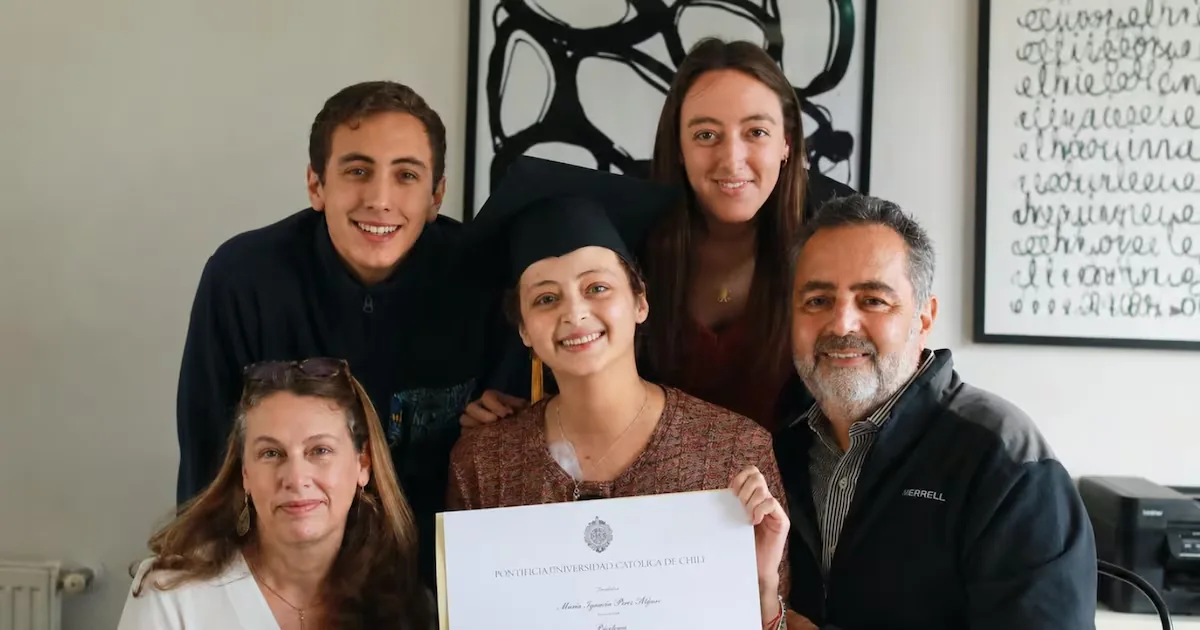
For almost five years, María Ignacia Pérez’s room has been paused in time. The bed, the nightstand, the wallpaper with the image of the Brooklyn Bridge she chose, and all her decorations remain in the same place. Even on her desk are the pastel-colored highlighters she used to organize her activities, neatly arranged in a pen holder.
Inside, her mother, Paulette Pefaur (60), and her brother, Matías Pérez (28), are sitting. Silently, they observe the space. For a few seconds, it feels as if both disconnect from the place, as if their minds evoke hundreds of scenes from the past. Until a noise brings them back to reality.
In March 2017, María Ignacia was 20 years old, and her life was focused on her Psychology studies at the Catholic University, field hockey, her group of friends, books, writing, and her family, made up of her parents and two siblings.
She was a healthy and athletic young woman, but one day she began to feel extreme fatigue and dizziness. She ignored the symptoms until a test revealed the cause and changed her future: acute lymphoblastic leukemia, a fast-growing cancer that affects the blood and bone marrow. They also detected a genetic alteration that made the disease more aggressive: her body produced white blood cells in excess and at such a speed that they did not mature. Instead of defending her, those cells ended up displacing the healthy ones.
“What is the next step?” her mother asked when she learned of the diagnosis. The doctors were clear: try everything, because time was against their daughter. From that moment, María Ignacia underwent various treatments, such as intensive chemotherapies that required hospitalization; medications her family had to buy in another country; therapy and a stay in the United States; and a bone marrow transplant donated by her younger sister. Several times she won the battle, but the cancer always reappeared.
“What is the next step?” her family asked over and over again, always hoping not to have to repeat it. But the possibilities for new treatments ran out, and the answer was to try one last option: a blood stem cell transplant from a stranger.
In simple terms, this is possible because all human beings have a unique “genetic barcode” different from the rest; however, by genetic chance, it is possible to find a person who shares compatibility characteristics. The more similar the genes, the higher the probability that a donor is compatible and provides healthy stem cells.
At that moment, María Ignacia and her family learned about the existence of DKMS, an international non-profit organization, created in Germany, dedicated to fighting blood cancer and other hematological diseases. Its goal is to register blood stem cell donors and find genetic compatibility for patients who need a transplant, also known as “blood siblings.”
The organization is present in seven countries, and Chile has been one of them since 2018. Its registration process is simple: by completing a form on its website, people receive a registration kit at home with three swabs (cotton swabs), which they must rub inside their cheeks and then place in an envelope. Then, the kit is returned, and the samples are sent to Germany for analysis.
But María Ignacia was not compatible with any donor registered in Chile or anywhere else in the world. In August 2021, to find that stranger, her family started a local search campaign. Her brother Matías calculated the probability: 1 in 10,000 Chileans could be the “genetic twin.” He thought the challenge was big but not impossible. He took on the role of campaign leader, created an Instagram account to spread the search, and registered all his friends, acquaintances, and university classmates. Paulette and the rest of the family did the same and went to people’s houses to collect the kits to deliver to DKMS.
All this allowed more than 11,000 people to register, of which about 6,000 samples were analyzed. However, time ran out. María Ignacia passed away on November 3, 2021.
“What is the next step?” For the last time, the question appeared in the family’s life. The context was different. It was no longer accompanied by hope. On the contrary, it came with deep uncertainty. What does a mother do after the death of a daughter? How does one cope with the loss of a sister? What should one feel after trying everything? Was it worth it if the outcome is not the expected one?
At that moment, Paulette and Matías had those doubts and many more. Today, some of them remain. But in others, they found an answer. Ignacia and her legacy helped resolve them.
***
Paulette Pefaur finds it hard to find the words to describe how the last almost five years without María Ignacia have been. It is understandable: no one is prepared for a scenario that breaks the natural cycle of life. At first glance, she appears calm, but that does not mean her pain has disappeared. On the contrary, it remains. She has only learned to cope with it.
To reach that state, Paulette acknowledges that she went through different emotions. Many she experienced in the same room where she is today. Anger was one of them. Although she felt it only once, she remembers that moment clearly: it happened one day before her daughter passed away.
—Ignacia was in a lot of pain, but she endured it. The only way to relieve it was by being practically asleep, and she did not want that. I suffered because I knew she was hurting. At that moment, I went out to the yard and shouted to the sky: “You know what?! This is too much, it’s unfair.” Inside, I had the intuition that we were not on a good path, but in my head, I thought she was going to be saved.
—How was it to battle between your intuition and hope?
—I knew what was going to happen, but I didn’t want to accept it. In fact, that night I went to bed and thought: “this is the last night,” and she passed away. I didn’t want to listen to my intuition because I always had hope that it wouldn’t end like that.
After María Ignacia’s passing, her family’s pace of life changed drastically. Mother, father, and siblings went from a frantic search campaign to a gradual grieving process. Paulette, for her part, faced a feeling of emptiness, sadness, and uncertainty. She didn’t know how to handle those emotions and questioned the meaning of what happened and its outcome after having tried everything to save her.
What she was sure of was to start a search that would give her comfort and allow her to recover as soon as possible. The reason was her family: she wanted to be present and able to support them.
—In some way, we have all tried to continue with our lives. Grief is a personal process, and everyone faces it in their own way. In my case, I decided to be there, to try to pull myself together for my children. It was very hard for them to lose their sister, but they couldn’t lose their mother.
To face the process, the family decided to see a psychologist. However, after a couple of sessions, they felt the group dynamic was not working. Paulette continued with individual therapy.
—I don’t know where I got the strength. My daughter’s friends recommended a psychologist, and I started doing many activities; among them, reading. Since María Ignacia passed away, I have bought and read more than 100 books, trying to find an answer and understand this process.
In that attempt to find comfort, Paulette confesses she also made some mistakes. She volunteered at a foundation that provides support, care, and a home for young people with cancer and their caregivers. She thought helping others with stories similar to hers would bring calm to her healing process.
—I managed to collaborate for a while, but it didn’t do me any good. There were many children in the same situation as María Ignacia, and I was not emotionally ready yet. I remain in contact and help with specific things at the foundation, but not continuously. For me, talking to the parents of those children was reliving it all over again.
That experience, along with the passing months, allowed Paulette to better channel her search for comfort and answers. On that path, she found mindfulness, a practice that allows people to be present beyond the physical, to experience and feel the challenges faced in life, with an attitude of acceptance and without judgment.
—The last four years of my life were focused on María Ignacia’s illness, accompanying her, and on my work as an engineer. I never imagined I would end up connected to this world. At the same time, I started studying transpersonal therapy. The idea is to learn to listen to people, allow them to vent, and help them find their own tools to self-manage and heal. I didn’t finish it because I wasn’t going to dedicate myself to that, but it helped me a lot; it was a complement to the psychologist. To this day, I continue with mindfulness and meditation.
—How did it help you?
—To find peace and comfort, to understand life a little. Thanks to María Ignacia, I came to this world. Her death left a huge void in my heart, but it also showed me this path, where I am at peace today. Although I still haven’t found a concrete answer, it has helped me a lot.
***
—In general, fine…
When asked how the last years without his sister have been, Matías cannot finish the sentence and gets emotional. It happens every time he remembers María Ignacia during the conversation.
—I think the automatic human response is to say “fine.”
Unlike Paulette, Matías admits he preferred to start his healing process without slowing down the pace he had since beginning the donor search with DKMS. Mother and son took different paths to face grief but share the same goal: to heal their wounds and the pain of a loss that remains present.
—The campaign took up 95 percent of my time, and honestly, I have never given myself the formal space to slow down. When Ignacia passed away, I started working because I didn’t know what to do with myself. I finished my degree and looked for a job; I went from job to job until I decided to start a business.
In 2023, together with two friends, Matías created Vambe, a start-up designed to organize processes and accelerate productivity in companies through artificial intelligence. In December last year, the platform generated more than 6 million dollars and works with about two thousand companies in more than three countries. The name Vambe derives from Bambi, the Disney movie. Matías named it that because María Ignacia was hyperlax and, when she fell while playing field hockey, it resembled a typical scene from the movie.
Amid his professional growth, Matías admits he has rarely given himself space to reflect on what happened with his sister.
—I don’t know what conclusion to reach. One can think of many things and possibilities, which also causes anxiety. But, in the end, that is the reality, and there is not much to change. Maybe I would reach the same conclusion: we are human beings. I also think that, in this process, there are few answers. There are more questions that generate internal dualities.
Today, Matías says María Ignacia is present every day. He decided to carry her memory in rules he applies in his life and that are non-negotiable. Some of them are to be empathetic and not judge people without knowing their stories, to give a sense of humor to tragic situations, and to enjoy life. She also remains present through all the people who surrounded her.
—Ignacia and I had a strong connection, which extended to her circle. Today, we still get together with her friends; some of her friends work at Vambe, and one of our clients is COPEC, where she did her internship.
Paulette, for her part, also feels accompanied by her daughter.
—I don’t know where she is, but she is present. I want to believe she is somewhere, being happy. Sometimes I ask her for things, not always, but usually to see if she can give me some help. Most of the time, they come true, so I say: “Thank you, daughter.”
***
In January 2022, three months after María Ignacia’s death, her campaign showed results: a Chilean donor was a “blood sibling” of another person in the world. With that first finding, in August of the same year, Relato Nacional published the chapter “Nothing is in vain.”
But the story did not end there. Currently, thanks to the search carried out by the family and DKMS, 152 compatible people have been identified, and 20 completed the donation. Of them, three Chileans — two men, aged 28 and 32, and a woman aged 25 — helped three men in the United States. In Chile, “blood siblings” were also found: a 24-year-old woman donated to a 5-year-old boy, and a 24-year-old man donated to another 23-year-old man.
In the room, during the interview, Paulette and Matías learned these figures. They get emotional upon learning the number of people they managed to help in the attempt to save María Ignacia. They look at each other and smile. For both, in a way, it is an answer to their past questions.
—María Ignacia positively impacted so many people. Whether alive or dead, she helped thousands of people. It is a pride to have had a daughter like her. It is gratifying to know that something good happened. For me, at least, now her death makes more sense —says Paulette.
—I’m very glad to hear that —adds Matías—. It makes me happy that the fate and ending of all those families could be changed. They were able to connect with someone thanks to Ignacia. In the end, as mentioned in the podcast chapter: “Nothing is in vain.”
Read more Iran calls Trump’s allegations of a supposed Tehran plan to assassinate him «psychological warfare»
__